 Languages
-
-
EVA Solar Encapsulant Film: Screw Design Below the Scorch Threshold
The compound arrives with its crosslinker already in it. The screw has one job: melt it thoroughly without starting the reaction.
EVA encapsulant · Photovoltaic film · Low-temperature extrusion · Scorch and gel
-
1. A thermoset that ships as pellets
EVA encapsulant compound is not a thermoplastic in the ordinary sense, even though it is sold in pellet form and run on a thermoplastic extruder. The pellets already contain an organic peroxide, a silane coupling agent and a stabiliser package. The peroxide is there because the film has to crosslink during module lamination, which happens somewhere around 140–160 °C. Between the pellet and the finished roll, the material has to be melted, homogenised and pumped — at temperatures below the point where that peroxide starts to work.
-
Encapsulant film being laid onto a photovoltaic module. The crosslinking that bonds it happens later, at lamination temperature — which is why extrusion has to stay well below that temperature.
-
That single constraint inverts the usual screw design brief. On most lines the screw is asked to deliver melting capacity and mixing energy, and the thermal margin is generous enough that nobody measures it. On an encapsulant line the margin is the product. Encapsulant-grade resin is specified at below 0.5 wt% gel content before it ever reaches the die, and the finished film has to hold about ±5 % thickness uniformity at 0.3–0.5 mm. Both numbers are downstream consequences of what the screw does to the melt.
-
KEY INSIGHT On this line the screw is not asked to add energy. It is asked to reach full melting while adding as little of it as possible.The EVA film range covers the product forms and the grades; the process question is narrower. Whether a material melts and flows at a given temperature is one question, and whether it survives that temperature is another — the distinction is set out in melting versus glass transition , and encapsulant duty is the clearest case in extrusion where the two answers sit very close together.
-
2. The barrel setpoint is not the melt temperature
A controller reading of 110 °C says what the band heaters are doing. It says nothing about the resin. Shear heating happens inside the channel, is invisible on the panel, and scales with screw speed and with how tight the clearance is. This is the mechanism behind the general observation that zone setpoints and actual melt temperature diverge, and on an encapsulant line the divergence is the difference between a clean run and a barrel full of gel.
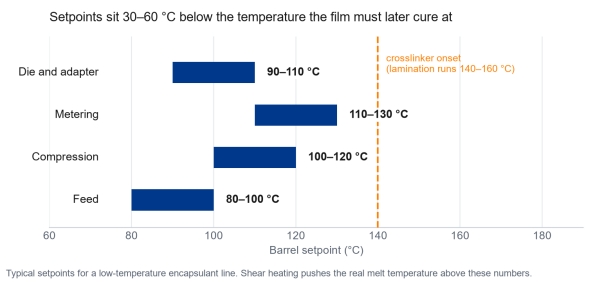
Published windows for this duty disagree by a wide margin, and the disagreement is informative rather than sloppy. A 1984 pilot-line study kept barrel zones at 88–105 °C, ran the die at 75 °C, and held the melt below 120 °C on a 24:1 screw with a water trickle through the screw and about three minutes of residence. An encapsulant line supplier today publishes barrel 80–120 °C with melt 100–130 °C. An equipment supplier publishes a hotter profile: feed 80–100 °C, compression 120–140 °C, metering 150–160 °C, on a 32:1 screw at 2.2:1 compression.
Published source Barrel setpoint Melt / die Line detail Pilot line study, 1984 88–105 °C die 75 °C; melt below 120 °C 24:1 L/D, 3.5:1 CR, water through the screw, ~3 min residence Encapsulant line supplier 80–120 °C melt 100–130 °C low-shear screw, distributive mixing, corrosion-resistant surfaces Equipment supplier feed 80–100; compression 120–140; metering 150–160 °C not stated 32:1 L/D, 2.2:1 CR, lower compression than a PE screw Three things move those numbers: which peroxide system the compound uses and what its onset actually is, the VA content of the grade, and where the temperature is measured — setpoint, barrel wall or melt stream. A number quoted without that context is not comparable to another number quoted without it. The useful conclusion is not ‘run at 130 °C’ but ‘know your peroxide, and measure in the melt’.
-
Typical setpoints on a low-temperature encapsulant line, against the temperature the film is later cured at. The gap is the operating margin — and shear heating eats into it from the barrel side.
Temperature control on a line like this is a hardware question as much as a setpoint question. The PE screw temperature guide shows how barrel and screw cooling are specified for a shear-sensitive resin, the compression and L/D numbers fix the melting length, and specific energy consumption tells you whether the work is arriving as heat you wanted.
-
3. What scorch looks like downstream
Premature crosslinking does not announce itself at the extruder. It appears in the film as gel particles and fish eyes, as surface roughness, and in severe cases as a line that has to be stopped and torn down. Because the defect is generated upstream and detected downstream, diagnosis depends on the pattern rather than on the appearance of any single defect.
What you see What it usually is Where to look Gels distributed evenly through the run Incomplete melting, or peroxide agglomerates that never dispersed Feed and compression zones; check screw speed and setpoint Gels appearing after a restart, clearing over time Material that sat hot in a dead spot during the stop and crosslinked there Screw tip, adapter, breaker plate, die entry Die lines and streaks Build-up or degraded layer at the die lip Die and adapter, not the screw Bubbles and voids Moisture, or volatiles not vented Drying, vent, compression profile Thickness drifting across the web Output pulsation Metering section, melt pump, screen pack The second row is the one operators underestimate. A line that produces gels immediately after every restart and then settles is not a bad batch of resin; it is showing you where the melt stops moving when the screw stops turning. That is a geometry and purge-discipline problem together, and no temperature adjustment fixes it. Film lines in general live with this, as the PVC film and sheet experience shows at a very different temperature.
Separating a screw problem from a die problem is the same exercise as checking wear without a teardown , and the regrind-heavy PET flake experience is a useful comparison because gel there has a different origin. If the conclusion is that the screw is the source, repair or replacement is the next decision.
-
4. Geometry for a low window
The screw has to accomplish full melting inside a window that a general-purpose polyethylene screw would blow straight through. The way that is done is gradual compression over a long length, deep channels, moderate screw speed and a large diameter running slowly rather than a small diameter running fast. The comparison against a standard PE profile is worth putting side by side.
Parameter General-purpose PE screw Encapsulant screw Compression ratio 3:1 or higher around 2.2:1 L/D 24–30:1 30–32:1 Channel depth conventional deeper, with a long gradual transition Mixing section barrier or dispersive element distributive only — pins, slotted flights Screw cooling optional water-cooled, treated as standard Speed higher rpm moderate rpm, larger diameter Lower compression is not a compromise on melting quality; it is the mechanism that keeps shear work out of the transition. A 3:1 profile generates the pressure and the temperature rise that make a PE screw efficient, and both are unwanted here. The logic that ties compression and L/D to melting behaviour is the same one described under the numbers that decide a screw , read in the opposite direction: you are buying length so you do not have to buy shear.
-
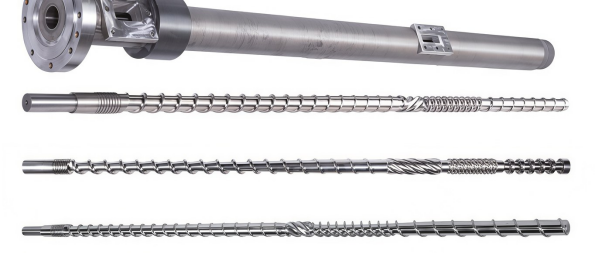
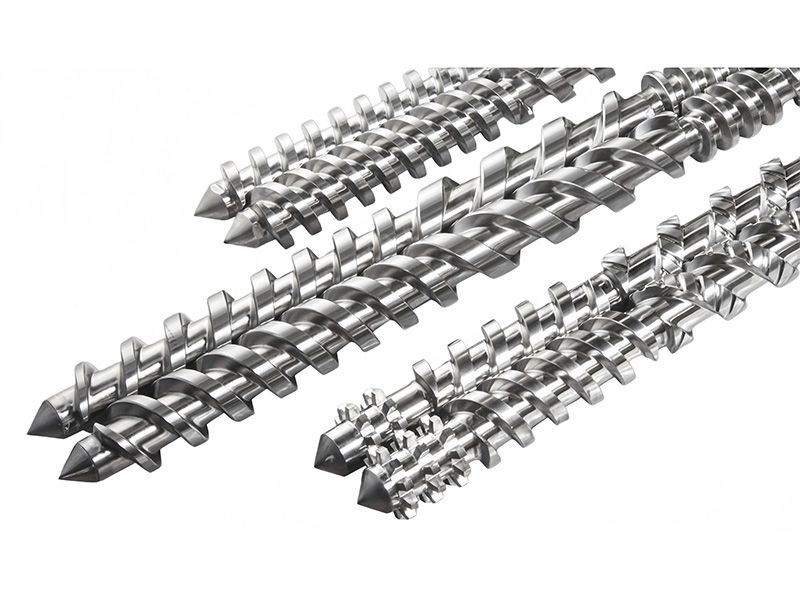
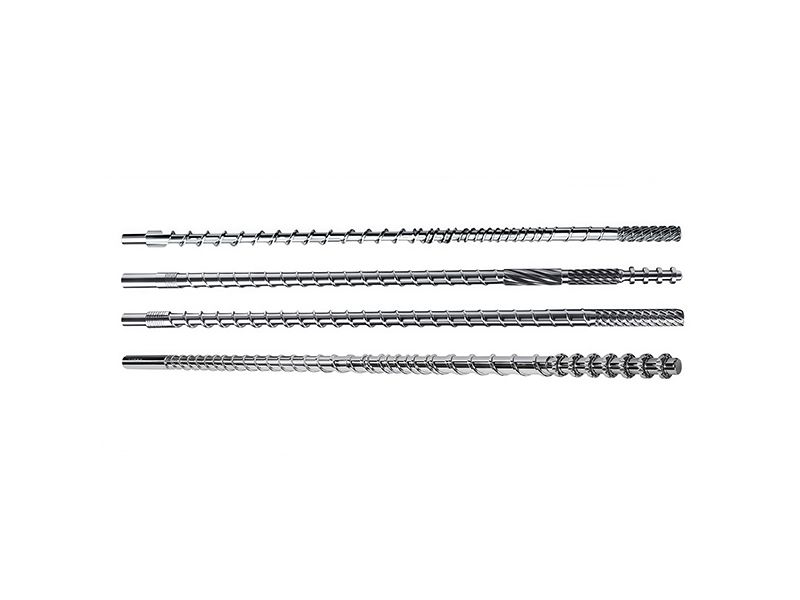
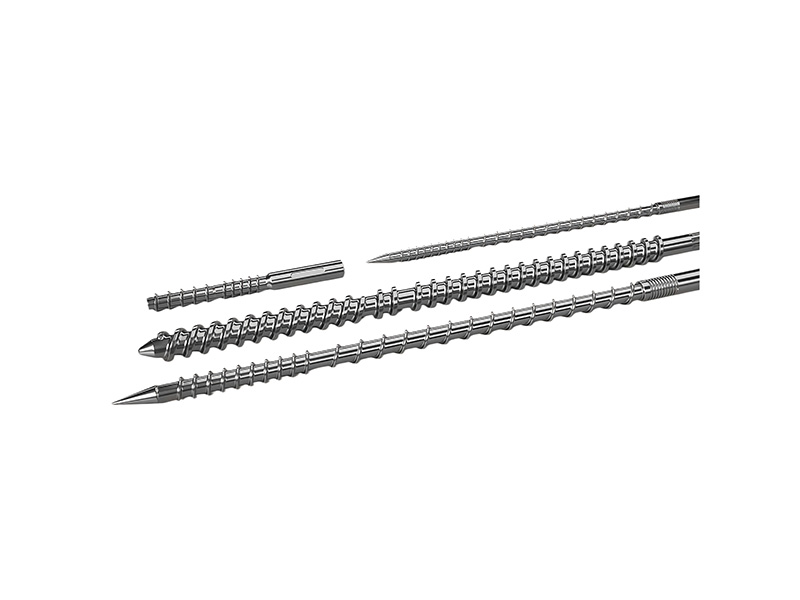
Cast-film screws in several configurations. Encapsulant duty sits at the low-shear end: deep channels, gentle compression, and a screw body that can be cooled from inside.
The nearest architectural match on a single-screw line is a cast film screw and barrel , since the downstream is a wide flat die rather than a pipe head. Where a barrier screw is proposed for the duty, the question to ask is whether its melt separation can be achieved without the pressure rise that comes with it — on a normal single screw selection that pressure is the point, and here it is the risk.
Diameter and speed are a deliberate trade rather than a preference. The high-speed single screw runs a different balance of the same variables, the single versus twin screw comparison explains when a twin-screw line removes the constraint altogether, and sheet duty on the same hardware is covered under sheet extrusion screws .
-
5. Mixing belongs on the distributive side only
Peroxide, silane and stabiliser have to be homogeneous in the film. The instinct is to specify a mixing section and let it work. The problem is which kind: dispersive mixing breaks agglomerates apart by applying high local shear stress, and high local shear stress is exactly what raises melt temperature in a place you cannot see. On encapsulant duty the correct tool is distributive mixing — repeated splitting and recombining of the stream with minimal energy input.
In practice that means pins, pineapple elements or slotted flights rather than a Maddock-style dispersive section. The distinction between the two families is the subject of dispersive versus distributive mixing , and it matters more here than on almost any other duty because the mixing job and the thermal job point in opposite directions. On a twin-screw compounding line the element choice gives the same trade a different set of answers; on a compounding barrel you can afford a kneading block that a single-screw encapsulant line cannot.
-
6. Dead spots and the restart gel
Because a dead spot is a scorch source rather than a slow contamination source, the flow path has to be streamlined and radiused throughout: no ledge at the clamp, no step at the breaker plate, no cavity behind the screw tip. Surfaces are polished for the same reason they are polished on high-purity lines — anything that holds melt holds it at temperature.
The screen pack is part of this. A coarse, low-restriction pack is normal on encapsulant lines because a fine pack raises pressure and therefore melt temperature, and because the residence time behind a blinded screen is exactly the condition that produces gel. Purge discipline at shutdown matters as much as geometry, following the same sequence as the purging and changeover routine . Where the line is vented, the vent port checks belong in the same routine.
Dead-spot discipline is a maintenance routine before it is a design feature. The maintenance and troubleshooting guide and the service life guidance both assume it, and a replacement project is the moment to write it into the handover.
-
7. Water-cooled screw: what it buys and what it does not
A water-cooled screw removes heat at the point where it is generated rather than at the barrel wall. That is the difference between controlling the setpoint and controlling the melt. It buys headroom at higher screw speeds, it shortens the time the material spends above the safe temperature, and it makes the temperature profile along the screw something the operator can actually influence.
It does not fix a geometry that generates too much heat in the first place, and it does not rescue a line that was left hot and idle. Those are separate problems with separate answers. The energy side of the same question — how much of the barrel's heat input is actually doing useful work — is covered under specific energy consumption , and on a low-temperature line the number looks unusual precisely because most of the melting work is mechanical.
-
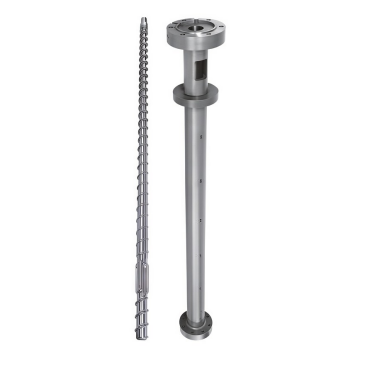
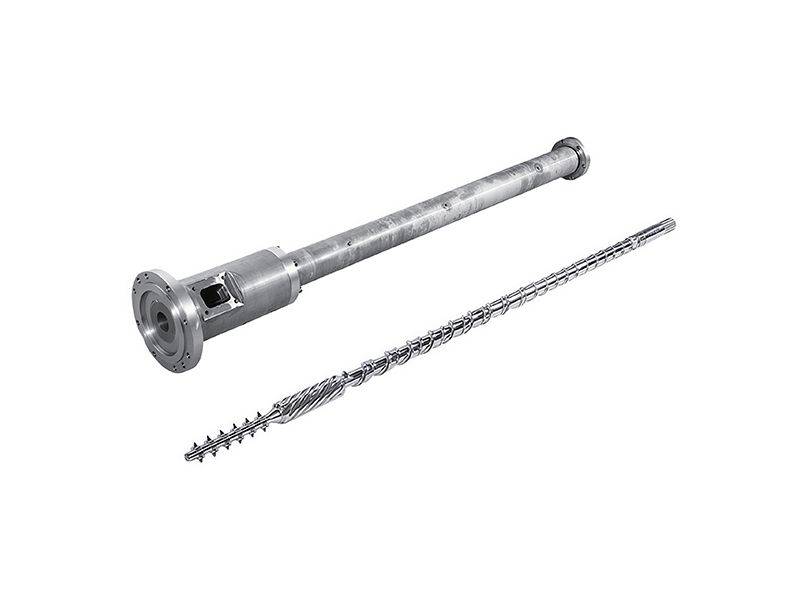
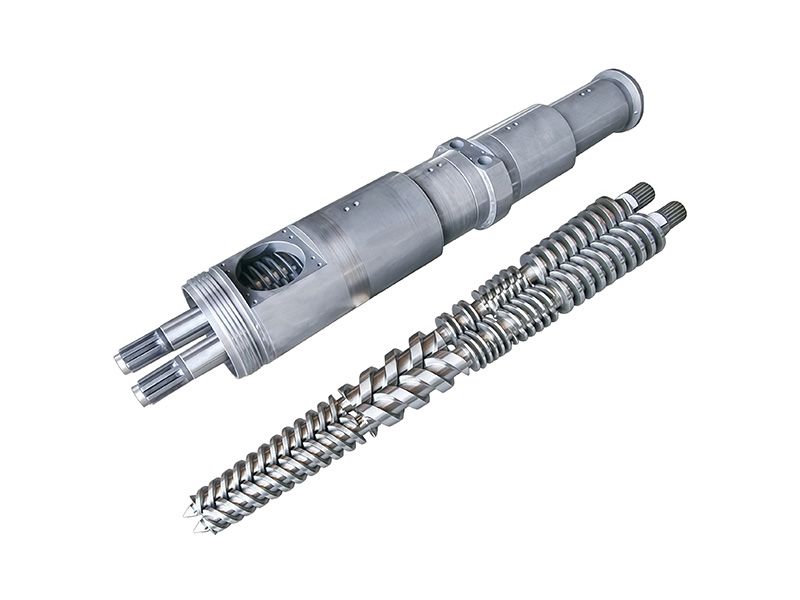
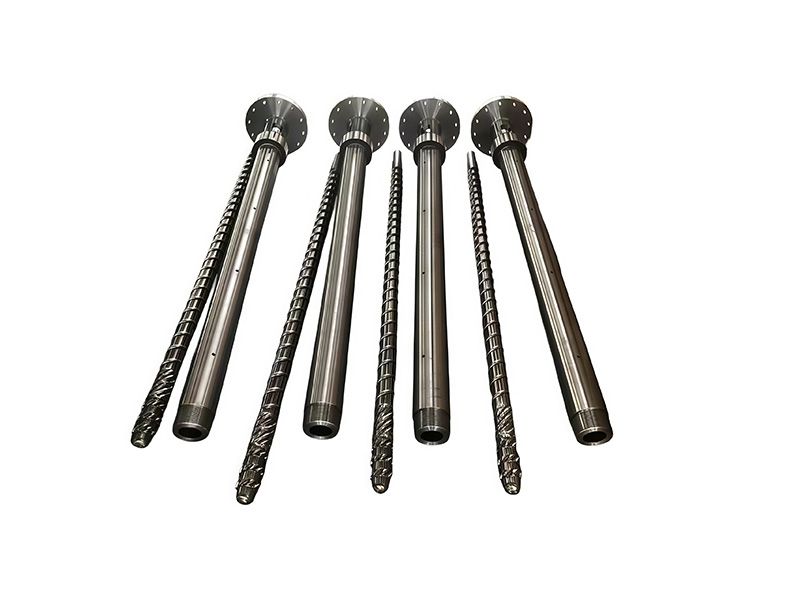
A screw and barrel pair for film duty. On encapsulant lines the screw is cooled from inside, so the body has to be drilled for coolant through its full length.
-
8. EVA and POE are not interchangeable duties
POE has taken a large share of the encapsulant market because of its moisture barrier and PID performance, and lines increasingly run both. The screw specification does not transfer. POE runs considerably hotter — roughly 150–200 °C against 100–130 °C for EVA — which changes the whole thermal design, and it does not produce acetic acid when overheated, which changes the metallurgy.
EVA encapsulant POE encapsulant Melt window about 100–130 °C about 150–200 °C Scorch risk high — narrow, low window present, managed by peroxide selection Corrosive by-product acetic acid when overheated none Melt-contact surface corrosion-resistant required standard wear surfaces generally sufficient Feeding tackier pellets, slip-prone different feed behaviour; check the throat A line built for one and switched to the other without changing the screw is a common source of complaints that get blamed on resin. The same family of mistake shows up across the EVA product range when pipe or sheet duty is added to a film line, since EVA sheet and board and EVA pipe tolerate a wider window than encapsulant film does.
Comparing polymers by grade rather than by duty is a habit that misleads on every line: LDPE, HDPE and LLDPE film is the same exercise in polyolefins, TPE sits at the softer end of the same spectrum, and the general PE process guide is the reference for how a window is set when the resin is forgiving.
-
9. Acetic acid: the corrosion nobody plans for
EVA at 28–33 % VA content, pushed past its window, splits off acetic acid. Acetic acid attacks steel surfaces, and it does so at exactly the moment the material is already degraded and sitting in a hot barrel. The result is a screw that shows corrosion in the metering section on a line that was specified with ordinary nitrided hardware.
The answer is a corrosion-resistant melt-contact surface — hard chrome or a nickel-alloy class, depending on how much abrasion the formulation adds. The parallel with PVC and HCl is direct and worth reading for the mechanism, since HCl corrosion on PVC lines produces the same self-accelerating pit pattern. The fluoropolymer version of the story is harsher still, and is set out under PVDF extrusion where HF rather than acetic acid does the damage.
Barrel construction follows from that: a bimetallic barrel with an alloy layer bonded into the bore, or an internal liner sleeve where the design calls for a replaceable bore. The comparison that decides between a bimetallic and a nitrided specification is set out in bimetallic or nitrided , and on EVA duty the corrosion side of that comparison is the one that decides it.
KEY INSIGHT A nitrided screw on an EVA encapsulant line fails on chemistry, not on hardness — the same way it does on PVC.The specification side of this is covered by the nitrided barrel guide , which is worth reading precisely to see which conditions it does cover, and by the bimetallic material selection guide . Where the answer is a nickel-alloy screw rather than a coated one, the bimetallic screw range is the relevant hardware.
-
10. Gauge stability is a screw problem before it is a die problem
Encapsulant film is thin, wide and specified to roughly ±5 % thickness. At 0.3–0.5 mm, output pulsation prints straight into gauge, and a pulsation that would be invisible on a 2 mm sheet becomes a visible band on a 0.4 mm web. Metering section design, screen pack restriction and screw speed stability all contribute, and a melt pump removes the remainder.
The diagnostic sequence for output that rises and falls is set out under surging and unstable output , and it applies here with the added constraint that you cannot solve a surge by raising temperature, which is the usual first move. Where residence time is the underlying variable, the calculation approach for residence time gives a way to quantify what a change in screw speed actually does to the material.
Output stability is a hardware question too: the high-speed single screw is specified around exactly this variable, and a replacement project should state the gauge tolerance as an acceptance criterion rather than a hope.
-
11. What to send us
For an encapsulant line the specification conversation starts with the resin, not the machine: grade and VA content, the peroxide system and its onset temperature, film width and thickness, target output, and whether the line also runs POE. Add the existing screw drawing if there is one, and the temperature profile currently in use — the profile tells us more about where the margin has gone than the drawing does.
The information that makes any custom screw and barrel project work is the same list, and the checks that should follow delivery are in the acceptance inspection procedure . PIPLL builds single screw barrels and bimetallic assemblies for film, sheet and pipe duty, and the custom engineering route starts from a drawing or a measured part. If the line is already down, the contact page is the fastest way to get a date.
-
✔ Compression and L/D set against the peroxide onset | ✔ Distributive mixing only, no shear spikes
✔ Corrosion-resistant melt path for overheated EVA | ✔ Water-cooled screw geometry for encapsulant film