 Languages
L/D Ratio and Compression Ratio: What the Two Numbers on a Screw Drawing Actually Decide
-
-
L/D Ratio and Compression Ratio: What the Two Numbers on a Screw Drawing Actually Decide
Two suppliers quote different figures for the same machine — and the argument is usually about the wrong one. L/D ratio and compression ratio set melting capacity and how hard the screw works the polymer. Everything else on the drawing is a consequence.
L/D RATIO · SCREW COMPRESSION RATIO · SINGLE SCREW DESIGN · EXTRUDER SCREW SPECIFICATION
-
1. Two numbers carry most of the drawing
A screw drawing is mostly dimensions: diameters, lengths, radii, tolerances. Two of those numbers do more work than all the rest put together — the L/D ratio and the compression ratio — because between them they set how much melting capacity the screw has and how hard it works the polymer to get there. Everything else is a consequence.
That is true on any single screw barrel and it is why two quotations for the same machine can look so different while both being internally consistent. The two numbers rarely disagree on their own; what differs is the assumption each supplier made about the compound and the line.
- L/D sets the length of the working surface relative to its diameter
- Compression ratio sets how much the channel volume shrinks from feed to metering
- Neither number says anything on its own about whether the screw is good
-
KEY INSIGHT
L/D and compression ratio describe capacity and work, not quality. A well-matched 25:1 screw usually outperforms a badly matched 33:1 screw — and costs less to run. -
Number What it actually defines What it does not define How to verify it on a drawing L/D Flighted length relative to diameter: melting capacity and residence time Mixing quality, compression, or wear resistance Measure the flighted length, divide by the nominal diameter — not by the measured OD Compression ratio Channel depth at the feed end divided by channel depth at the metering end Where the compression happens, or how abruptly Read both channel depths, or derive them from root diameter and OD -
2. L/D: what length buys, and what it costs
L/D is the effective flighted length divided by the nominal diameter. It is a normalised measure of how much barrel the polymer has to travel through, so it is really a statement about melting capacity, mixing opportunity and residence time — three things that are usually described as one.
The cost side is usually left out of the conversation. Every increment of L/D adds barrel length, heater zones, floor space and drive torque requirement, and it adds residence time. On a thermally stable polyolefin such as PE that is close to free. On rigid PVC , where the thermal degradation activation energy is low and the material conducts heat poorly, it is the opposite: more length means more time at temperature, and the process window narrows.
The practical consequence is that L/D is chosen per compound, not per machine size. The PE screw design and temperature guide and the PE pipe barrel both work from that assumption, and they arrive at different lengths for different duties on the same diameter.
-
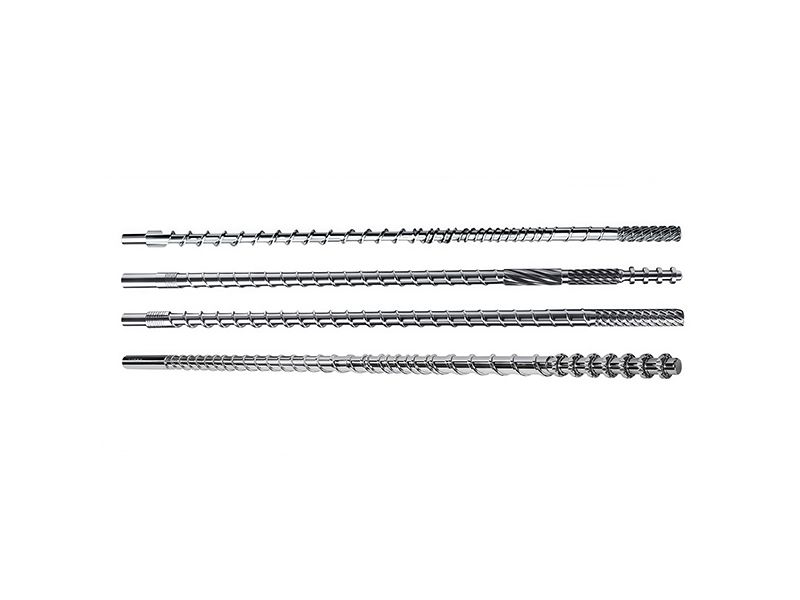
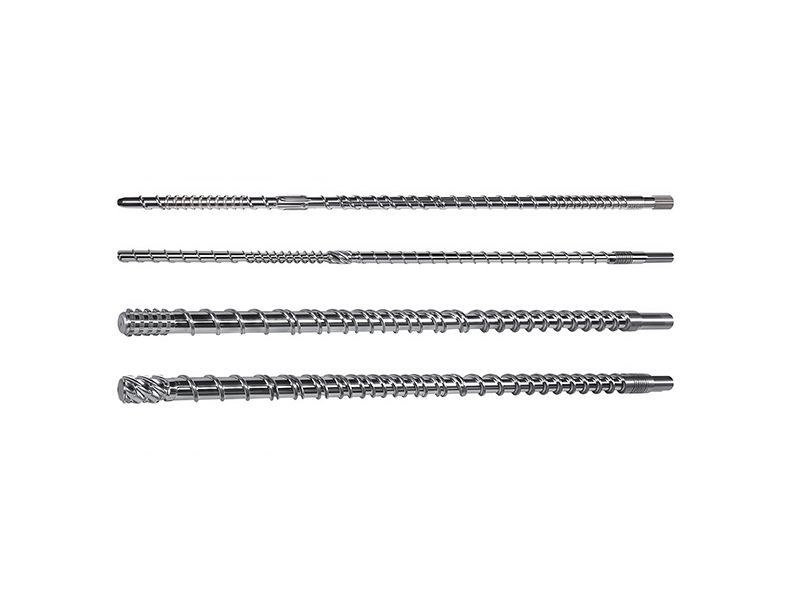
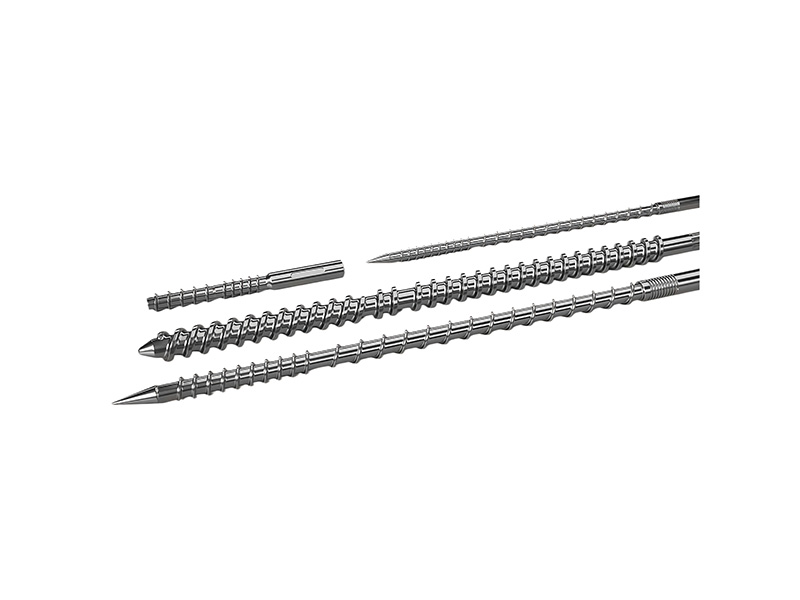
Screws laid out in rows. The flighted length is the part of the screw that does the work; the shank and drive end add machine length but no melting capacity.
-
3. Compression ratio is a volume ratio, not a pressure ratio
This is the most common misreading, and it causes real specification arguments. Compression ratio compares the channel depth at the feed end with the channel depth at the metering end. Because the channel is a helical groove of roughly constant width, the depth ratio can be treated as a volume ratio — but the screw does not build pressure by ratio. Pressure comes from the die, the screen pack and the metering section’s ability to pump against them.
- Higher ratio means the solid bed is squeezed harder as it melts
- It does not mean the machine will develop more head pressure
- It does mean more shear heating, which is a cost on heat-sensitive grades
Two screws can share a compression ratio of 3:1 and behave nothing alike, because one compresses gradually over fifteen diameters and the other does it over four. The ratio is a summary; the profile is the design. That is why a drawing review is worth more than a specification comparison, and why the screw geometry and lubricant matching note is a better guide to what changes behaviour than any single number.
KEY INSIGHT
Ask for the channel depth at both ends and the length over which the transition happens. A supplier who can only give you the ratio has not told you what the screw does. -
4. What the published ranges say, and why they disagree
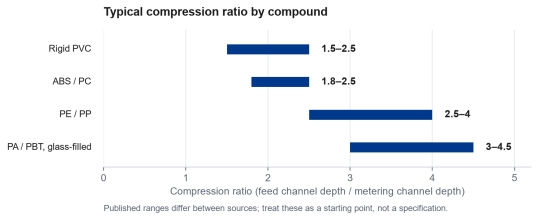
Published tables of “typical” values are a starting point and not much more, because they are derived from different machine populations. Rigid PVC appears as 1.5–2.0:1 in one table and 2.0–2.5:1 in another; PE appears anywhere from 2.5:1 to 4.0:1. The disagreement is not sloppiness. It reflects differences in screw diameter, feed-throat design, die resistance and how conservative the author is about degradation.
-
Typical compression ratio by compound. The ranges overlap because they come from different machine populations — treat them as a starting point for a conversation, not as a specification.
Compound Typical L/D Typical compression ratio What drives the choice Rigid PVC 20–24:1 1.5–2.5:1 Heat sensitivity dominates; keep shear and residence time low Flexible PVC 24–28:1 3.0–3.5:1 Plasticiser tolerance allows more work; lower melt viscosity PE / PP 24–30:1 2.5–4.0:1 Thermally stable, crystalline; can take compression and mix harder ABS / PC 24–28:1 1.8–2.5:1 Amorphous, viscous; conservative compression, good mixing at low shear PA / PBT, glass-filled 22–30:1 3.0–4.5:1 Sharp melting transition and hygroscopic; venting matters as much as L/D Two rows in that table deserve separating. Rigid and plasticised PVC are usually discussed as one compound and they are not: the difference between rigid and flexible PVC moves the compression ratio by more than a full point, which is why one barrel cannot serve both.
-
5. Why a higher compression ratio is not an upgrade
There is a persistent belief that more compression means better melting, so more must be better. In practice the ratio is chosen to match the bulk density of the feed and the heat sensitivity of the polymer, and pushing it past that point buys shear heating you did not ask for.
- Too low: the solid bed is not compacted, melting is incomplete, output surges
- Too high: the melt overheats in the transition zone, and on PVC that means degradation rather than better mixing
- Right: the channel volume shrinks roughly in step with the density change as the polymer melts
The symptom of a mismatched ratio is usually read as something else — surging, gels, black specks, unstable pressure. The surging diagnostic is where most people start, and it is worth doing before anyone reopens the screw question.
There is one case where more compression is genuinely the answer, and it is not “better melting”. It is a screw working against high die resistance or a heavily restricted screen pack, where the metering section has to be able to push through it. The barrier screw comparison sets out where that logic holds and where a barrier design does the job better than raw compression.
-
6. Residence time: the cost that L/D hides
Residence time is the other half of L/D, and it is the half that decides colour changeover, purge consumption and degradation risk. A longer screw at the same output holds more material for longer; a longer screw run faster to keep the same output holds less, but shears it harder. Neither is free.
- Heat-sensitive compounds: shorter residence time is worth more than extra mixing capacity
- Frequent colour or grade changes: the material held in a long screw is what you throw away at every changeover
- Reinforced compounds: longer residence time at temperature plus high shear is a fibre-length problem as well as a degradation problem
This is why a vented two-stage screw typically runs 28–33:1 rather than the 20–30:1 that single-stage screws run in the same applications. The extra length is not there to mix better; it is there to fit a decompression and venting zone between two pressure-building sections. The twin screw residence time calculation walks through the same arithmetic for a twin, where the numbers behave differently.
Residence time also decides how much material goes out of the door at a grade change, which is a cost most L/D conversations ignore entirely. The purging and changeover guide treats it as a design variable, and the service-interval benchmarks supply the other half of the same calculation.
-
7. Peripheral speed: the limit that is not on the drawing
Two screws of the same L/D and the same compression ratio can have completely different output ceilings, because the limiting variable in service is usually not the ratio — it is the surface speed of the flight tip. That is set by diameter and rpm together, and it is what actually decides how much shear heat the polymer sees.
This is the whole design logic behind a high-speed single extruder screw barrel : a smaller diameter can be run faster within the same surface-speed limit, so it produces more from a shorter screw. The HDPE pipe case shows what that trade looks like when output is the constraint rather than mixing.
- Common working limits are around 0.3–0.4 m/s for rigid PVC and 0.5–0.7 m/s for PE and PP
- A larger diameter reaches the limit at a lower rpm, so diameter caps output as much as length does
- A screw specified only by L/D and ratio can therefore be right on paper and wrong on the line
KEY INSIGHT
If you are comparing two quotations, compare peripheral speed at your running rpm before you compare L/D. The first number explains most of the difference in output.The same arithmetic explains why a pipe line and a film line on the same diameter rarely share a screw. Output per rpm is set by the surface-speed limit, and the high-speed HDPE pipe output case shows how far that logic is pushed when kilograms per hour is the whole brief.
-
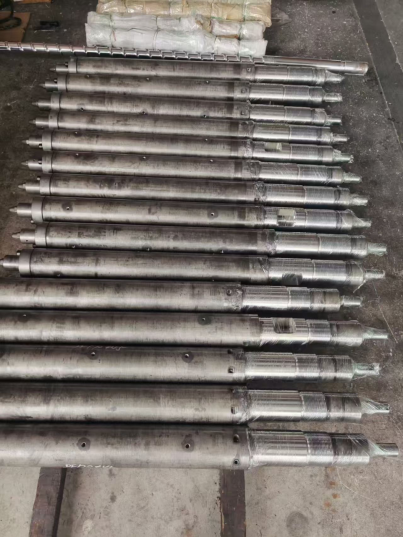
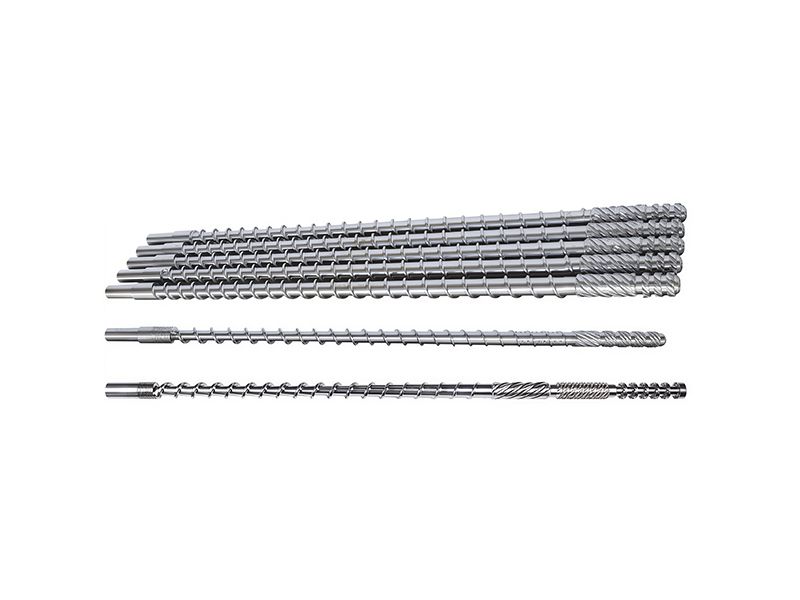
Screws at the dispatch rack. Flight OD, channel depth and flighted length are the three measurements that confirm the drawing was built, and they are taken on the finished part rather than assumed from the model.
-
8. Twin screws do not have a compression ratio in the same sense
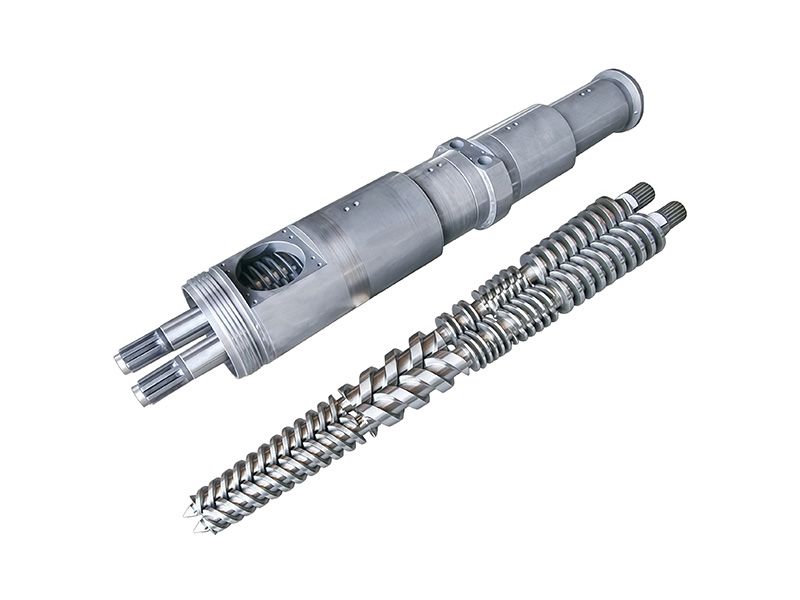
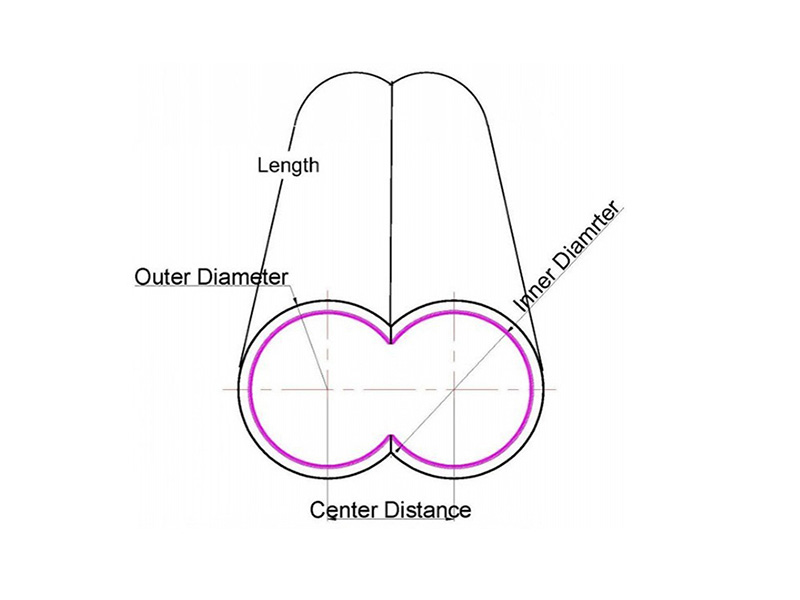
On a conical twin or parallel twin machine, the working surface is built from elements rather than cut from one billet. Compression is produced by the sequence of conveying and kneading elements, so quoting a single compression ratio is at best an approximation and at worst misleading.
- L/D still applies: it is the usable length of the process section
- Compression is a function of the element configuration, not a depth ratio
- Two machines with identical L/D can have entirely different melting behaviour
For PVC pipe and profile lines this is where the parallel twin PVC guide and the four main twin types comparison do more work than any table of ratios; for the single-screw side, the single screw range is organised by application rather than by number.
On a compounding line the equivalent decision is the element sequence rather than a depth ratio, and the compounding configuration notes describe it in the same terms — what the material has to be able to do by the end of a given length.
-
9. Reading the screw you already have
If the goal is a replacement, the most useful thing you can do before contacting anyone is to measure the screw in front of you. Four measurements reconstruct the specification well enough to argue about — and they double as a wear record, because the same readings a year later will tell you how fast the geometry is moving. The no-teardown wear check covers the process signals that tell you when to bother taking them.
Measurement How to take it What it gives you Flighted length and OD From the first full flight to the screw tip, and the flight OD at several points L/D — and the wear on the OD at the same time Channel depth, feed end Root diameter to OD, at the first full turn The numerator of the compression ratio Channel depth, metering end Same method, in the last three turns before the tip The denominator — the number most often guessed Transition length Number of turns over which the depth changes Whether the compression is gradual or abrupt, which the ratio hides Two practical notes on the enquiry itself. If the machine is proprietary, a replacement built from OEM drawings is usually faster than reverse-engineering the profile from a worn part, and the details a replacement has to confirm are the ones that most often come back wrong.
-
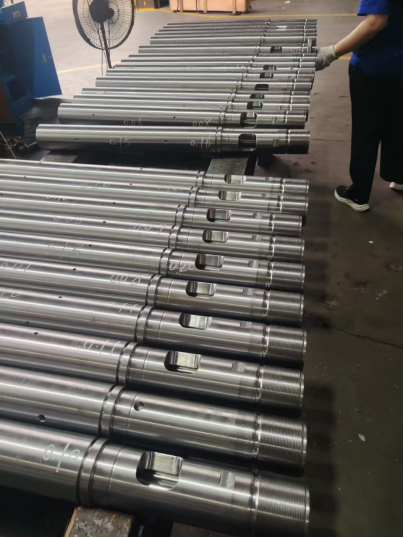
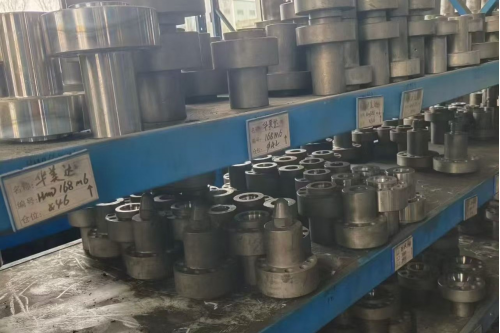
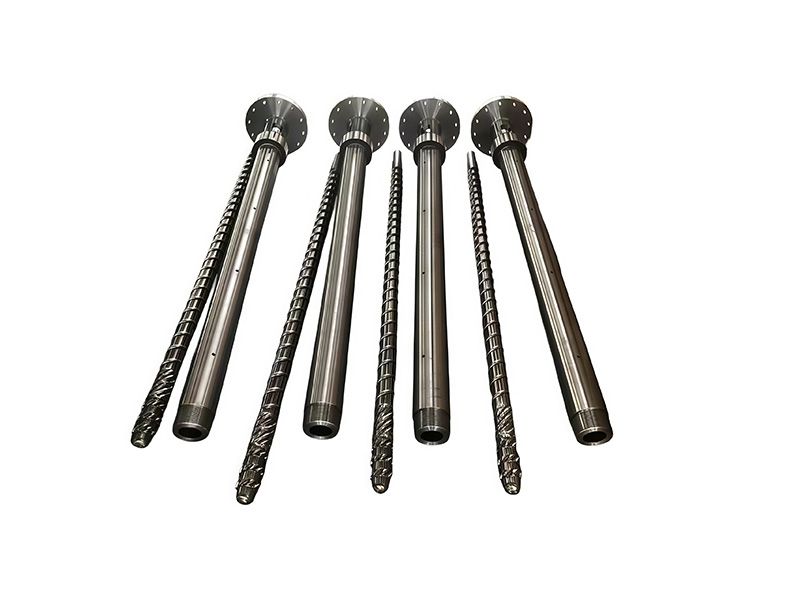
Barrels and screw components racked in the warehouse with their paper labels. Dimensional records kept with the part are what make the next specification a calculation instead of a guess.
-
10. What to write on the enquiry
An L/D and ratio enquiry that gets a useful answer contains the machine, the compound and the target — in that order. The full checklist is longer; this is the minimum that lets a supplier design rather than guess.
- Screw diameter, existing L/D, and the machine make and model
- Resin family and grade, plus filler or reinforcement and percentage
- Target output, running screw speed and the current melt temperature
- The four measurements from section 9, if you are replacing an existing screw
- What the line does badly today: output, mixing, degradation, or changeover time
That last line matters more than it looks. The same machine can call for a longer screw, a different compression profile or simply a worn part replaced, and which one is right depends on the symptom. A custom screw and barrel review is the route when geometry has to change; the replacement guide covers the decision when it does not, and the manufacturing process and capacity pages set out what is practical to build and how quickly. PIPLL builds these from a drawing or from measured dimensions, so either route ends in the same place.
One closing caution. L/D and compression ratio are easy to compare across quotations and therefore easy to over-weight. The specification that actually decides whether the screw performs is the combination of geometry, alloy and fit — which is why the single versus twin comparison and the PE/PP/PVC selection note both start from the application rather than from a table, and why feed-throat design can change the effective answer on the same barrel length.
-
Frequently asked questions
Is a higher L/D always better for mixing?No. Extra length adds residence time and shear history. For heat-sensitive resins a shorter, correctly profiled screw usually gives cleaner melt and lower degradation than a long general-purpose screw.Can two screws with the same compression ratio behave differently?Yes. The ratio only compares feed and metering channel depths. The length of the transition zone and the rate of depth change control how the solid bed is compacted and how much shear heat is generated.Why do published compression-ratio tables disagree?They are drawn from different machine populations, feed-throat designs and conservatism about degradation. Treat any published range as a conversation starter, not a specification.What should I measure on an existing screw before asking for a replacement?Flighted length and OD, channel depth at the feed end, channel depth at the metering end, and the number of turns over which the depth changes. Those four numbers reconstruct L/D and the real compression profile.Does a twin-screw extruder have a compression ratio?Not in the same sense. Compression is produced by the sequence of conveying and kneading elements, not by a single channel-depth ratio. L/D still applies as the usable process length. -
✔ Single Screw & Barrel Specialist | ✔ L/D & Compression Profile by Compound
✔ Nitrided · Bimetallic · HVOF · Through-Hardened | ✔ Custom Geometry · Wear Mapping · OEM Replacement