LDPE vs HDPE vs LLDPE for Film and Extrusion — How chain structure shapes material choice and single screw design
A blown film line can run smoothly on LDPE and draw more motor load after a switch to an LLDPE-rich blend. The finished film may resist puncture better even as the line becomes harder to run. That tradeoff is a practical starting point for comparing LDPE vs HDPE vs LLDPE. The polyethylene family helps explain what the film will do. The actual resin grade, blend and output target determine what the screw must do. PIPLL polyethylene extrusion applications .
LDPE vs HDPE vs LLDPE at the Chain Level
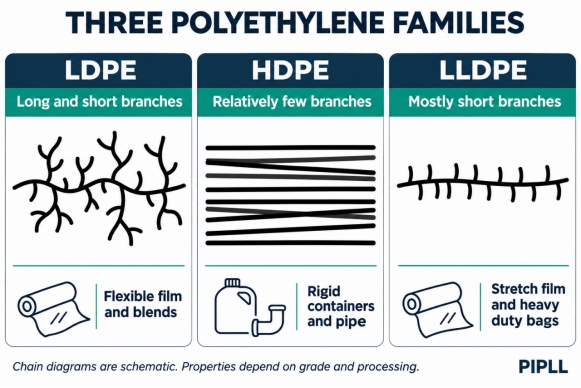
LDPE (low-density polyethylene) is commonly made by high pressure polymerization. Its long and short branches hinder close packing. Long branches also contribute to the melt strength that helps many LDPE film grades hold a stable bubble. Typical uses include flexible films, coatings and blend layers.
HDPE (high-density polyethylene) has relatively few branches, so chains can generally pack and crystallize more readily. Its stiffness is useful in rigid bottles, containers and pipe. Film grades also make thin shopping bags where stiffness at low gauge matters.
LLDPE (linear low-density polyethylene) is typically made by copolymerizing ethylene with an alpha olefin such as butene, hexene or octene. Its mostly linear backbone carries short branches. Typical uses include pallet wrap, heavy duty sacks and sealant layers that need toughness or stretch. ExxonMobil polyethylene grade data .
Figure 1. The three PE families differ in chain branching and typical applications.
Compare the Film at the Gauge You Plan to Sell
Stiffness and feel. HDPE generally gives the stiffest feel at the same gauge. LDPE and LLDPE grades cover a range of flexibility, with overlap. Compare modulus and handling on film of the intended thickness.
Clarity and gloss. Many LDPE grades make clear, glossy film. LLDPE grades can also deliver good optics. Haze and gloss depend on the grade, thickness, surface condition and cooling. Compare the two films at comparable gauge and line conditions.
Toughness and puncture. LLDPE is a common choice for improving puncture resistance and toughness. Tear can differ in the machine and transverse directions, particularly when orientation changes with the blow-up ratio or drawdown. Test both directions and use a puncture test that represents the package. Dow film grade example .
Extrusion load. Many LLDPE film grades show less shear thinning than conventional LDPE, so a switch can increase load and head pressure at the same output. LDPE often provides useful melt strength, which helps the bubble hold its shape. Compare the grade data at the same melt flow test conditions and confirm the behavior on your line. Dow research on PE blown film rheology .
Trial Two Common Film Blends
LDPE with LLDPE. Start with the resin that supplies the main product property. If puncture is the priority, trial an LLDPE-rich formulation and step in an LDPE grade to see whether bubble stability or motor load improves. Measure haze, puncture and seal performance at the target gauge. A clearer or easier-running blend is only an improvement if it still meets the package requirements.
HDPE with LLDPE. For a thin shopping bag, start with an HDPE film grade that meets the stiffness target. Trial a small LLDPE addition if the bag tears around sharp corners. Check bag opening, stiffness, tear in both directions and seal strength before approving the blend.
Hold output, gauge and other settings as steady as practical for the first comparison. Record any adjustment you need to keep the line stable. Use the approved grade and formulation for pressure pipe and other specified products.
Match Each Single Screw Section to the PE Blend
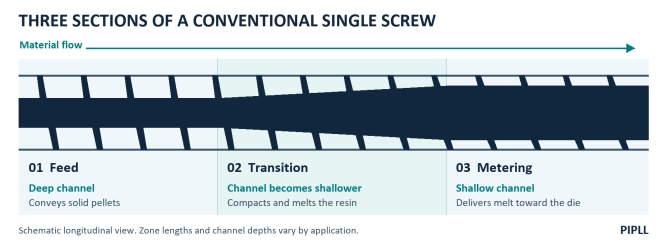
Figure 2. A conventional single screw uses different channel depths for feeding, melting and metering.
Feed section. The deeper channel conveys solid feed. Review channel depth, pitch, feed throat cooling and whether the barrel is smooth or grooved. If a change from pellets to a pellet and regrind blend causes output to fluctuate at constant rpm, check bulk density, feed consistency and bridging before attributing the fluctuation to the melting section.
Transition or melting section. In a conventional screw, the root diameter increases and the channel gets shallower. A barrier design adds a flight that lets melt cross into a separate channel while retaining most solids on the other side. If particles remain unmelted at the target rate, review melting length and barrier clearance alongside actual melt temperature. Tightening a clearance or increasing the compression ratio can also increase shear heating and load. For a conventional screw, the feed-to-metering channel depth ratio approximates the geometric compression ratio when pitch and channel width are comparable.
Metering section and optional mixer. The metering section delivers melt against resistance from the screen pack and die. A mixer can help even out temperature and color, with a pressure and shear cost that depends on its design. If pressure climbs after a grade switch, check the screen pack, die restriction and actual melt temperature before changing the screw. LyondellBasell film extrusion guide .
Review the Geometry Against the Actual Grade
On an LLDPE-rich film line that approaches its drive limit, assess the melting section and mixer together to find where load and heat build up. For HDPE film at higher output, check that the available melting length can finish melting the grade before the metering section. On an LDPE-rich line that already melts cleanly, compare melt temperature variation and head pressure stability before specifying more mixing. Use the existing screw drawing, measured conditions and target kg/h to make that review specific. PIPLL blown film screw and barrel .
Measure the Line Before Changing the Screw
Set a stable baseline with a known blend, then log resin grades and proportions, output in kg/h, rpm, motor load, actual melt temperature and head pressure. Record film gauge, bubble behavior and the defects that show up. Log the screen condition and the pressure reading location so the next run can be compared.
If motor load rises at the same output, compare the two grades at the measured melt temperature and check the screen pressure drop if the line has both readings. For an energy comparison, record extruder specific energy consumption in kWh/kg using the same power measurement boundary each time. For example, drive input of 36 kW at 120 kg/h equals 0.30 kWh/kg on a drive-only basis. Track heaters and other auxiliaries separately if you want a line-level comparison.
If output per revolution has gradually declined on the same recipe, check feed consistency and downstream resistance. Where wear is suspected, measure screw flight diameter and barrel bore at matching axial positions and compare clearance with the drawing or baseline. These screw barrel inspection readings help assess whether extruder screw barrel refurbishment is suitable. PIPLL single screw and barrel range .
Frequently Asked Questions
Can one screw run all three PE families? It can cover some combinations if the line meets the required output, load, melt uniformity and product quality for each grade. A film grade and a pipe grade can ask very different things of the same screw.
Is there a standard LDPE to LLDPE blend ratio? Choose the ratio from a controlled trial against your puncture, optics, seal and throughput targets. Different grades and dies can shift the best result.
Does the same melt index mean the same motor load? Melt index measures flow under one set of test conditions. Resins with the same reported value can behave differently at the shear rates and temperatures inside the screw and die.
Discuss Your PE Film Line with PIPLL
When comparing LDPE vs HDPE vs LLDPE for a new film, share the machine model, screw diameter and L/D, feed barrel type, resin grades, target output and the problem you want to solve. Include a screw drawing if available so PIPLL can review the existing geometry. Custom screw design process . Contact PIPLL .
Technical and Sales Contact
Harry Jiang | PIPLL
Email: harry@pipll.com | WhatsApp: +86 182 6854 1152
Website: www.pipll.com


+86 15267878906

1306 W building , NB-IoT Industrial Park, No. 199 Changxing Road, Jiangbei, Ningbo.
 Languages