 Languages
PE Extrusion Guide: Screw Design, Temp & Troubleshooting
PE Polyethylene Extrusion: A Complete Guide to Screw Design, Temperature and Troubleshooting
LDPE, MDPE, HDPE and LLDPE do not share one screw. This guide covers what actually changes between the families, how to set the L/D ratio, the compression ratio and the temperature profile, and how to read the eight problems that show up on a running PE line.
PE POLYETHYLENE EXTRUSION · HDPE PIPE EXTRUSION · PE SCREW L/D AND COMPRESSION RATIO · POLYETHYLENE EXTRUSION PROBLEMS
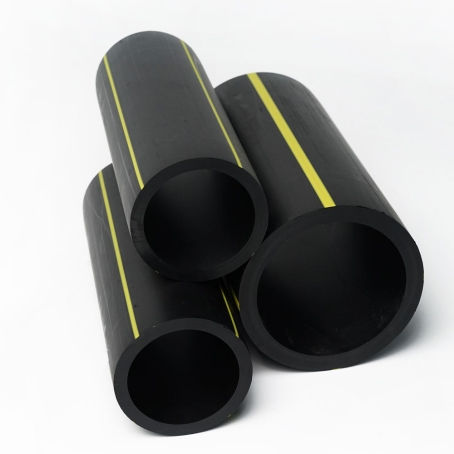
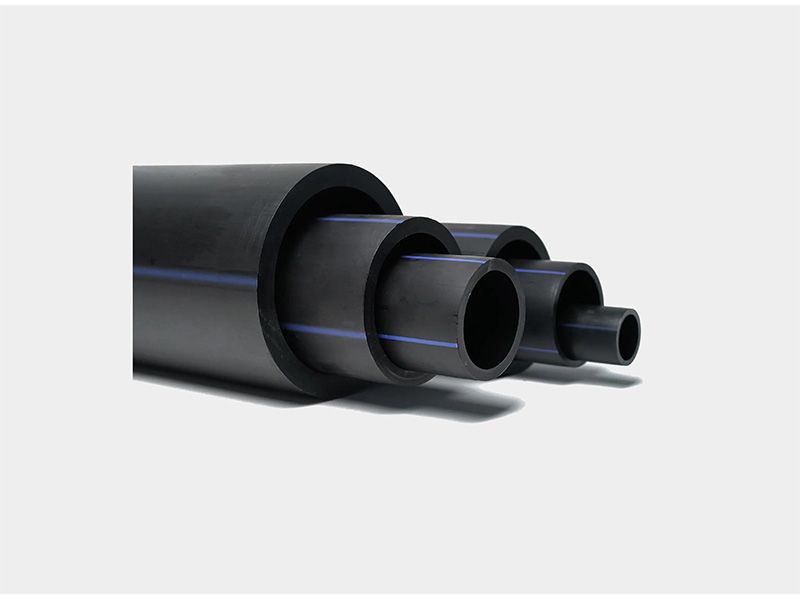
HDPE pressure pipe. The wall-thickness tolerance on a PE pipe line is decided upstream of the die — by how steadily the screw meters melt, not by the haul-off.
- 1. What PE extrusion actually isPolyethylene is the highest-volume plastic in the world, and most of it passes through a single screw extruder at least once. In its simplest form, PE extrusion means feeding polyethylene resin — pellet, granule or flake — into a heated barrel, conveying and compressing it along a rotating screw, melting it into a homogeneous melt, and pushing that melt through a die to make pipe, film, sheet, cable coating or pellet.The screw does four jobs in a single pass: convey, compress, melt and meter. Everything downstream — wall thickness, film gauge, surface finish, output stability — is decided by how well those four stages are balanced for the particular PE family sitting in the hopper. That is why a screw that runs beautifully on HDPE pipe can under-mix an LLDPE film grade and over-shear a heat-sensitive compound on the same machine.KEY INSIGHT PE is not one material. Density and melt index decide how much friction the solids generate in the feed zone, how much shear the melt will tolerate, and how much die swell you have to compensate for at the head. Specifying “a PE screw” is the most common — and the most expensive — shortcut in extrusion.2. The four PE families are not interchangeableDensity and melt index are the two numbers that decide screw geometry. Density sets the crystallinity, the stiffness of the solid bed and the die swell; melt index sets the melt viscosity and how much shear the polymer will take before it starts to misbehave. Move either one and the screw that suited the last job is now wrong — which is why the bimetallic or nitrided debate follows the filler, not the brand.
Family Density (g/cm³) Typical melt index Solids feed behaviour Die swell What it means for the screw LDPE 0.910–0.925 0.2–4.0 (film) Soft, high friction, feeds readily High Tolerates a broad temperature window; needs a deep enough feed and good mixing, not more shear MDPE 0.926–0.940 0.2–2.0 Moderate friction Medium Sits between LDPE and HDPE designs — the compromise screw that does neither job perfectly HDPE 0.941–0.965 0.05–1.0 Harder, lower friction, feeds reluctantly Low Needs a longer compression zone and real feed assist; barrel wear is lower but torque is higher LLDPE 0.915–0.925 0.5–3.0 Soft but slippery, narrow melting range Medium–high Needs more mixing rather than more shear; the classic source of melt fracture and bubble instability - The practical consequence is that MDPE and HDPE runs on the same machine rarely want the same screw. If the product mix genuinely alternates, plan for a second screw and a matched barrel rather than one compromise geometry that underperforms on both.3. Screw design: L/D ratio and compression ratioL/D ratio buys melting and mixing length. Compression ratio buys pressure build-up and shear. They are not independent: raise both and residence time, torque and melt temperature all climb together. The published screw and barrel dimensions for your machine are the starting point, not the answer.
PE family / product Typical L/D Compression ratio Feed depth Design notes LDPE, blown film 20–25:1 2.5–3.0 Deep Low-shear screw; the mixing section matters more than the compression ratio LDPE, pipe and sheet 20–25:1 2.5–3.0 Deep Conventional geometry is enough at moderate output MDPE 25–30:1 2.5–3.2 Medium Bridge design; verify against the actual melt index before committing HDPE, pipe, conventional 25–30:1 2.8–3.2 Medium Grooved feed throat strongly recommended HDPE, pipe, high output 33–38:1 2.8–3.5 Shallower Longer metering zone; feed section decides whether the speed is usable LLDPE, film 25–30:1 3.0–4.0 Medium Add mixing elements; do not try to solve melt fracture with compression ratio alone Engineered PE, high filler or regrind 30–33:1 2.5–3.5 Medium–shallow Wear protection stops being optional at this point - KEY INSIGHT Compression ratio has to match the bulk density of the feedstock, not the finished part. A screw sized for virgin pellet will starve on low-bulk-density regrind and flake, which is the single most common reason a recycling line under-delivers against its nameplate output.
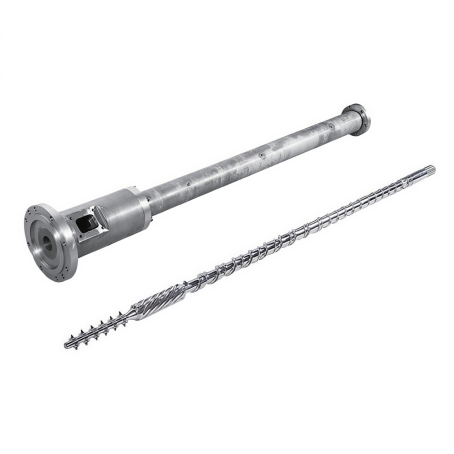
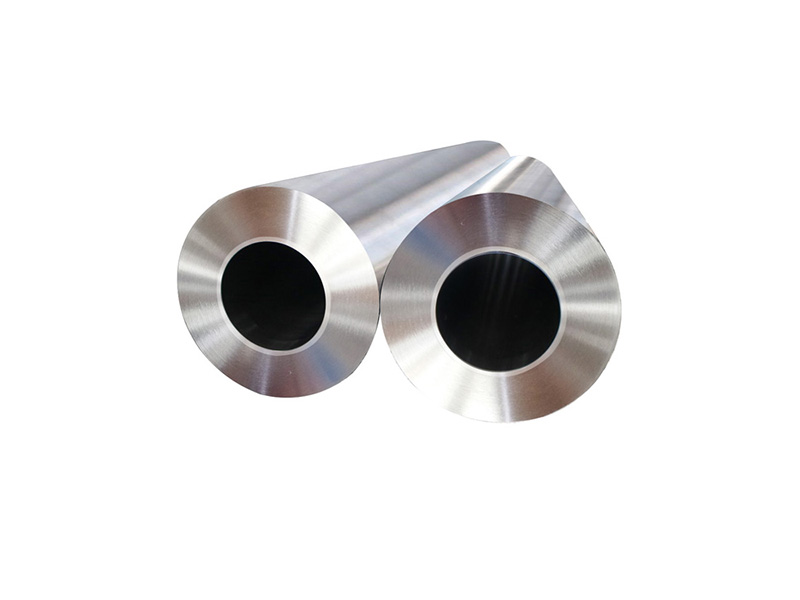
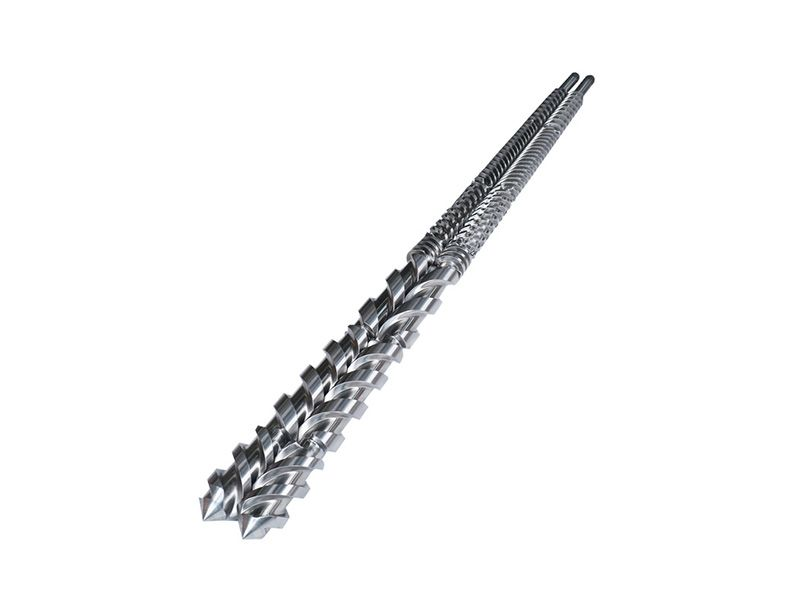
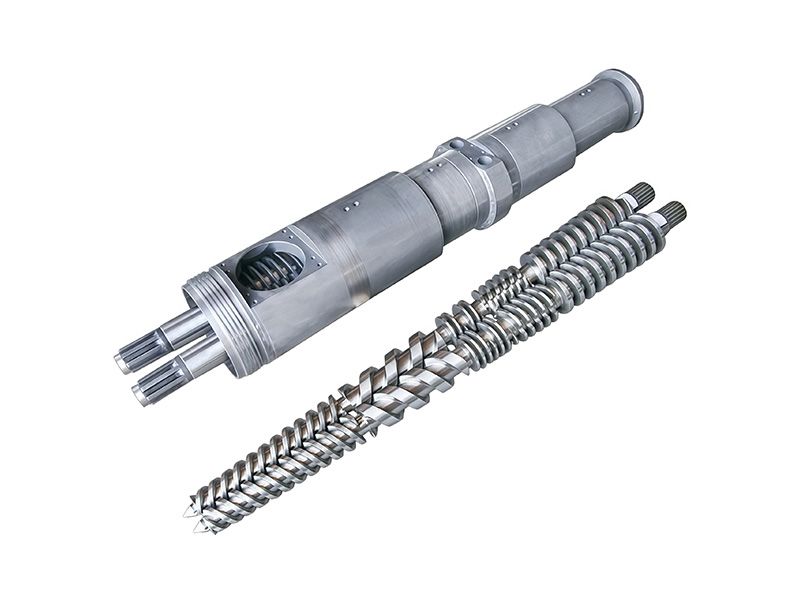
A pipe-extrusion screw and barrel set. Screw and barrel are one working pair: the clearance, the wear allowance and the alloy family only mean anything when both parts are measured against each other.
- 4. The temperature profilePE is semi-crystalline, so the profile should climb gradually from the feed to the die — steep steps create unmelt and torque spikes, and a cold feed zone will stall solids conveying long before the heaters are anywhere near the problem.
Zone LDPE MDPE MDPE LLDPE Feed, zone 1 140–165 °C 150–175 °C 160–185 °C 150–175 °C Compression, zones 2–3 165–190 °C 175–200 °C 185–215 °C 180–210 °C Metering, zones 4–5 180–205 °C 180–205 °C 190–215 °C 200–225 °C 200–225 °C Adapter 190–210 °C 195–215 °C 205–225 °C 205–230 °C Die head 195–215 °C 200–220 °C 210–230 °C 210–235 °C Measured melt 195–215 °C 200–220 °C 205–225 °C 210–230 °C - These are starting ranges for a conventional single screw line. Confirm against the resin supplier's datasheet — melt index, comonomer type and the additive package will move them by 10–20 °C. Three habits keep the profile honest:· Set the melt temperature first — the barrel zones are a means to it, not a target in themselves.· Check the melt with a needle probe at the head, not with the barrel thermocouple sitting in a heater band.· Log the profile with the resin batch — when a problem appears three weeks later, the temperature record is the first thing anyone asks for.5. PE pipe extrusion, step by stepA PE pipe line is a chain of conditioning stages, and every one of them can take the blame for a wall-thickness problem that actually started in the screw.
Step What happens What decides the result 1. Drying and handling Resin and regrind conditioned before they reach the hopper Moisture content and contamination level 2. Feeding Gravimetric or volumetric dosing into the feed throat Gravimetric or volumetric dosing into the feed throat Feed consistency; on HDPE, the condition of the grooved throat 3. Melting and homogenising Solids converted to a uniform melt along the screw Screw geometry and the barrel temperature profile 4. Melt filtration Screen pack traps gels and contamination Mesh selection and pressure stability 5. Pipe head Spiral mandrel distributes melt around the circumference Melt temperature uniformity entering the head 6. Sizing and cooling Vacuum sizing calibrates the outside diameter; water baths cool the wall Vacuum level, cooling length, line speed 7. Haul-off and cutting Pipe pulled at constant tension and cut to length Haul-off stability and saw synchronisation - Steps 3 to 5 are where screw geometry, barrel condition and die design meet. A worn screw or an opened-up bore shows up here first, as a slow drift in wall thickness rather than a step change.6. PE film extrusion: where it differsFilm is where the LDPE and LLDPE difference bites hardest. LDPE has long-chain branching, so it holds a bubble well and tolerates a wide die gap. LLDPE is linear: it has lower melt strength, a narrower melting range and a much stronger tendency to melt fracture, so the die gap has to come down and the melt temperature has to go up.· Die gap — LLDPE generally runs a narrower gap than LDPE; wide gaps invite sharkskin at the same output.· Frost line — a low, stable frost line is what holds the bubble. Move it and you change the optics as well as the stability.· Melt strength — bubble instability on an LLDPE-rich blend is usually a melt-strength problem, not an air-ring problem.· Screw side— more mixing, not more compression. A barrier or Maddock section earns its place here far more than a higher compression ratio does.
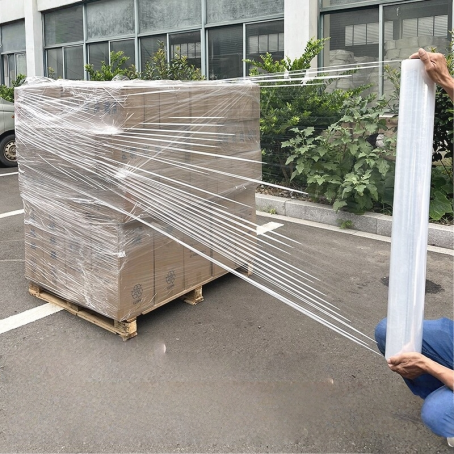
LLDPE stretch film. Linear PE has lower melt strength than LDPE, so bubble stability is decided by the melt temperature and die gap long before it is decided by the air ring.
- 7. Eight PE extrusion problems and what they usually areMost of these arrive as an output or a surface complaint. Only two of the eight are usually a screw problem — the rest are feed, temperature or contamination, which is also why extruder surging is so often misread as a worn screw.
Symptom What it usually is on a PE line First move Melt fracture / sharkskin (LLDPE) Excessive shear at the die with too wide a gap Narrow the die gap and raise melt temperature 10–15 °C before touching the screw Bubble instability, blown film Low melt strength with a linear grade, plus uneven cooling Lower the frost line, correct the air ring, reduce output Output drift over a shift Screw or barrel wear, or a bridging feed Measure screw OD and barrel ID, then inspect the feed throat Torque spikes Feed starvation or a cold feed zone Raise zone 1, verify hopper flow, inspect the grooved throat Die lines and longitudinal striping Die build-up, a ruptured screen pack, or a melt fracture precursor Change screens, clean the die, re-check the melt temperature Black specks Degraded resin held in dead corners, often with a worn screw Purge properly, then borescope the mixing section Pipe wall-thickness variation Surging, melt temperature variation, or a worn head and check component Verify heater control, then measure screw wear Voids and bubbles in the pipe wall Moisture, entrapped air, or excessive decompression Dry the resin, review venting, adjust back pressure - 8. Screw and barrel construction for PE dutyPE is not particularly corrosive, so the construction decision is almost entirely about abrasion — and abrasion arrives with the filler, the regrind and the sheer number of tonnes pushed through the barrel.
Construction Surface hardness Wear resistance Corrosion resistance Typical PE duty Indicative service life Nitrided 38CrMoAlA HRC 52–55 Good Fair Virgin PE, low-filler compounds 3–5 years Standard bimetallic alloy HRC 58–62 Excellent Good Medium-filler PE, general extrusion 5–7 years Tungsten carbide bimetallic HRC 65–68 Superior Good High-filler or recycled PE, high-output lines 7–10 years SKD11 internal liner sleeve HRC 60–62 Excellent Medium Highly abrasive PE compounds, WPC composites 5–8 years - 8. Wear, corrosion and the barrel material decisionOnce the geometry is right, service life is decided by what the material does to the metal surface. Two mechanisms dominate. Abrasive fillers — calcium carbonate, talc, glass fibre — grind at the flights and bore. Corrosive compounds attack the same surfaces chemically. PVC with high filler loading does both at once.PIPLL publishes four bimetallic alloys for this reason, and the choice is a trade between wear resistance, corrosion resistance and working temperature rather than a search for the hardest available surface.
Alloy Wear Corrosion Layer Hardness Max temp PIPLL01 (Fe-Ni-Cr-B) Very good Good 2–3 mm HRC 58–65 ≤400°C PIPLL02 (Ni-Cr-Co-B) Good Very good 1.5–2 mm HRC 50–58 ≤450°C PIPLL03 (Ni-Cr-Co-V-B) Very good Very good 1.5–2 mm HRC 55–60 ≤450°C PIPLL04 (Ni-WC-Cr-B) Excellent Very good 1.5–2 mm HRC 55–65 ≤600°C PIPLL manufactures PE screw and barrel sets from Φ20 mm to Φ500 mm, up to 12 m in length, on a 38CrMoAlA base with a centrifugally cast alloy layer of 2–3 mm where bimetallic construction is specified. Where the wear zone should be replaceable rather than renewed, an internal liner sleeve is the alternative. Screw and barrel are supplied and measured as one matched pair through our process control , because a new bore against a worn screw is a known and expensive way to fail twice.
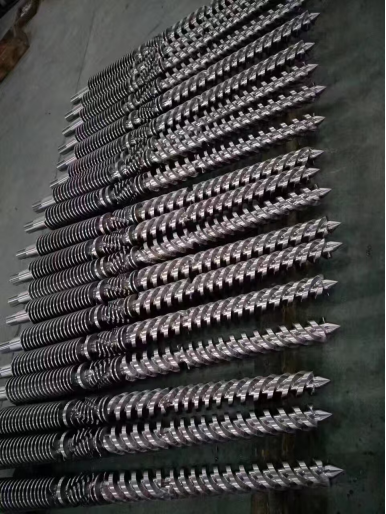
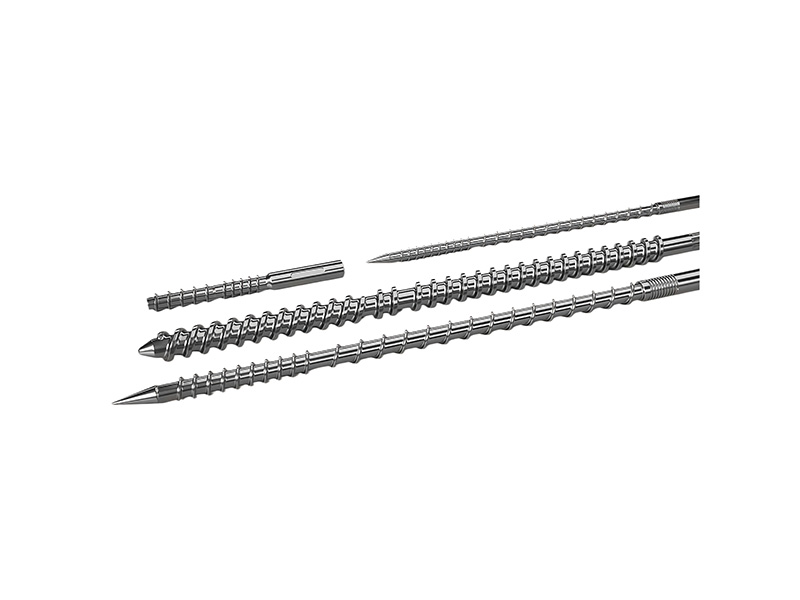
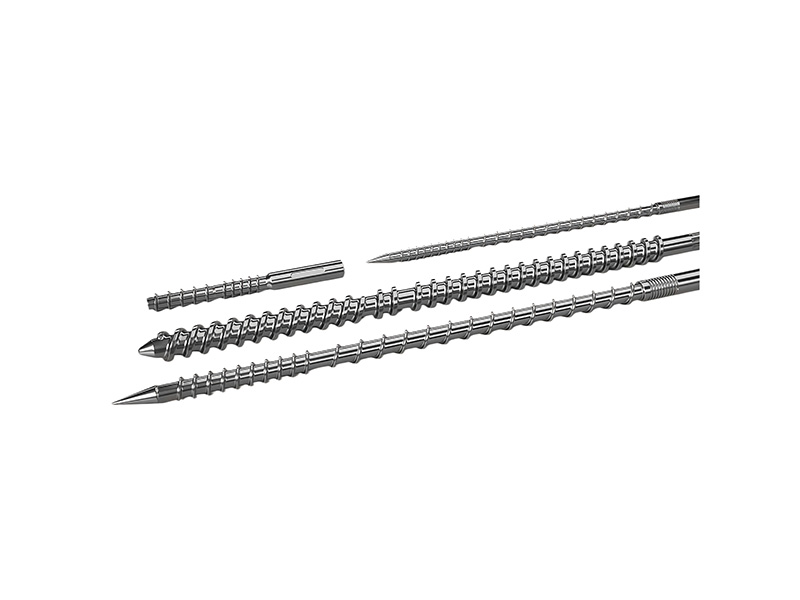
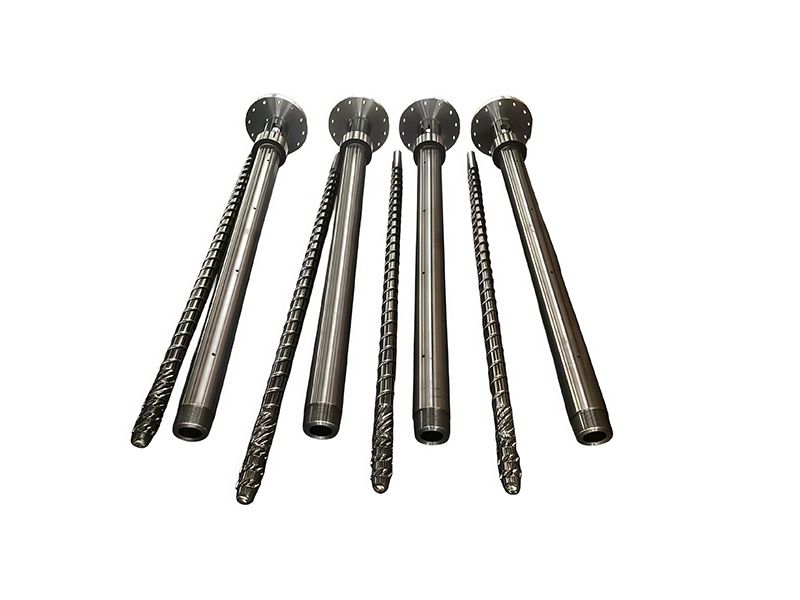
Finished screws in the workshop. Wear protection is a coating on a geometry — if the geometry is wrong, the coating only makes the wrong answer last longer.
9. What to send before you ask for a PE screw and barrelA quotation built on complete data comes back correct the first time. The list below is short, and all of it is information you already have — the custom screw barrel project guide walks through what each item actually decides.Category What to send Machine Machine brand and model, screw diameter, existing L/D and compression ratio Material PE family, density and melt index, and the actual supplier grade Feedstock form Virgin pellet, regrind, flake, or a blend — with the approximate percentages Product Pipe OD and wall, film width and thickness, sheet gauge, or pellet output Performance target Required output in kg/h and the current measured output Pain points What is going wrong now: output drift, black specks, melt fracture, early wear Line data Temperature profile in use, screw speed, motor load, and back pressure Interfaces Flange, feed throat, heater band and die-head dimensions Wear history Installed date and the last bore and screw measurements, if any 10. Frequently asked questionsCan one screw run both LDPE and HDPE?It can run both; it will not be optimal for both. The compromise is usually visible as under-melting on the HDPE side or excessive shear on the LDPE side. If the product mix alternates regularly, a second screw and matched barrel is normally cheaper than the scrap the compromise generates.Do I need a grooved feed throat for HDPE?For anything above moderate output, yes. HDPE pellet has lower friction against the barrel wall than LDPE, so solids conveying — not melting — becomes the limiting stage. A grooved throat with forced cooling raises the achievable feed rate and is what makes a high-speed screw usable at all.How do I know whether the screw or the barrel is worn?Measure both, at the same axial positions, and compare them as a pair. The screw and barrel wear inspection procedure covers the measurement plan. If the screw OD is largely unchanged and the bore has opened up, the barrel is the problem. If the screw flight OD has dropped, the screw is. Reading one number without the other is how good parts get replaced unnecessarily.Is bimetallic worth it for unfilled PE?Usually not for virgin, unfilled PE — a correctly nitrided screw and barrel will outlive the machine's next overhaul. It becomes worth it the moment filler, regrind, or high output enters the picture; the alloy selection guide sets out where each construction earns its cost.Related PIPLL resourcesNeed help specifying a PE extrusion screw and barrel?Send the PE family and melt index, the product, and the line data you are running today. We will come back with the screw geometry, the L/D and compression ratio, the barrel construction, and a matched screw-and-barrel set quoted as one pair. PIPLL is an extruder screw and barrel manufacturer working in Φ20–500 mm.