 Languages
Twin Screw Elements Guide: Conveying vs Kneading Blocks, Configurations and Alloys
-
Twin Screw Elements: Conveying vs Kneading Blocks, Configurations and Alloys
Screw element geometry — pitch, flight depth, kneading-block angle and metallurgy — decides where a co-rotating line melts, mixes, vents and builds pressure. Get the element map wrong and no downstream fix recovers the output or the dispersion. This guide sets out the element types, the angle trade-offs, the materials and the configuration logic that a compounding line is actually built on.
-
TWIN SCREW ELEMENTS · KNEADING BLOCK · CO-ROTATING SCREW ELEMENTS · MODULAR SCREW ELEMENTS
-
1. What Twin Screw Elements Actually Are
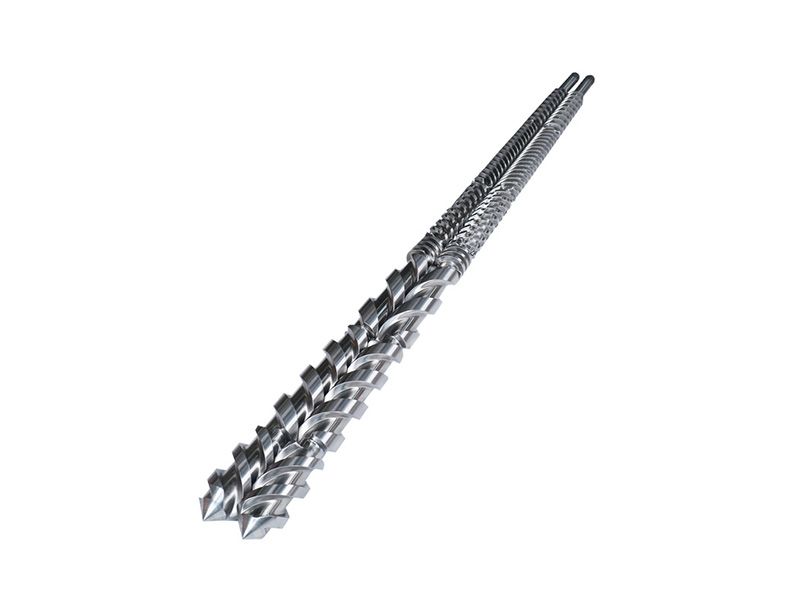
A co-rotating twin screw extruder does not have a single machined screw. It has two splined shafts onto which a sequence of short, interchangeable screw elements is threaded and keyed in place. Each element is only one or two screw diameters long, and the whole stack — feed elements, kneading blocks, mixing elements and discharge elements — is assembled to match one specific job. That modularity is the point: the same barrel runs compounding , recycling or high-fill duty simply by re-sequencing the elements.
Because the elements are interchangeable, three things decide how the line behaves. Geometry decides how much each element conveys, shears and mixes. Arrangement decides where melting, mixing, venting and pressure-building happen along the barrel. Metallurgy decides how long the whole stack survives the abrasive filler or glass fibre it is being asked to push.
-
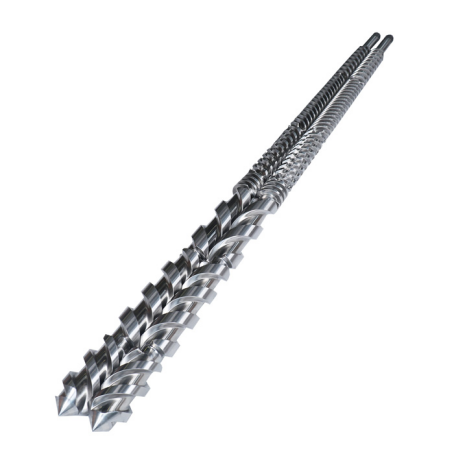
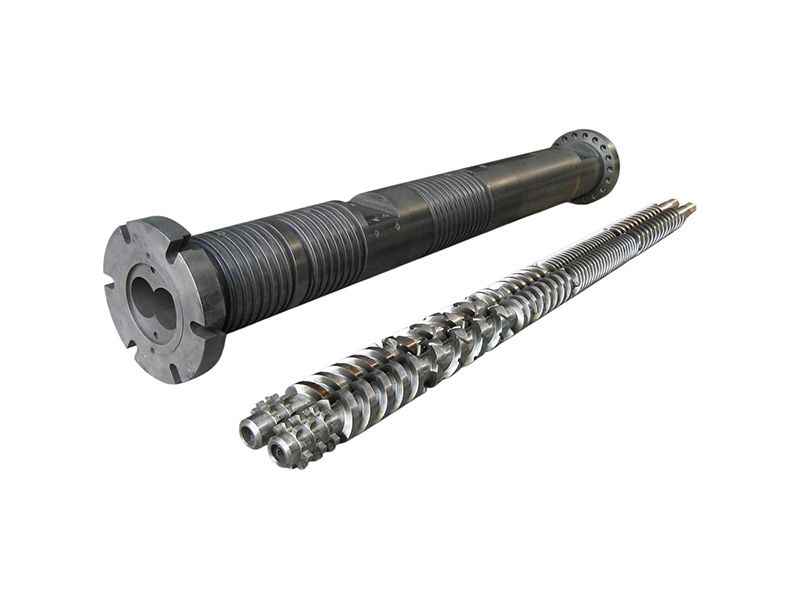
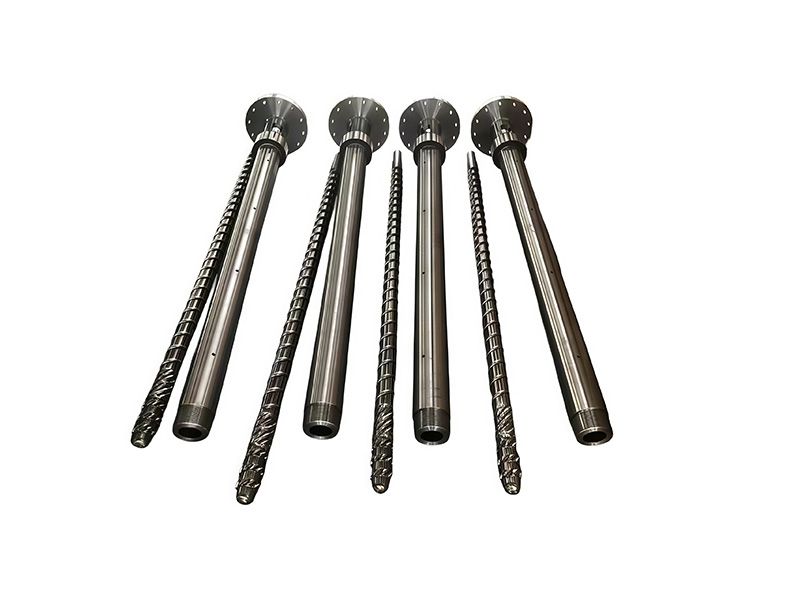
A modular co-rotating twin screw. The barrel is a fixed bore; the screw is a stack of interchangeable elements threaded onto splined shafts — the configuration, not the barrel, is what changes between products.
-
2. The Four Element Families
Almost every configuration is built from four families of element:
Conveying elements — forward-pumping flights of a fixed pitch. They transport material, generate axial force and do the least mixing. Pitch, not speed, is their main mixing variable.
Kneading blocks — a stack of offset discs. The stagger angle between discs controls how aggressively the element shears, disperses and mixes. This is the workhorse of dispersion.
Mixing / distributive elements — toothed discs and gear-like elements that split and recombine the melt stream. They homogenise without the hard shear peak of a kneading block.
Reverse (left-handed) elements — elements threaded in the opposite hand. They hold the melt back, filling the upstream section and building the local pressure that makes kneading blocks and vent sections work.
KEY INSIGHT — A kneading block only mixes when it is full. Reverse elements and restricted profiles are what fill it. An under-filled kneading block spins in a half-empty channel and does almost no dispersive work.
-
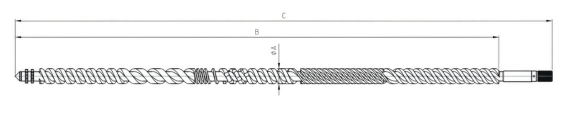
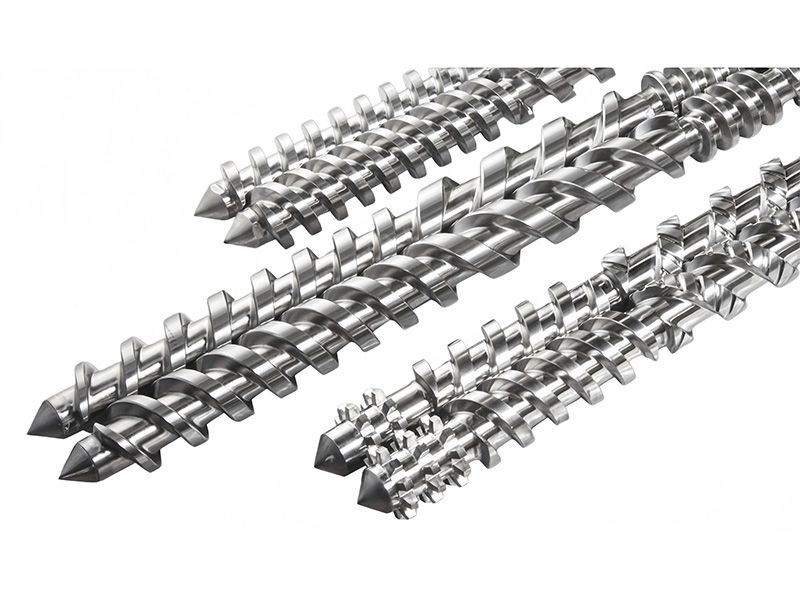
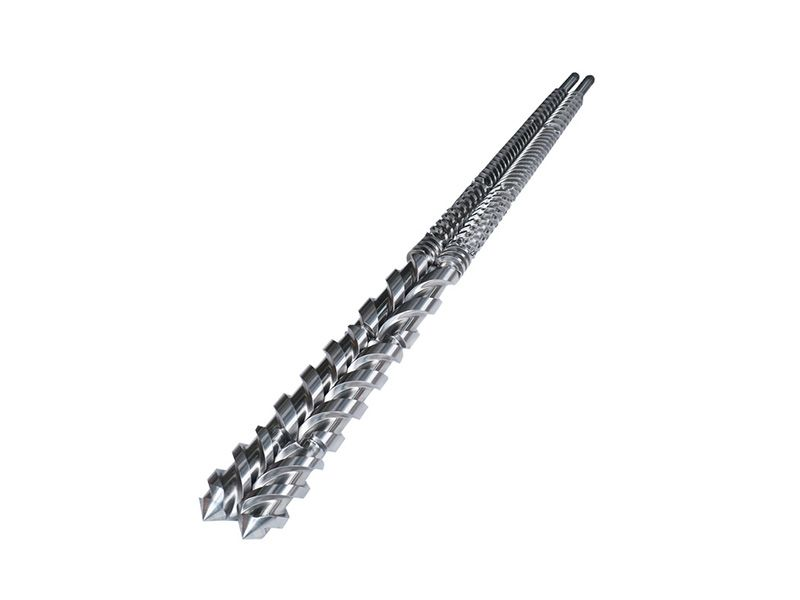
A twin screw element map. Each pitch, disc and block is a drawing-driven choice — the configuration is a pressure and mixing map read from feed to discharge.
-
3. Kneading Block Angles: 30°, 45°, 60° and 90°
Angle Conveying Mixing action Typical position 30° Strong forward Gentle distributive mixing Early melting section; low-shear resins 45° Neutral / mild forward Balanced distributive + dispersive General-purpose melting and mixing 60° Mild reverse Strong dispersive mixing Dispersion of pigments, fillers, glass fibre wet-out 90° Neutral (no axial push) Maximum shear, no conveying Short high-shear zones; pressure-restricted sections The common mistake is to reach straight for 60° or 90° blocks to ‘mix harder’. Higher stagger buys dispersion at the cost of shear heat and residence time. For thermally sensitive or highly filled compounds, a chain of 45° blocks often does more useful work than one 90° block.
-
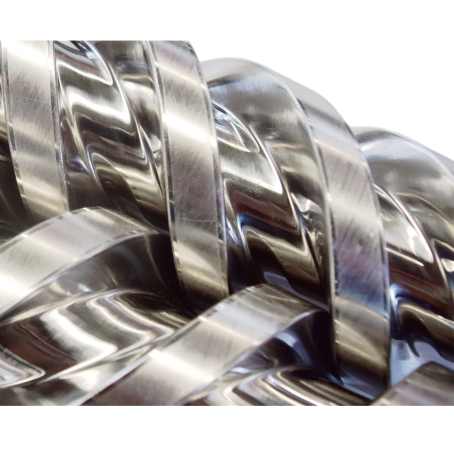
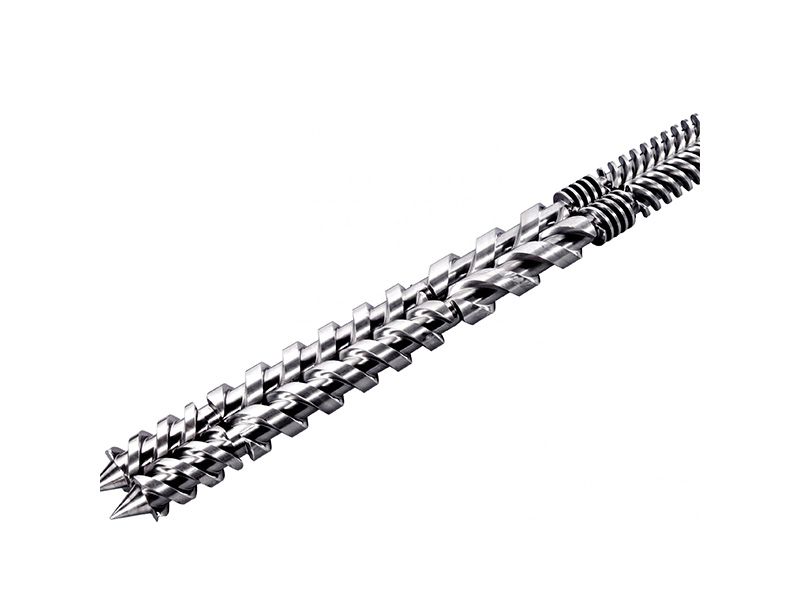
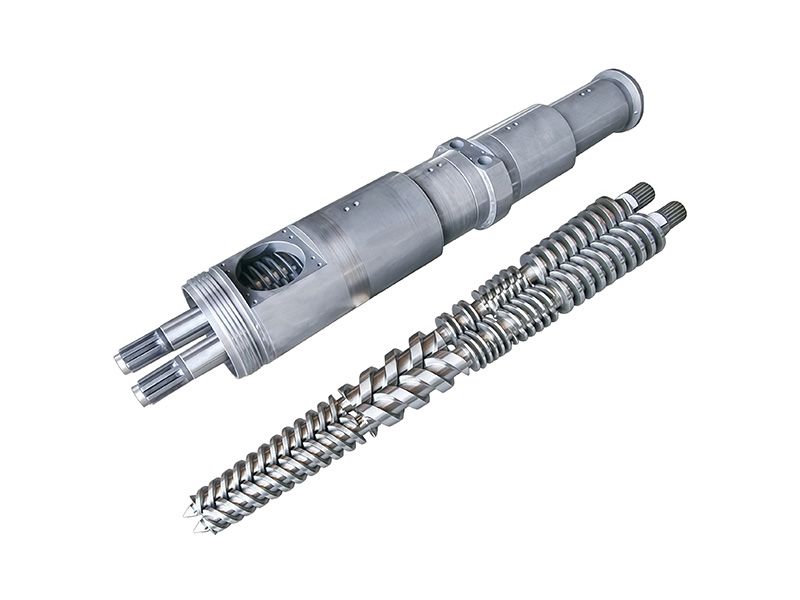
Close-up of intermeshing twin screw flights. Flight clearance and disc geometry control leakage flow, shear intensity and element life under abrasive fillers.
-
4. Element Geometry: Pitch, Depth and Channel
Geometry parameter What it controls Practical effect Pitch (1D / 1.5D / 2D) Conveying rate per revolution Short pitch pumps less, fills more and builds pressure; long pitch starves the channel and reduces shear Channel depth Fill ratio and shear rate Deeper channels fill more and shear less; shallower channels intensify shear and mixing Flight clearance Leakage flow over the flight Tighter clearance mixes better but accelerates element wear against abrasive fillers Disc width (kneading block) Shear intensity per disc Wider discs shear harder; narrower discs give more distributive re-orientation Free volume / Do/Di ratio Capacity and torque demand A 1.55 Do/Di ratio is the common compounding standard; higher ratios give more volume at lower specific energy -
5. Element Materials and Metallurgy
Element material Typical hardness Best for Notes Nitrided steel HV 950–1,000 surface General-purpose unfilled compounds Lowest cost; case is thin, so heavy abrasion breaches it quickly Through-hardened tool steel HRC 58–62 Moderately filled compounds Uniform hardness through the section W6Mo5Cr4V2 high-speed steel HRC 62–65 Glass-fibre, mineral-filled and flame-retardant compounds The standard high-wear choice; retains hardness at compounding temperatures HIP powder-metallurgy HSS HRC 63–66 High glass-fibre loadings, tight-dispersion masterbatch Fine, homogeneous carbide distribution resists both abrasive and erosive wear Tungsten carbide (WC-Co) HV 1,100–1,600 High glass-fibre, ceramic-filled, high-abrasion recycled feed Highest wear life; brittle, so thermal shock and impact must be managed KEY INSIGHT — Wear is a clearance problem, not a breakage problem. The moment an element’s flight or disc clearance opens up, the leakage flow rises, mixing efficiency drops and the barrel temperature profile drifts — long before anyone sees visible damage.
-
6. Building a Screw Configuration
Zone Element choice What it must achieve Feed Wide-pitch (2D) conveying elements Accept the bulk feed, minimise back-pressure, start conveying Melting / compression Tightening pitch + 30–45° kneading blocks Compact the solids, build friction, melt without a shear spike Mixing / dispersion 45–60° kneading blocks + toothed discs Wet out fillers, disperse pigments and additives Venting / decompression Reverse element + long-pitch conveying Drop pressure below atmosphere at the vent so volatiles can escape Second mixing 45° blocks + distributive elements Homogenise after the vent, distribute any liquid feed Discharge / pressure build Short-pitch conveying + 90° or reverse element Build the stable pressure the die or pelletiser needs -
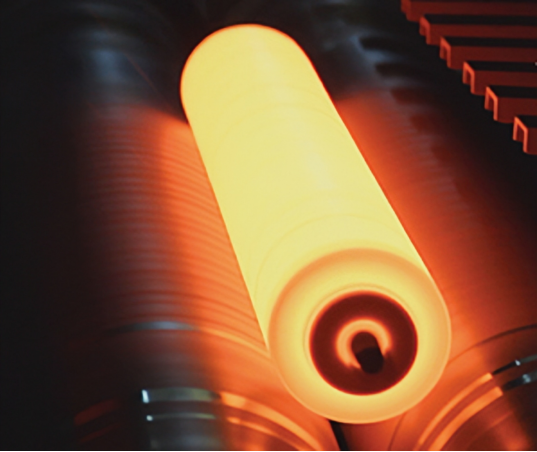
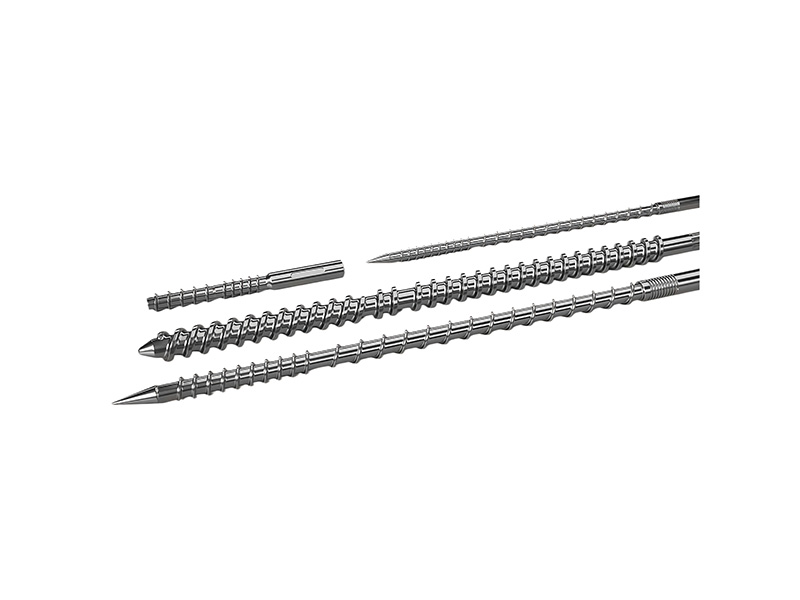
Centrifugal casting of a bimetallic alloy layer. Element material — nitrided, high-speed steel, HIP or tungsten carbide — is a life-cost decision driven by the filler loading.
-
7. OEM Compatibility: Coperion, Leistritz and Others
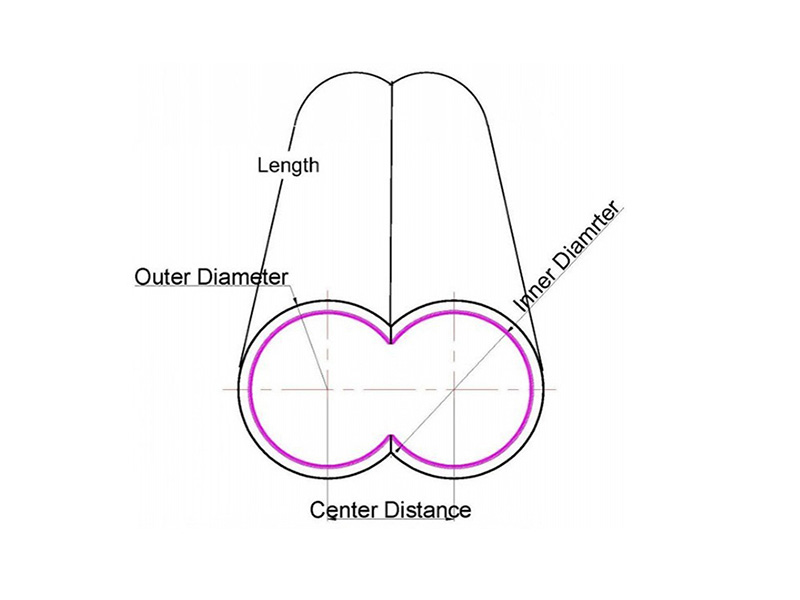
Elements are not universal. They are matched to the machine’s spline, centre distance and Do/Di ratio. Coperion ZSK, Leistritz ZSE and other series each require their own specification. A drop-in replacement brief must carry the spline specification, centre distance and element outside diameter, not just the brand name.
-
8. Wear and Replacement
Symptom Likely cause Action Output drops at constant speed Opened flight clearance — leakage flow rising Measure element clearance; replace worn elements Melt temperature creeps up Worn discs shear less efficiently, stock re-circulates Check kneading-block disc wear; re-balance the configuration Dispersion quality falls Kneading blocks no longer fill and shear Replace discs or shorten pitch to restore fill Vent flooding / surging Reverse element worn, pressure map shifted Inspect the vent-adjacent elements Local barrel hot spots Single worn element creating a shear anomaly Inspect elements adjacent to the hot zone -
9. Selection and RFQ Checklist
Provide: Machine OEM, series and screw diameter · Element type and quantity · Kneading-block disc angle and width · Element material requirement · Formulation (fillers, fibre loading, abrasives) · Existing drawing or worn sample · Output target and screw speed.
-
10. Frequently Asked Questions
What is the difference between conveying and kneading elements?
Conveying elements pump material forward with little mixing; kneading blocks shear and mix with little forward pumping.What kneading block angle should I use?
Start at 45° for general compounding. Move toward 30° for gentle work and toward 60° for dispersion. Reserve 90° for short high-shear zones.What material for glass-fibre compounds?
High-speed steel (W6Mo5Cr4V2) at a minimum; HIP powder-metallurgy HSS or tungsten carbide for high loadings.How do I know when to replace elements?
Track output, melt temperature and dispersion quality rather than looking for visible damage. -
Need Help Specifying Twin Screw Elements?
Send the machine OEM and series, the screw diameter, the formulation with filler and glass loading, and the configuration you are running today. PIPLL is an extruder screw and barrel manufacturer working in Φ20–500 mm and up to 12 m.
Eric Dong | Co-founder | Email: eric@pipll.com | WhatsApp: +86-15267878906 | Website: www.pipll.com