Choosing Between Single Screw and Twin Screw Extruders
By Harry Jiang | PIPLL
Choose the extruder around the process, not the number of screws. A single-screw extruder is often a practical choice for steady melting and forming of a prepared material. A twin-screw extruder gives more flexibility when the job requires controlled feeding, compounding or devolatilization. This PIPLL guide compares the two designs by the production questions that actually affect quality, output and cost.
What Each Extruder Does
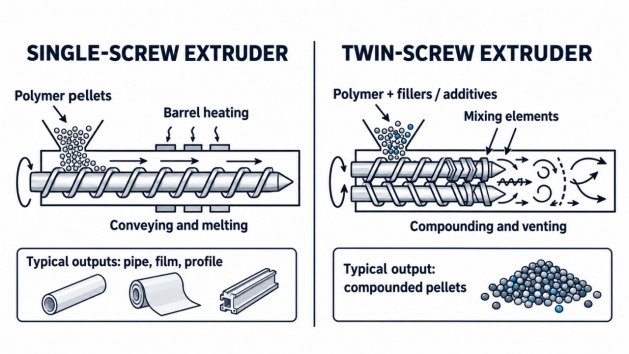
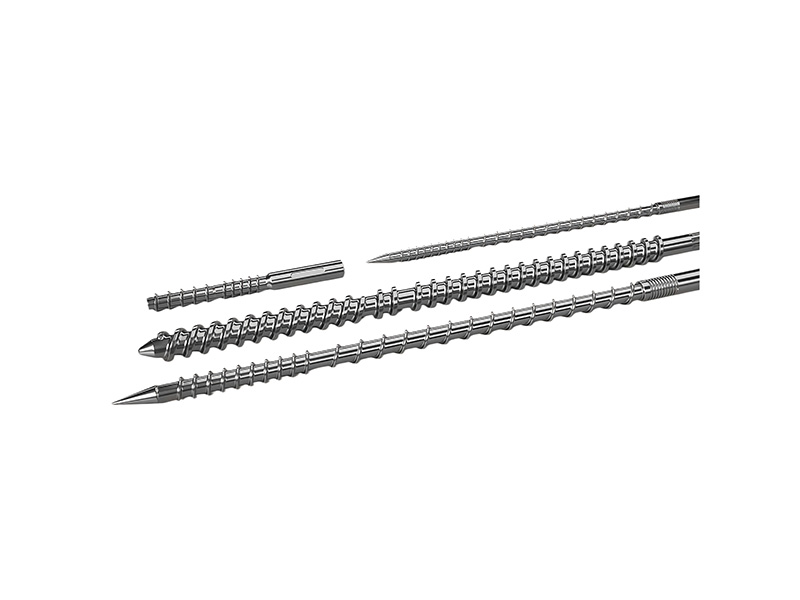
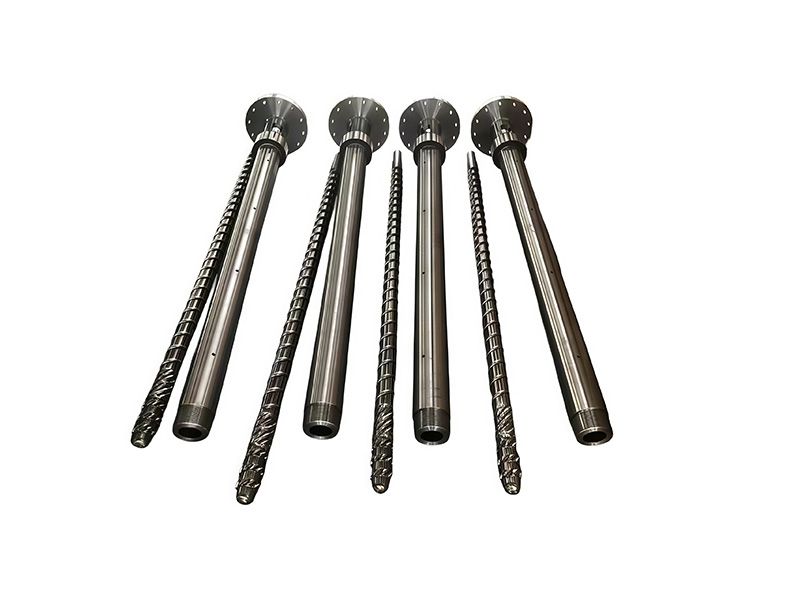
A single-screw extruder conveys solid material along one rotating screw. Barrel heat and mechanical energy melt the resin; the screw then builds a reasonably uniform flow toward the die. Screw geometry, feed design and optional mixing sections determine how well it melts and homogenizes the material. It is more than a simple conveyor.
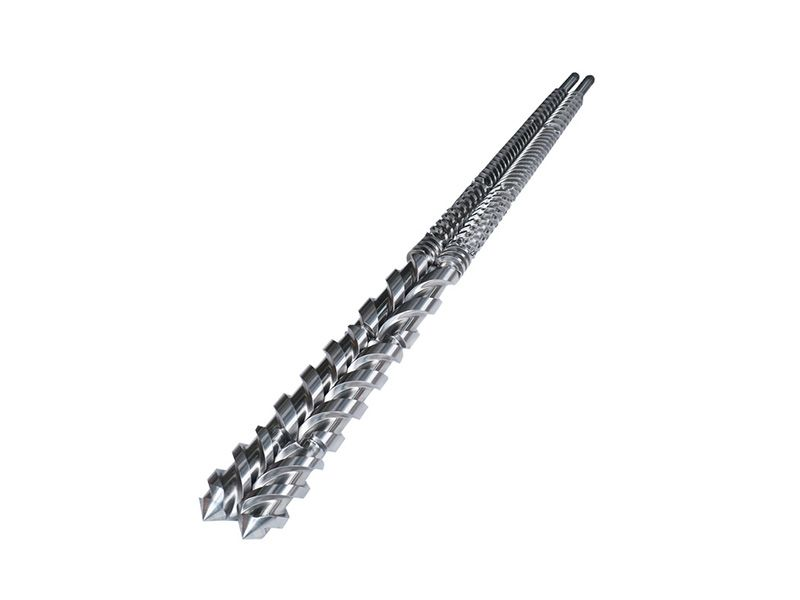
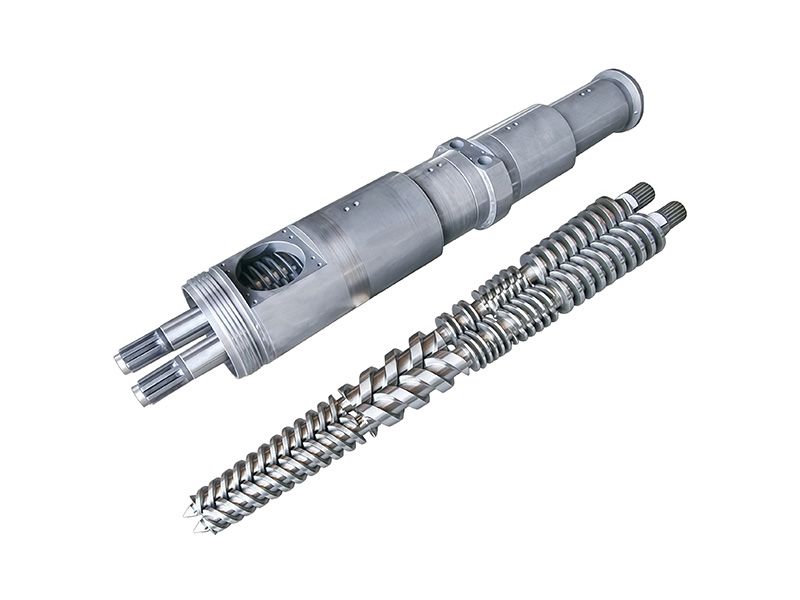
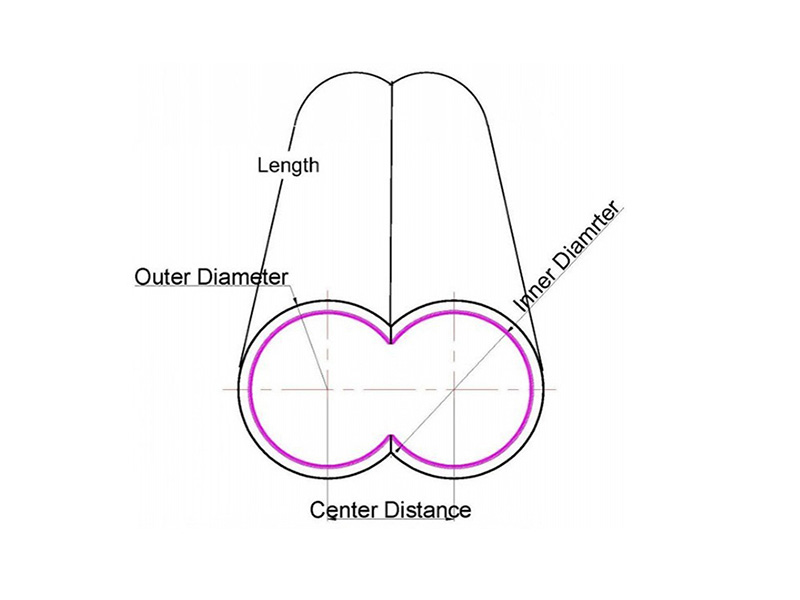
A co-rotating, intermeshing twin-screw extruder uses two screws and configurable conveying and kneading elements. It is widely used to combine polymers with fillers, pigments, glass fiber or additives and can incorporate side feeding and venting. Twin-screw is not one design: counter-rotating machines are also common in rigid PVC pipe and profile processing . This article mainly compares single-screw extrusion with co-rotating twin-screw compounding. The reciprocating screw in an injection-molding machine is a different equipment decision.
Figure 1. Typical process roles of single-screw and twin-screw extruders.
Four Differences That Matter in Production
Mixing and Compounding
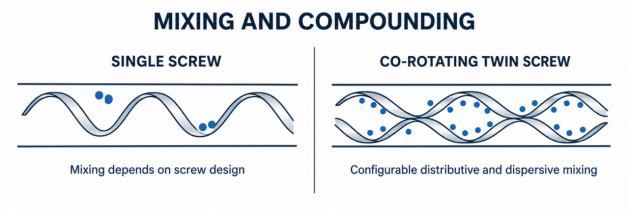
A conventional single screw can melt and blend a prepared formulation, and a purpose-designed mixing section can improve distributive mixing. When the product needs strong, repeatable dispersion of high filler loads, pigments, flame retardants or reinforcing fibers, a co-rotating twin screw offers more ways to tune mixing intensity through its screw-element arrangement. More shear is not always better: excessive shear can damage fibers or a heat-sensitive polymer.
Figure 2. Mixing depends on the screw configuration and material target.
Feeding and Venting
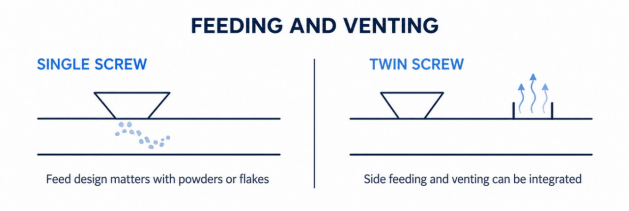
Low-bulk-density flakes, powders and high additive loads can limit intake on either machine. A single-screw line may need a grooved feed section, crammer or other feed-assist equipment. A suitable twin-screw compounding line can add a side feeder downstream and reserve vent sections for moisture or volatile removal. Neither arrangement eliminates the need to test bulk density, feeding stability and vent carryover with the actual material.
Figure 3. Feed and vent options should match material behavior.
Throughput and Energy
A twin-screw line can deliver high output in a well-matched compounding duty, but two screws do not automatically mean higher throughput. High-output single-screw systems are available for pipe and other products. The useful comparison is kilograms per hour at the required quality, melt temperature and operating stability. For energy, compare specific energy consumption in kWh/kg at the same recipe and production target rather than assuming one design is always more efficient.
Capital and Maintenance
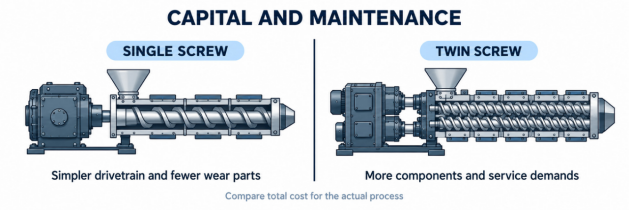
A single-screw extruder generally has a simpler drivetrain and fewer screw components to inspect or replace. A modular twin-screw system adds screw elements, barrel sections, a more complex gearbox and more detailed assembly work. That usually raises initial investment and maintenance demands, but the relevant measure is total cost for the intended process, including yield, uptime, wear, scrap and changeover time.
Figure 4. Include wear parts and service work in the equipment comparison.
How to Choose for Your Application
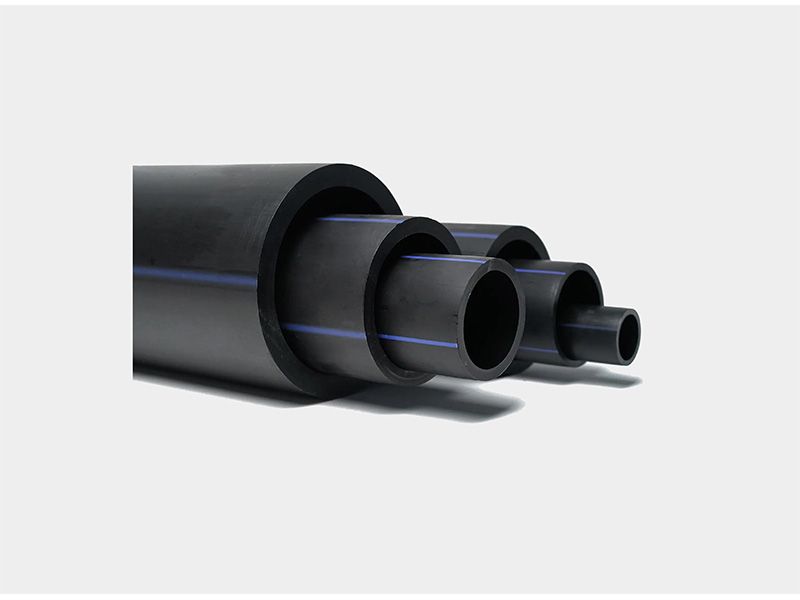
Start with the material and product, then test the proposed equipment against the constraints below. Product names alone do not determine the answer: PE pipe and rigid PVC profile, for example, commonly use different extruder configurations.
| Process need | Likely starting point and check |
| Prepared resin into pipe, film or sheet | Evaluate a single-screw line first. Check melting quality, pressure stability, output and die requirements. |
| High filler, color or fiber loading | Evaluate co-rotating twin-screw compounding. Confirm dispersion, fiber retention and feeding capacity. |
| Rigid PVC pipe or profile | Include counter-rotating twin-screw options. Check PVC fusion, melt temperature and pressure stability. |
| Recycling with light flakes or volatiles | Compare feed-assist and venting solutions on both machine types using the actual recyclate. |
| Tight budget or frequent maintenance | Compare total installed and operating cost, not purchase price alone. |
Before ordering a screw or barrel, record the resin and formulation, target output, product specification, feeding behavior, venting need, acceptable melt temperature and current machine drawing. PIPLL can offer a no-cost initial screw and barrel specification check and point out dimensions or process questions worth verifying before you discuss a replacement.
Technical and Sales Contact
Harry Jiang | PIPLL
WhatsApp +86-18268541152 | Email harry@pipll.com


+86 15267878906

1306 W building , NB-IoT Industrial Park, No. 199 Changxing Road, Jiangbei, Ningbo.
 Languages