 Languages
Screw Barrel Maintenance and Troubleshooting
Screw Barrel Maintenance and Troubleshooting
A practical guide to extending screw barrel life, reducing downtime, and solving common injection molding and extrusion problems.
GET A FREE QUOTE NOW
Key Takeaways
- • Screw barrel wear is normal. What is not normal is black specks, uneven plasticization, output drop, noise, or rapid wear within a short period. These are signals, not "old age".
- • Nine out of ten field problems trace back to one of four causes: wrong material selection, wrong process settings, wrong maintenance, or contamination. The fix is in finding the right one of the four.
- • A written preventive maintenance schedule (daily / weekly / monthly / quarterly / annual) catches most problems before they cause unplanned downtime.
- • Measurement, not guesswork, drives the repair-or-replace decision. The three numbers that matter are screw OD, barrel ID, and the clearance derived from them.
- • Operator training on preheating, purging, and shutdown is the single cheapest way to extend screw barrel life.
1. Symptom → Cause → Action Matrix
The fastest way to start a diagnosis is to read the symptom, find the most likely cause, and take the cheapest verification step before changing parts. The table below covers the most common shop-floor symptoms.
Symptom Likely causes First check (lowest cost) What to do next Output drop Screw-barrel wear, check-ring leakage, insufficient heating, feed problem Measure screw OD and barrel ID, check heater indicators Calculate clearance, inspect check ring, verify temperature profile, then check feed throat Black specks / yellow streaks Material stagnation, dead corners, overheating, poor purging Inspect mixing section, check barrel inner wall Improve purging compound and procedure, reduce temperature, clean or replace screw if needed Uneven plasticization Worn mixing elements, wrong compression ratio, unstable back pressure Check back-pressure and screw-speed trend over last 50 cycles Re-evaluate screw design for the resin, stabilise back pressure Noise / current fluctuation Misalignment, material shortage, foreign object, bearing issue Visual inspection of hopper and screw, listen at start-up Check alignment, screen for contamination, inspect drive system Leakage / unstable injection Worn check ring, worn barrel, poor nozzle fit Measure check ring and seat dimensions Replace check ring first, then re-measure barrel ID Screw breakage Excessive torque, jammed foreign object, fatigue Inspect broken face for origin point Audit material contamination and process settings, confirm screw material is appropriate Surging / pulsating Feed instability, worn Check material flow Measure screw wear, output output screw, temperature fluctuation and heater-band performance stabilise back pressure, install gravimetric feeder if needed Nozzle drool / stringing Temperature too high, worn nozzle, incorrect tip Check nozzle temperature and tip condition Lower nozzle temperature, inspect tip, replace nozzle if worn 2. Root Causes of Wear and Corrosion
The table below maps each root cause to the damage pattern it produces and the upstream control that limits it.
Root Cause Damage pattern Upstream control Abrasives (fillers, glass, carbon) Sandpaper-like scoring on barrel bore and screw flight Material and surface treatment selection, lubrication Corrosive gas (PVC , halogenated flame retardants) Pitting and rust on the barrel surface, screw corrosion Nickel-based alloy barrel and screw, tighter temperature control High-temperature oxidation Nitride layer cracking and flaking Stay within resin recommended processing window Dry run (no material) Local overheating, accelerated wear Operator discipline, automatic material-low shutdown Cold starts, misalignment High torque on screw barrel and drive coupled screw Preheat and soak procedure before start-up Misalignment One-sided screw rub, uneven wear, noise Alignment check at installation, periodic verification Improper purging and shutdown Carbonised residue, black specks Purging compound selection, purging procedure Contamination (metal, sand) Scratches on the bore, chipped flights Magnetic traps, sieves, controlled material handling Excessive back pressure or screw speed Shear overheating, material degradation Process recipe audit, melt-temperature verification 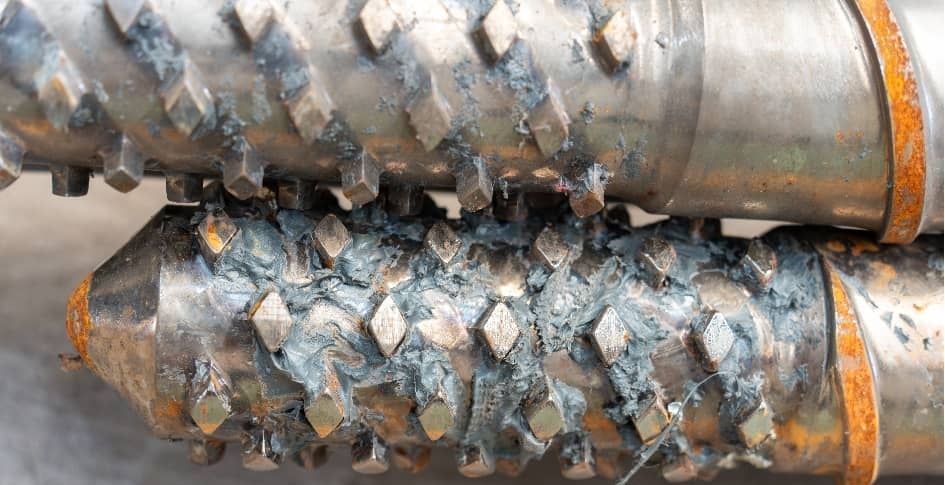
3. Screw-Barrel Clearance Tolerance Reference
3.A — Screw-barrel clearance tolerance reference (general-purpose)
Clearance is the single most important measurement on a screw–barrel pair. Excessive clearance causes output loss, unstable back pressure, surging, black specks, and uneven plasticization. For a general-purpose twin screw barrel , the recommended screw–barrel clearance and replacement triggers are:
- Screw OD 30–50 mm — target clearance 0.08–0.15 mm; replacement trigger > 0.30 mm.
- Screw OD 30–60 mm — target clearance 0.10–0.20 mm; replacement trigger > 0.40 mm.
- Screw OD 60–100 mm — target clearance 0.15–0.25 mm; replacement trigger > 0.50 mm.
- Screw OD 100–150 mm — target clearance 0.20–0.30 mm; replacement trigger > 0.60 mm.
- Screw OD > 150 mm — target clearance 0.25–0.40 mm; replacement trigger > 0.80 mm.
For abrasive duty (glass-filled, mineral-filled, high-filler compounds) tighten the target by about 30% and bring the replacement window in earlier. For corrosive duty (flame-retardant grades, PVC , halogenated compounds) tighten on the upper limit and watch for pitting, not just clearance. For non-abrasive, non-corrosive duty (PE, PP, general-purpose PS) the standard range is fine.
A reliable screw barrel manufacturer will always publish this kind of tolerance band with the shipment, and the better ones — industrial screw barrel exporters worth working with — will measure your specific screw and barrel on receipt and confirm the numbers before first start-up.
PIPLL comment: As one of the industrial screw barrel exporters serving global compounding customers, PIPLL provides a clearance reference card with every shipment, labelled to the specific resin duty. That's a small but useful reason top exporters invest in pre-shipment measurement — a one-number disagreement on first start-up can cost a compounding line a full shift.
4. Wear Pattern Atlas
Different failures leave different marks. Use the table below to read what the screw or barrel is telling you before you disassemble.
Pattern observed Where it appears Most likely cause Confirm by Longitudinal scoring in the bore Compression and metering zone Abrasive filler (glass, mineral) Check filler content in resin datasheet One-sided wear on screw flights Specific flight faces Misalignment Dial indicator check, alignment test Pitting on the bore, rust on the screw Feed to front end Corrosion from PVC or halogenated additives Measure pH of condensate, switch to nickel alloy Cracked or flaking nitride layer Anywhere High-temperature oxidation / over-temperature Hardness traverse on a coupon Step wear at metering zone end Screw flights Abrasive wear by excessive back pressure Confirm screw barrel was metering and OD Wear at the check ring seat Front of screw and barrel seat High cycle count on injection molding Measure check ring OD and seat ID Black or carbon buildup Mixing section, dead corners Material degradation, poor purging Borescope, then purge test Thread chip or impact damage Anywhere Foreign object contamination Magnetic trap check, hopper inspection 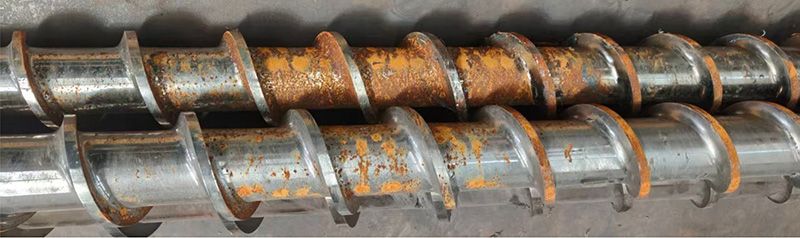
5. Common Misdiagnoses
Many service calls are wrong by the time they reach the maintenance team. The list below pairs look-alike symptoms with the actual cause, and the single check that distinguishes them.
5.A — How to read a misdiagnosis before it costs you a week
A wrong diagnosis is usually more expensive than a part fault, because it sends the team to fix the misdiagnoses in compounding and extrusion lines:
- Black specks blamed on resin contamination, when the real cause is a worn mixing section or check ring scratching the barrel wall.
- Output drop blamed on resin variability, when the cause is screw-barrel clearance that has grown past tolerance.
- Rapid wear blamed on the screw barrel supplier, when the cause is surging from a cold start, or process drift.
- Surging blamed on the screw, when the feed throat is the actual bottleneck.
- Nozzle drool blamed on temperature, when the check ring seal has worn and is bypassing.
A reliable screw barrel manufacturer will treat these like a checklist on the first call. In PIPLL investigation, PIPLL diagnostic flow starts with three measurements — screw OD, barrel ID, and clearance for each worn sample — before any recommendations and made.
If your line has been "diagnosed" three times in the last six months without resolution, the problem is likely measurement, not material.
6. Daily Operation Best Practices
The cheapest improvement in screw barrel life comes from how the line is operated every day. None of the items below cost anything to adopt; together they prevent most of the failures we see in the field.
- Preheat properly. Follow the resin supplier’s recommended temperature profile
- Avoids long dry running. Do not let the screw spin without material for extended periods.
- Keep the barrel packed. Select appropriate output compatible with the resin and machine.
- Protect during stops. Remove aggressive or heat-sensitive material, if possible, remove the screw for cleaning and storage.
- Check heaters, thermocouples. A failed heater, incorrect, and thermocouple can create hot spots.
- maintenance history. Keep log files of target temperatures, output, and PIPLL. compound, for troubleshooting.
PIPLL caution: for compounding customers, the loss of a single shift to premature wear costs more than ten years’ worth of preventive purging compound.
7. Preventive Maintenance Schedule
7.A — Preventive maintenance schedule for a bimetallic twin screw barrel
The cadence depends on your resin, filler content, production hours and machine class. As a baseline, an experienced screw barrel manufacturer typically recommends the following rhythm for a twin screw barrel:
- Daily — Check temperatures, heater function, motor current, output stability, and purging.
- Weekly — Inspect the feed throat, check the purge procedure, check the nozzle condition, verify adapters and bolts.
- Monthly — Measure output stability, check screw speed and back pressure.
- Quarterly — check the check ring, nozzle, and heater bands, re-check coupling alignment / can be variant.
- Annually (or by condition) — Pull the screw, measure screw OD and barrel ID, inspect bores, check flights, check for pitting and cracking liner, evaluate wear.
If annual measurement shows clearance near the upper limit for the resin, plan a full rebuild during the next scheduled outage. A five-year screw barrel plan will often help prevent the emergencies. — a five-year data record on preventive fill, data input on the barrel liner. PIPLL field practice: As one of the screw barrel exporters serving long compounding customers in Southeast Asia and Latin America, PIPLL difference — maintenance of a screw barrel in sustainable service and reducing downtime, and saving you and a machine replacement.
8. Inspection and Measurement
When performance drops, a systematic inspection is necessary. The three numbers that matter most are screw OD, barrel ID, and the clearance derived from them.
8.1 Screw inspection
- Measure screw outer diameter at multiple points.
- Inspect flight for scratches, chipping, cracks.
- Check for straightness, galling, pits, and corrosion.
- Measure hardness and nitriding depth if possible.
8.2 Barrel inspection
- Measure inner diameter at multiple positions, check tapers.
- Check borescope for scratching, pitting and any wear bands.
- Check flanges and threads for corrosion, cracks, damage.
8.3 Clearance Check
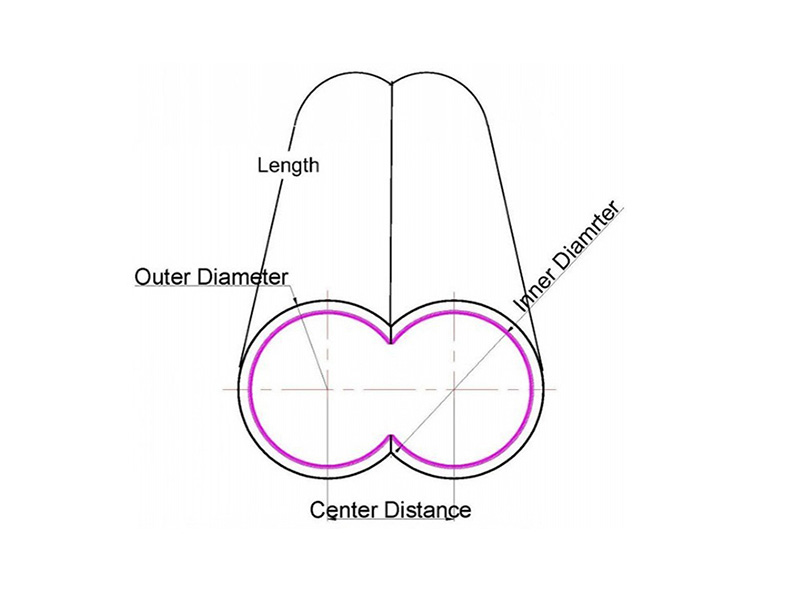
Screw-barrel clearance is one of the most important measurements. Excessive clearance causes output loss. See Screw friction, material backflow, and increased pressure drop. Screw barrel clearance and material by backflow.
8.4 Check Ring and Nozzle
For injection molding the check ring, seat, and nozzle are common wear points. A worn check ring causes inconsistent shot size, leakage, and output drop.
9. Spare Parts and Tooling Checklist
Plan inspections. The list below covers the items most often needed before maintenance. The largest replacements lead to the shortest production downtime.
Keep at least one major critical spare set — plus spare check rings and nozzle tips, typically 3–6 months of continuous duty use. A single emergency every year can eat the barrel and a full set of check rings used in spare. A spare complete twin screw barrel and full set of barrel, PIPLL kits per cone. As enables within every replaced screw barrel so the line can be restored to specification in a single shutdown.
10. A — How to decide: repair the existing screw barrel or replace it
Not every worn bimetallic screw barrel replacement. The decision is driven by service application, cost, remaining life and machine condition.
- Repair makes sense when wear is moderate and uniform, and the barrel liner (diameter is still inside tolerance, the screw can be remachined, welded, or sprayed composite coating. Good for extrusion, and the duty is not highly abrasive.
- Replacement is the better path when the barrel liner is severely worn or corroded, nitriding has large areas flaked off, the screw has bent, cracked or broken, no longer gives stable production.
A cost analysis should include not only the repair price but also downtime, scrap rate, energy consumption, and the risk of a second failure inside the same quarter.
10. B — Six levers that extend bimetallic twin screw barrel life
The cheapest life extension almost never comes from a new machine. It comes from six operational levers a reliable screw barrel manufacturer will tell you about on day one:
- Match material to resin — Standard nitrided steel is rarely enough for glass-filled, corrosive, or high-filler resins. A bimetallic twin screw barrel with the right alloy layer pays back fastest in abrasive duty.
- Use the right surface treatment — Tungsten carbide coatings, nickel-based alloys, PM HSS, and full bimetallic liners each unlock a different price/performance envelope.
- Stabilise the process — Excessive temperature, screw speed, and back pressure are silent killers. A stable process is also a quieter process.
- Filter and control contamination — Screens, magnets, and clean material handling eliminate the most violent damage mode (chips and scratches).
- Keep the feed consistent — Bridging and surging show up as torque spikes that wear the flight flanks asymmetrically.
- Train operators — Cold starts, dry running, improper purging, and emergency shutdowns cause a large share of catastrophic losses.
PIPLL perspective: As a custom screw barrel exporter working with customers in 30+ countries, PIPLL treats material selection, bimetallic alloy choice, and process training as a single package — that's why top exporters of screw barrels publish this kind of guidance rather than hiding it.
10.C — First-Instructions for the six most common screw barrel failures
When a production line calls with a complaint, most field tickets fall into one of six problem families. These are the first-line actions a good screw barrel manufacturer will reach for first:
- Black specks — Reduce temperature by 5–10 °C, improve purging compound, inspect mixing section and barrel wall, replace worn check ring, clean or replace screw if needed.
- Output drop — Measure screw–barrel clearance, inspect check ring, check feed throat for bridging, verify temperature profile, adjust back pressure if appropriate.
- Rapid wear — Upgrade screw barrel material, check alignment, improve start-up and shutdown procedures, eliminate unnecessary dry running.
- Surging or pulsating output — Check material flow, verify heater zones, measure screw wear, stabilise back pressure.
- Nozzle drool or leakage — Lower nozzle temperature, inspect nozzle and tip, replace worn check ring or nozzle.
- Screw breakage — Audit material contamination and process settings, confirm screw material matches the resin.
If the same fault returns within weeks of the repair, the cause is usually upstream — contamination, wrong material grade, or a process that the current screw barrel was never designed for.
PIPLL support note: As an experienced screw barrel manufacturer working with bimetallic and twin screw barrel designs, PIPLL routinely helps customers triage these six faults through video inspection, wear-mark analysis, and replacement specification. Reach out at www.pipll.com with photos and process data to shorten the diagnosis loop.