 Languages
How Long Does a Screw Barrel Last, and When Should It Be Replaced?
How Long Does a Screw Barrel Last, and When Should It Be Replaced?
A practical guide to service-life ranges, the warning signs you can see before you measure anything, and the repair-versus-replace decision.
SCREW BARREL SERVICE LIFE · WEAR INSPECTION · BARREL REPLACEMENT · EXTRUSION MAINTENANCE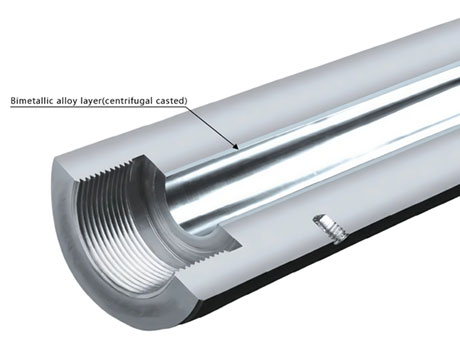
Cross-section of a bimetallic barrel
a centrifugally cast alloy liner inside a forged steel shell
A screw barrel is a consumable — plan for it
A screw and barrel wears out. No screw barrel outlasts the machine it sits in. So the useful questions are not whether replacement will be needed, but when, how to plan it, and how to detect wear before it becomes a production crisis.
Typical replacement interval: two to seven years, driven by what you process, how the line is built and how it is operated.
The cost is rarely just the part. On a multi-shift line, lost output, expedited logistics and overtime installation usually exceed the procurement cost of the barrel.
A planned schedule set at installation is the single most effective way to lower lifecycle cost.The four factors that set service life
Material processed. Clean unfilled polymer is gentle on steel. Glass fibre is sandpaper. Calcium carbonate is medium-grade sandpaper. Wood powder, stone powder and post-consumer recyclate are the harshest. The same line on different recipes can deliver completely different service lives.
Construction of the screw and barrel. A nitrided barrel is right for light duty and fails early on heavy duty. Bimetallic construction — a thick wear-resistant alloy layer inside a tough steel body — exists for exactly this reason.
Temperature and screw speed. Higher temperature and higher speed accelerate wear. So does running too cold, because the screw has to push harder. Every line has a stable operating envelope, and finding it adds years of service.
Operating discipline. Cold starts, dry running, improper purging and unplanned shutdowns are the silent killers of barrel life. The habits that prevent them are in Section 7.KEY INSIGHT Material and construction set the budget of available service life. Operating envelope and maintenance discipline determine how fast that budget is spent. A premium bimetallic build run carelessly can be exhausted in two years; a modest nitrided build run well can deliver six.
Typical service life, by duty and construction
Duty Nitrided barrel Bimetallic barrel Unfilled polymer 5–8 years, often longer on a well-run line Not usually required Moderately filled compounds (calcium carbonate, talc) 3–5 years 6–8 years Heavily filled / glass-fibre compounds 2–3 years 5–7 years Post-consumer recycled feedstock with contamination 1–3 years 3–5 years WPC decking and SPC flooring (≥50% filler) 12–18 months 3–5 years Every line is different, but the order of magnitude is well established. A line replacing its screw barrel every twelve months has an underlying problem — wrong material specification, wrong screw design, wrong operating habit, or a quality issue on the part itself. The extruder screw barrel replacement guide works through the usual suspects.
Highly filled systems deserve separate mention. WPC decking and SPC flooring carry filler loadings of 50% or more — often calcium carbonate, talc or wood fibre — and they wear hardware correspondingly fast. The high-filling polymer conical twin screw barrel page documents the configuration PIPLL specifies for this duty, alongside the WPC and SPC application pages.
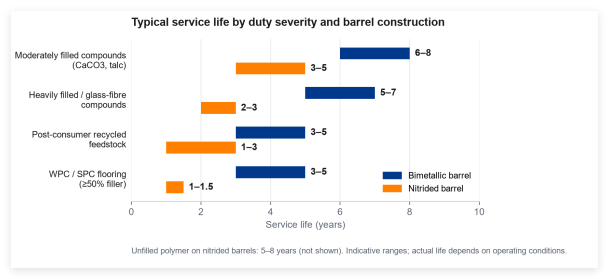 Typical service life by duty severity and barrel construction (indicative ranges)
Six warning signs you can see before you measure anything
Wear is detectable without instruments. Long before dimensions drift out of tolerance, the line tells you something has changed.
- Output declines slowly. Temperatures and screw speed unchanged, yet output is 5–10% below baseline. Increased backflow through widened clearances is the usual cause.
- Zone temperatures drift up. Operators compensate for falling output by raising setpoints — a sign the screw and barrel are no longer a matched pair.
- Melt instability or surging. Output pulses, or the extrudate surface turns wavy, streaky or rough. Worn screws and excessive clearance are typical causes; see why extrusion output goes up and down for the other suspects.
- Black specks appear. Carbonized material held in the dead corners of a worn screw or in bore scratches. Purging will not clear it — the part is worn.
- Motor current rises. The drive works harder to push material through widened clearances. Visible on the control-panel trend.
- Purge frequency increases. If the line is purged twice as often as six months ago, the surfaces are degrading and retaining burnt material.
Add data trending to that list. When a line runs consistently, zone temperatures, motor current and output form a baseline any competent operator can read at a glance. A 5% drift sustained over weeks is a leading indicator, and it appears before any single measurement crosses a threshold. A simple trend log is the highest-value monitoring practice available to a production team.
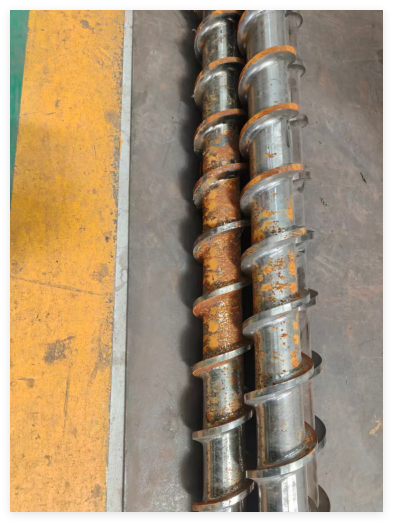 Advanced wear and corrosion on screws retired from service — the end state of warning signs that appear months earlier
How wear is actually measured
When warning signs accumulate, measurement is the next step. Three numbers matter:
- Screw outer diameter at several points along the length. A standard micrometer is enough; results are compared with the original drawing or a known-good reference.
- Barrel inner diameter at several positions, using an internal micrometer or bore gauge.
- Clearance between the two, calculated from the first two values. This is the single most important wear indicator on the assembly.
The check extruder screw wear without teardown procedure is written for operators who need a measured value without pulling the screw. Once the numbers are in hand, compare the measured clearance with the resin-specific wear limit published by the manufacturer. The bimetallic screw barrel guide publishes typical wear limits by resin family, with the recommended action at each threshold:
Clearance vs wear limit Recommended action Below 60% Plan the next replacement for the following scheduled shutdown 60–80% Procure a replacement within the current quarter Above 80% Treat replacement as urgent Take baseline measurements on a known-good screw-barrel pair immediately after installation. The rate at which clearance changes over time is more informative than any single absolute reading, and operators who keep a clearance trend log typically spot an impending replacement weeks or months before one measurement crosses the published limit.
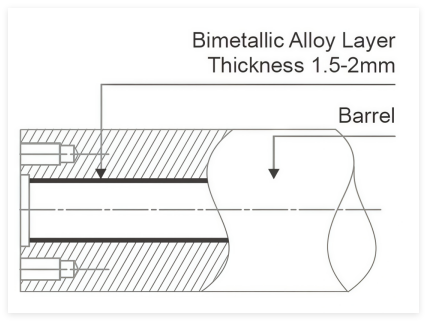 Bimetallic alloy layer, typically 1.5–2 mm inside the barrel bore: thickness and hardness are specified at order and verified at inspection.
Repair or replace? Not every worn barrel needs full replacement.
Three questions settle it.
- Is the wear uniform or localized? Uniform wear on a bimetallic barrel can sometimes be re-honed and returned to service for another year. A deep gouge or a corroded patch generally means replacement.
- Is the screw worn too? Replacing one component without the other is rarely cost-effective: a new barrel paired with a worn screw repeats the wear-in period at full intensity. The bimetallic screw barrel guide covers the matching logic.
- What does unplanned downtime cost? On a three-shift operation, the downtime cost of an emergency replacement usually exceeds any saving from extracting extra months from a worn part.
Where wear is light, a planned shutdown is close and the rest of the line is sound, repair is appropriate. Where wear is significant, or the assembly has already been through several overhauls, replace it. The full decision logic is set out in the extruder screw barrel replacement guide .
Replace as a matched pair. Over a five-year horizon the pair approach is consistently more cost-effective, because it eliminates the asymmetric wear-in that comes from pairing a new component with a worn one — and it simplifies logistics and reduces the number of planned shutdowns required.
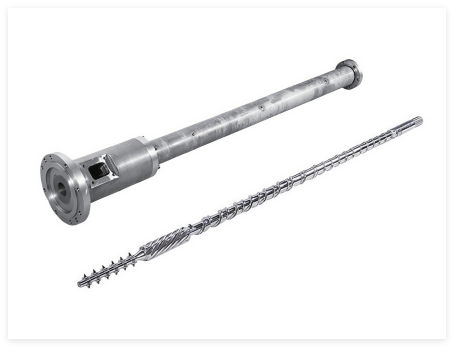 Screw and barrel as a matched pair: asymmetric wear-in is the hidden cost of replacing only one half
Five habits that measurably extend service life
- Preheat to specification. Follow the resin supplier's temperature profile and hold the prescribed soak time before starting the screw. Cold starts with material already in the barrel cause the most common form of damage.
- Never run the screw empty. Material between screw and barrel acts as a hydrodynamic medium and as thermal protection. A few minutes of dry running scores the surface. An empty hopper is an emergency, not a waiting state.
- Use a purge compatible with the resin in service. An incompatible purge burns; a compatible one cleans. Purge before shutdown, especially with heat-sensitive or corrosive grades. Leaving corrosive resin in the barrel between batches is one of the fastest routes to corrosion-driven wear.
- Keep a maintenance log. Resin grade, filler percentage, zone temperatures, output, motor current and downtime. A simple record makes slow drift visible long before it becomes a crisis — ask for the PIPLL maintenance log template .
Underpinning all five is operator training. An experienced team that understands the relationship between operating parameters and component life delivers substantially longer service intervals than the same line run by a less experienced team, at identical machine settings. Reduced replacement frequency, lower scrap rates and fewer unplanned stoppages make it the highest-leverage operational intervention available to a production manager.
Why proactive replacement is cheaper
A scheduled replacement in a planned maintenance window is typically a half-day job. An emergency replacement on a line that is down is a multi-day job plus lost output. Once clearance approaches the upper limit for the resin in service, schedule the replacement for the next planned shutdown rather than waiting for failure — the extruder screw barrel replacement guide sets out the cost arithmetic.
Where downtime is expensive, hold a spare screw and barrel set on site. The carrying cost is recovered the first time it avoids a multi-day unplanned shutdown. Procure the spare at the time of the planned replacement so that it is dimensionally and metallurgically matched to the current configuration, and make sure its documentation matches the in-service assembly so the maintenance team can verify fit before installation.
 PIPLL production site — high-performance screws and barrels for global extrusion lines.
Frequently asked questions
Output is dropping — is it always the screw and barrel?Not necessarily. Check-ring wear, heater-band failure and feed-throat bridging are common mimics. See why extrusion output goes up and down .
Can a bimetallic barrel be re-lined?In principle yes; in practice it is rarely cost-effective. Most operations replace the complete barrel and recycle the steel substrate.
Does higher throughput accelerate wear?Yes, but not linearly. Temperature, contamination and dry running are more significant accelerators. A well-run fast line outlasts a poorly-run slow one.
How do I identify a trustworthy supplier?Start with a factory-direct twin screw barrel manufacturer that documents materials, dimensions and inspection in writing. See the process documentation and the custom screw barrel project walkthrough .
What documentation should a replacement barrel ship with?A material (mill) certificate, a dimensional inspection report covering screw diameter, barrel bore diameter and calculated clearance, a hardness report for any wear-resistant lining, and a bonding-strength test result for bimetallic liners. The custom screw barrel project walkthrough shows the package PIPLL ships as standard.
Is planned replacement downtime really different?Yes. A planned replacement in a shutdown window is a four-to-eight-hour operation; an emergency replacement is a multi-day operation involving diagnosis, expedited procurement and overtime installation. In most plants that differential is the strongest financial argument for scheduling.
The short version
- A screw barrel lasts somewhere between eighteen months and eight years.
- Four factors decide where you land: material, construction, operating envelope and maintenance discipline. All four are controllable.
- Watch the six warning signs, and measure screw and barrel diameter once or twice a year.
- Replace proactively when clearance approaches the limit — and replace as a matched pair.
- Follow the five operating habits. They matter more than the upgrade you buy.
A screw barrel is a depreciating asset. Informed operation extends its life materially, and planning removes the cost of unplanned failure. Neither requires specialist knowledge — only an understanding of the factors at work and a disciplined approach to logging. For a quotation on a planned replacement, send the part numbers and a small set of photographs to the engineering team.
Need help with a replacement project?
PIPLL manufactures replacement screw and barrel assemblies for extrusion and recycling lines, and reviews OEM drawings, worn-part measurements and operating conditions to recommend the right metallurgy, flight geometry and wear protection.
- Replacement screw and barrel assemblies matched to OEM fit
- Bimetallic barrels and through-hardened screws for abrasive and high-filler duty
- Wear inspection procedure and wear limits by resin family
- Maintenance log template, supplied with every quotation on request
- Material certificate and dimensional inspection report with every shipment