Barrier Screw vs Conventional Screw: When Does Your Extruder Need a Barrier Screw?
A conventional single-flight screw can run many polymers successfully. So why do some high-output extrusion lines use a barrier screw instead?
The answer is not that a barrier screw is automatically "better." It is that separating solids from melt during the melting stage can give the screw designer more control over melting rate, melt temperature, homogenization and output stability in the right application.
For buyers replacing or upgrading an extrusion screw, the practical question is: when does a barrier screw solve a real processing problem — and when is a conventional screw still the smarter choice?
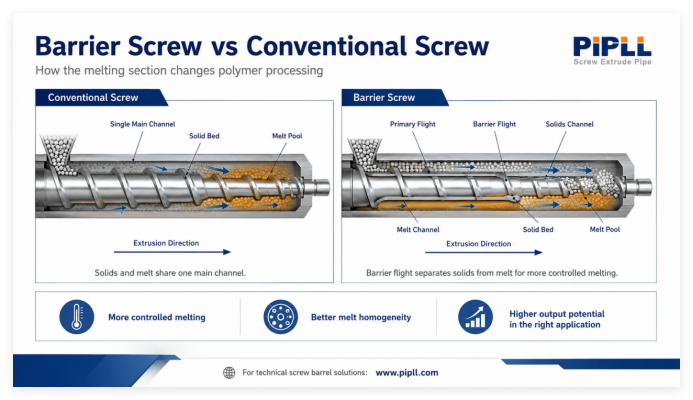
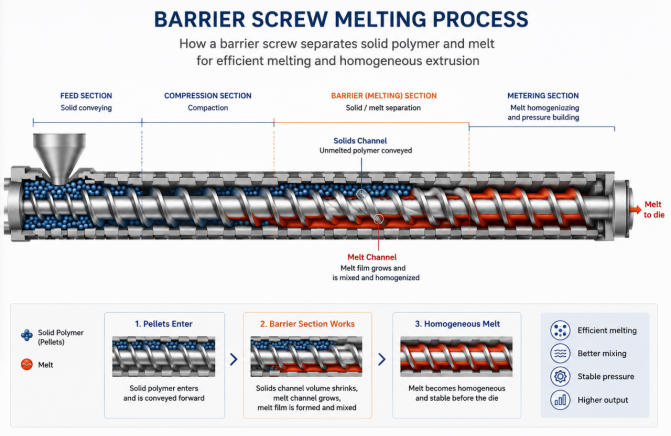
A barrier screw adds a secondary flight in part of the melting section. The geometry creates separate paths for unmelted solids and molten polymer. As the material progresses, melt can cross the barrier flight while larger solid particles remain in the solids channel until melting is completed.
This differs from a conventional screw (single-flight screw), where solids and melt occupy the same main channel throughout the melting process.
Controlled melting — not simply more shear.
By separating melt from unmelted solids, a barrier design can reduce the chance that already-molten polymer is repeatedly exposed to the same high-shear melting environment. This can help control melt temperature while allowing the remaining solids to continue melting.
A barrier section is often combined with a downstream mixing element. The barrier section manages melting; the mixer then improves thermal and compositional uniformity before the melt reaches the die.
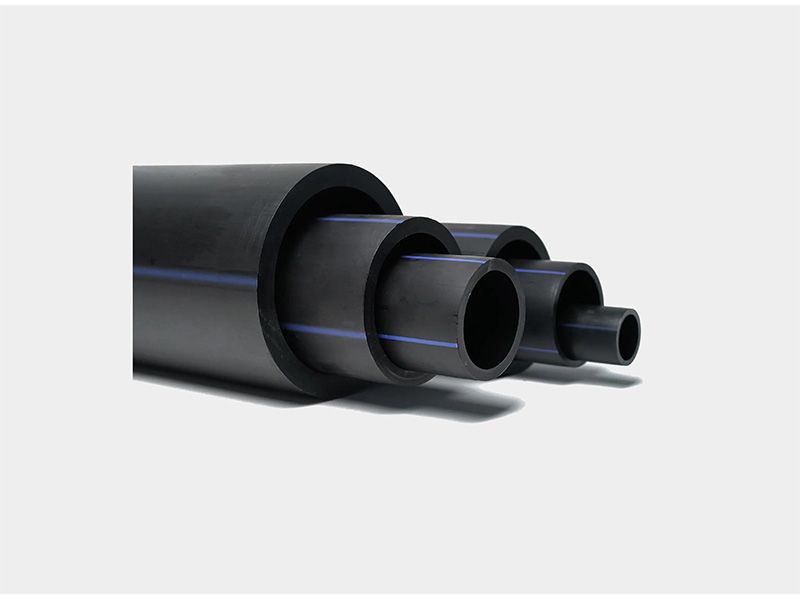
For polyolefin pipe, blown film, sheet and other demanding single-screw applications, a well-matched barrier screw can support higher throughput without relying only on higher screw speed or aggressive shear.
When melting becomes more predictable, pressure, melt temperature and output can also become easier to control. This is especially valuable where downstream product quality is sensitive to melt consistency.
| Design Factor | Conventional Screw | Barrier Screw |
|---|---|---|
| Melting concept | Single main channel | Separate solids and melt channels in barrier section |
| Material flexibility | Often broader and simpler | More application-specific |
| Melt control | Depends strongly on transition geometry | More controlled solid-to-melt separation |
| Mixing | Basic or separate mixer | Often paired with dedicated mixing element |
| High-output potential | Good when correctly designed | Can be advantageous in demanding high-output applications |
| Sensitivity to wrong design | Moderate | High — barrier clearance and geometry must match resin and process |
| Best use | General-purpose or stable known applications | When melting, output or melt-temperature control requires a more engineered solution |
A special screw design only works when the rest of the extrusion system can use the additional melting and conveying capability.
A barrier screw is primarily a melting-control device. It should not be treated as a substitute for every type of mixing.
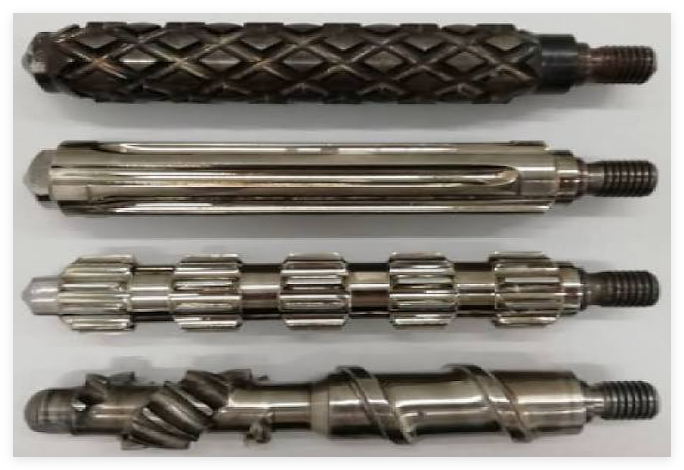
Depending on the product, PIPLL may combine a barrier section with a Maddock-type, pineapple or other mixing geometry. The correct choice depends on whether the process needs more distributive mixing, dispersive mixing, thermal homogenization, or a combination of these.
More mixing is not always better. Excessive shear can increase melt temperature, degrade sensitive polymers and consume unnecessary energy.
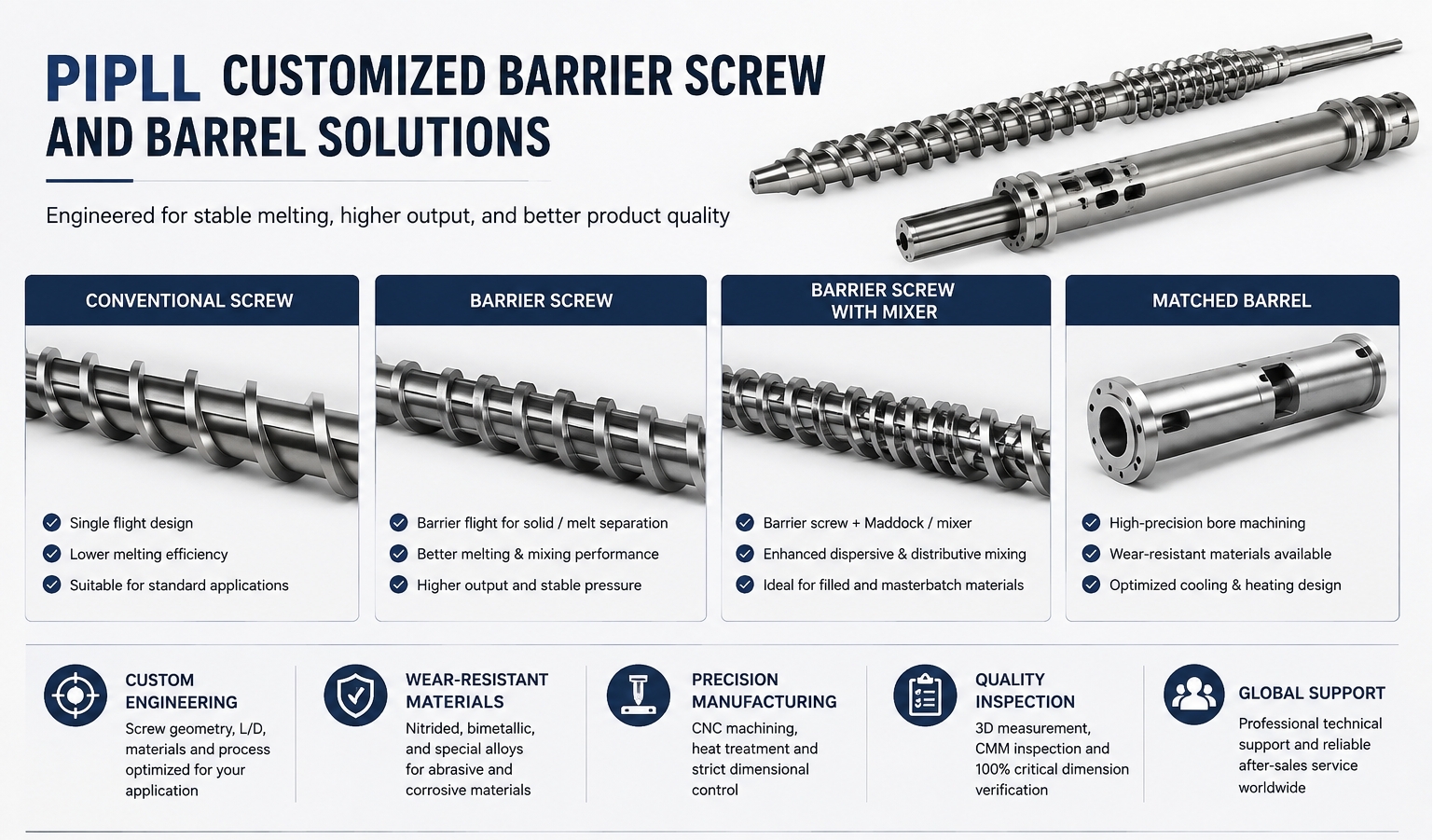
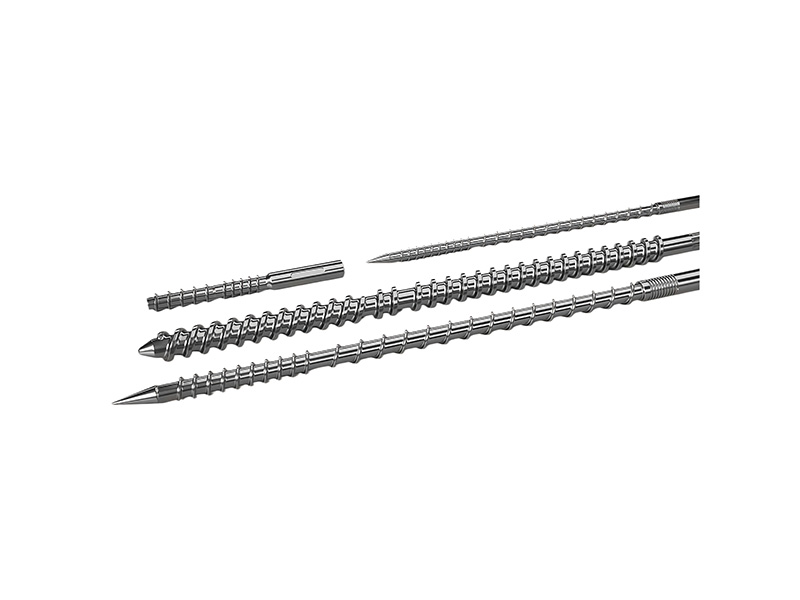
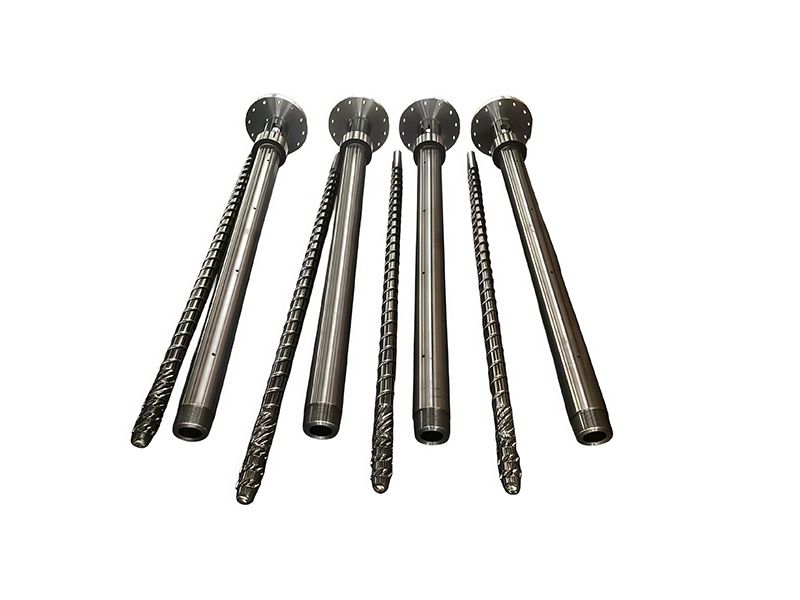
PIPLL develops replacement and customized single-screw assemblies for extrusion applications including pipe, blown film, sheet, profile and extrusion blow molding.
The objective is not to sell the most complex screw. It is to select the simplest geometry that can reliably deliver the required melting, output, temperature control and product quality.
A barrier screw can be a valuable upgrade when melting capacity, melt temperature or homogenization limits a high-output extrusion process. But it is not a universal replacement for a conventional screw.
The correct decision depends on polymer, feed system, screw diameter, L/D ratio, throughput, screw speed, melt temperature, pressure and downstream requirements.
Before copying another screw design, identify the actual bottleneck. A well-matched conventional screw can outperform a poorly matched barrier screw — while a correctly engineered barrier screw can unlock a process that has reached the limit of conventional melting.
Need help with a screw or barrel project? Send your extruder model, material, output target, drawing, or current production problem for an initial technical evaluation.


+86 15267878906

1306 W building , NB-IoT Industrial Park, No. 199 Changxing Road, Jiangbei, Ningbo.
 Languages
