Dispersive vs Distributive Mixing in Twin Screw Extrusion
A color streak and a dark speck can look like the same mixing problem on a pellet line. Under magnification, they may tell two different stories. If large pigment clusters remain, you may need more effective breakup. If fine pigment is concentrated on one side, you may need better redistribution. That distinction is the starting point for dispersive vs distributive mixing in co-rotating twin screw compounding.
What Each Kind of Mixing Changes
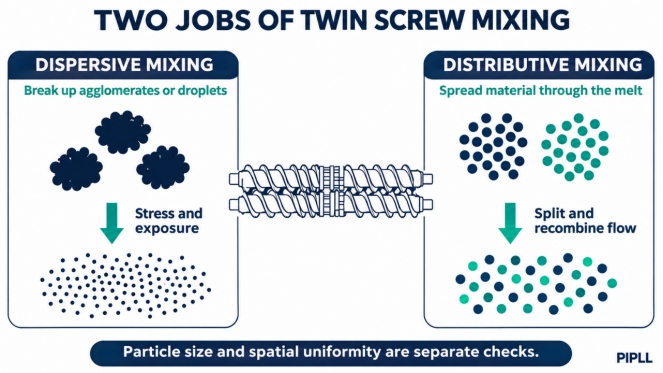
Dispersive mixing reduces the size of agglomerates or droplets. Think of a lump of brown sugar in dough. You must apply enough force to break it down. In a polymer melt, shear and extensional stresses can break up pigment or filler agglomerates. In an immiscible polymer blend they can deform and break up droplets, with interfacial tension and coalescence also affecting the final morphology.
Distributive mixing changes where the ingredients end up. Think of sesame seeds spread through dough by folding. Their positions change while the seeds stay roughly the same size. In an extruder, repeated splitting, stretching and recombining of melt streams can reduce concentration differences across the material.
Figure 1. Dispersive mixing changes particle or droplet size. Distributive mixing changes spatial uniformity.
One element can contribute to both jobs. Evaluate agglomerate size and spatial uniformity separately when comparing screw layouts. Particle tracking study of twin screw mixing elements .
How the Screw Elements Change Stress and Flow
Use Kneading Blocks to Get the Required Breakup
A kneading block for a twin screw extruder changes the path the melt takes around the disks and through the intermeshing region. Wider disks often favor dispersive action. Stagger angle and conveying direction influence how the material advances and how full the zone becomes. A 45 degree kneading block can behave very differently from another 45 degree block with wider disks or a different arrangement of neighboring elements.
A neutral or reverse conveying element can increase upstream fill and change pressure and exposure time. It may help when a zone needs more breakup. It can also increase torque, melt temperature and the time material spends in the zone. Review disk width, angle, handedness and sequence together before adding restriction. Coperion twin screw compounding fundamentals .
Use Flow Rearrangement to Improve Distribution
Narrower disk blocks and selected slotted or toothed elements can split and recombine material effectively. The best fit depends on the actual geometry, fill and throughput. Two profiles that look similar on a parts list can differ in conveying and pressure generation, so compare the drawings and the operating window. PIPLL guide to conveying elements and kneading blocks .
Account for Heat and Fiber Length
Dispersive mixing usually requires higher local stress. Viscous dissipation can heat the melt. Distributive mixing can often use lower peak stress, although a restrictive element or a highly filled zone can still consume power and generate heat. Compare actual melt temperature and drive load at the same output. To compare specific mechanical energy in extrusion, divide screw shaft power in kW by mass throughput in kg/h to obtain kWh/kg. Use the same power basis in each trial and account for drive and gearbox losses if estimating shaft power from electrical input.
For glass fiber compounds, one useful layout melts the matrix before side feeding the glass. Downstream mixing must open and wet the bundles and distribute the fibers while preserving the required length. Compare residual fiber length and the relevant mechanical property alongside dispersion. A layout that leaves intact bundles can fail the application even if the fibers are long. Experimental study of fiber length and screw design .
Diagnose the Defect Before Rearranging the Screw
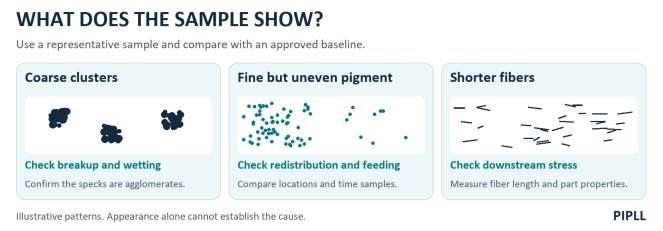
Three illustrative patterns show coarse clusters, fine but uneven pigment and shorter fibers, each with a suggested check.
Figure 2. Use the sample pattern to select an initial check and confirm it with measurements.
Coarse specks or clusters. Take steady state samples and compare thin sections or film specimens at consistent magnification. If you confirm large agglomerates, check feeding, wetting and the available dispersive stress. If the speck appears only after a long run or after a changeover, also check for degraded residue, contamination or material held up in the die.
Fine pigment with visible bands or mottling. Compare sections from different positions and samples taken over time. Stable feeder rates with spatial variation point toward a redistribution problem. A periodic color swing may come from feed variation or surging. A finer grind alone can leave the same concentration pattern.
Uniform glass loading with short fibers. Measure the length distribution against an approved baseline and check mechanical performance. Review the elements after the side feeder and the die restriction. For a line with visible bundles, confirm wetting and incorporation before reducing mixing intensity.
When you change rpm. Keep formulation and throughput fixed for the comparison where practical. A speed change affects shear rate, fill, melt temperature and residence time together. The net change in mixing depends on the screw layout and feeding conditions. Record rpm, feed rate, torque, melt temperature and head pressure alongside the defect result. PIPLL guide to checking residence time .
For a pigment concentrate, preblending, a targeted dispersive section and downstream redistribution can be a useful sequence. For a fiber compound or a heat sensitive additive, the feed location and allowable exposure may favor a different order. Use the sample to choose which change to trial first.
How PIPLL Can Match the Elements and Barrel to the Job
PIPLL's customization service brings element geometry, machine fit and wear protection into the same review. For a color masterbatch extrusion screw design, share the carrier, pigment type and loading, and a sample or image of the defect. For a filled compound, add the filler or fiber percentage and the properties the finished pellets must deliver. Those details help narrow the review to the zones that affect the problem. PIPLL custom screw and barrel service .
When ordering twin screw extruder parts, provide the machine model, shaft spline and element drawings, rotation direction and a layout showing the feed and vent positions. If performance has gradually declined, include flight and bore measurements from corresponding zones. Where abrasive fillers have worn a bore, PIPLL can discuss a wear resistant alloy lining against the actual duty. Confirm bore geometry, clearances and fit for the machine before selecting the replacement. PIPLL bimetallic extrusion barrel .
Frequently Asked Questions
Can one kneading block do both kinds of mixing? Yes. It can generate stresses that break up agglomerates and also redistribute material. The balance depends on disk geometry and how full the section runs.
Can a microscope tell me which mixing step is weak? It can help separate large clusters from uneven concentrations of fine particles. Compare several locations and run samples to distinguish spatial variation from changes in feeding over time.
Should I choose a 90 degree block for every difficult pigment? Select geometry and exposure based on the actual pigment, carrier, throughput and available torque. Confirm results with agglomerate measurements, melt temperature and product quality.
Share Your Layout and Defect Sample
If you are troubleshooting dispersive vs distributive mixing, send PIPLL your screw map, formulation, throughput, rpm, melt temperature and a defect image. Include torque and head pressure trends if available. That gives us a starting point for discussing which elements or barrel zones to review. Contact PIPLL .
Technical and Sales Contact
Harry Jiang | PIPLL
Email: harry@pipll.com | WhatsApp: +86 182 6854 1152
Website: www.pipll.com


+86 15267878906

1306 W building , NB-IoT Industrial Park, No. 199 Changxing Road, Jiangbei, Ningbo.

 Languages