 Languages
-
-
XPS Foam Board Extrusion: Why the Cooling Screw Decides the Board
In a tandem line the first extruder melts and mixes. The second one has to remove heat without letting pressure down — and that is where board quality is actually won.
XPS FOAM BOARD · CO2 FOAMING · TANDEM EXTRUSION · BARREL WEAR
-
1. Two extruders doing opposite jobs
An XPS line is not one machine with a long barrel. It is a tandem: a primary extruder that melts general-purpose polystyrene, disperses the nucleating agent and the flame retardant, and takes the blowing agent under pressure; then a secondary extruder whose job is to take heat out of that gas-loaded melt and deliver it to the die at a precise temperature, still under pressure. The two screws are asked to do opposite things to the same material within a few metres of each other.
That is why the questions buyers ask about a foaming line — what is the L/D, what is the compression ratio, what alloy is the barrel — have different answers for the two stages. A primary screw optimised for dispersion and a secondary screw optimised for heat removal are not interchangeable, and neither is a general-purpose screw with a gas port bolted onto the barrel. The product side of the same duty is covered on the XPS foam board page ; this article is about what the hardware has to do to get there.
Both stages exist in PIPLL's range as separate specifications: the foaming screw and barrel for single screw lines , the conical twin foaming configuration , and the parallel twin version used where the primary stage is twin-screw. Foaming is also run on PE for EPE foam , with the same split of duties.
-
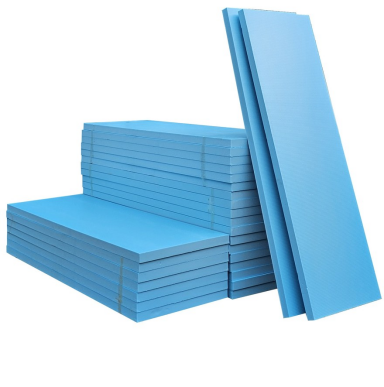
XPS board off the line. The uniform cell structure is the visible result of a pressure and temperature history that was held steady for the whole run.
-
2. What the gas does to the melt
Carbon dioxide becomes supercritical above about 31 °C and 7.4 MPa, which means the whole process runs in that state: it behaves partly like a liquid solvent and partly like a fast-diffusing gas. It is injected into the melt at pressures in the 12–18 MPa range, and it has to be fully dissolved before the die, not merely mixed. Undissolved gas does not make fine foam; it makes the large voids that show up as weak spots and as heat paths through the board.
The second effect is the one that reshapes the whole line: dissolved CO2 drops the melt viscosity sharply. Material that was a stiff polystyrene melt downstream of the injection point behaves like a much thinner fluid, which is why the secondary extruder has to be a heat exchanger first and a pump second. It also means the pressure margin is thinner than it looks — a viscosity drop plus a pressure drop is how premature foaming starts inside the barrel instead of at the die.
Parameter Typical operating range What it controls CO2 injection pressure 12–18 MPa Single-phase dissolution; below this the gas comes out of solution early Melt temperature at die 115–135 °C Melt strength at expansion; too low freezes the die, too high collapses the cells Nucleating agent (talc) 0.3–1.0 wt% Cell density and uniformity Closed-cell content above 95 % Thermal performance and moisture pickup Cell size 100–250 µm Balance of insulation value and compressive strength Board density 25–50 kg/m³ (30–45 typical) Strength against thermal conductivity KEY INSIGHT
The gas is not an additive that gets stirred in. It is a dissolved component whose solubility depends on pressure and temperature, and the screw line has to hold both steady all the way to the die. -
3. Primary screw: melting is the easy part
Polystyrene melts without drama. What is difficult on the primary stage is dispersion. Talc is dosed at a fraction of a percent, and if it arrives at the die as agglomerates it nucleates too few cells and the foam comes out coarse. Flame retardant has to be uniformly distributed for the same reason a fire test is pass or fail on the worst square metre of board, not on the average.
This is ordinary compounding work, which is why the primary stage is usually a high-torque twin screw at an L/D of roughly 32–36:1. The logic of getting solids dispersed into a melt is the same one described for filled compounds and for masterbatch , and it depends on the difference between dispersive and distributive mixing rather than on raw screw length. The element sequence that does it is covered in the twin screw element guide , and the barrel itself in the compounding barrel range .
One detail worth writing into the specification: the injection point has to sit downstream of complete melting. Gas injected into a partly solid bed gets trapped in the solid fraction and released unevenly later. That is a geometry decision, not an operator decision, and it is why a generic compounding screw with a port added later usually underperforms a screw designed around the port.
The gas loop changes the melting stage more than it looks: the screw has to arrive at the injection point with a fully melted, quiet melt, which is the condition the L/D and overheating note describes from the other direction. Deep versus shallow channels decides how much volume sits between the flights, and the single screw range covers the smaller one-extruder foam lines where a tandem is not justified.
-
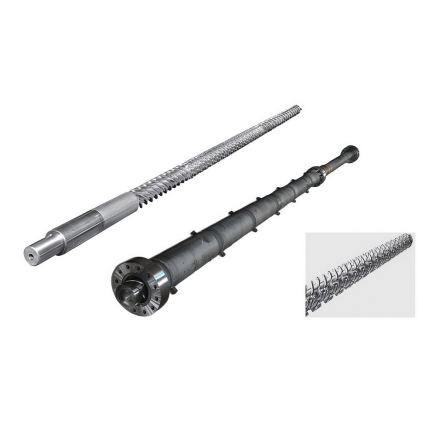
A foaming screw and barrel. The deep channels and the long body are there to give the melt surface area against a cooled wall without adding shear.
-
4. Secondary screw: a heat sink that must not drop pressure
The cooling screw is the part of an XPS line that is hardest to get right and easiest to under-specify. Its job is to remove a large amount of heat from a viscous, gas-loaded melt while holding pressure high enough that nothing expands early. Those two requirements pull against each other: cooling raises viscosity, viscosity raises the pressure needed to move the melt, and every additional restriction is another place where the material sits and cools unevenly.
The usual answer is a long single screw — up to about 34:1 — with deep channels and a low-shear profile, run slowly, with the barrel set up as a cooling jacket rather than a heater. Deep channels matter here for a specific reason: they increase the volume of melt in contact with the cooled wall per unit of shear, which is the trade described under deep versus shallow screw channels . The temperature profile and the L/D interact the same way as on any single screw , except that the objective is inverted: you are trying to arrive cold.
Two failure modes bracket the operating window. Cool too far and the melt loses so much mobility that it freezes on the barrel wall or clogs the die lip; the symptom is a pressure spike and a board with a torn skin. Cool too little and the melt leaves the die without enough strength to hold the expanding gas; the cells collapse, and the board comes out dense and corrugated. Neither is a screw defect, and neither is fixed by turning a setpoint — they are the two edges of the window the cooling screw has to hold the line inside.
Where the line runs hot or the L/D is marginal, the classic overheating symptoms described for twin screw L/D and overheating turn up in a different form: not degradation, but a melt that never gets cool enough to foam well. The compression and L/D numbers are the place to check whether the geometry can physically do the job.
Dispersion upstream is what makes the cooling stage possible: a melt with agglomerates in it cannot be held at a steady pressure because the agglomerates change the viscosity as they pass. That is the same argument as dispersive versus distributive mixing and the element guide , and it is why the parallel twin barrel is normally the primary stage rather than the secondary.
-
5. The die, and the seconds after it
Expansion happens in the die and immediately after it, and the hardware there is unforgiving. A tapered lip with a matched land length drops the pressure in a controlled way; a lip that is too short foams inside the channel, and a land that is too long adds back-pressure the cooling screw cannot afford. Die temperature is set separately from the melt because it controls skin formation — the surface of an XPS board is a different material from its core.
Downstream, the calibrator and haul-off lock the dimensions before the board has finished cooling, and biaxial draw at the die exit aligns the polymer and reinforces the cell walls. Thickness and width variation that appears here is usually read as a die or haul-off problem, and often it is. The diagnostic sequence for diameter and thickness variation applies directly, with one addition: on a foaming line the output pulsation that shows up as gauge banding often starts at the gas metering pump rather than at the screw.
The same sheet-forming hardware appears across the range — the sheet extrusion screw and barrel and the PS sheet and board pages — but foaming adds the gas loop to a line that otherwise looks like any flat-sheet job.
Thickness banding that survives a die adjustment is usually a pressure problem upstream, not a die problem — the sequence for dimensional variation is the right place to start. The flat-die hardware itself is covered under sheet extrusion screws , and the non-foamed version of the same product under KT foam board .
-
6. Where the barrel actually wears
An XPS barrel wears for three reasons that are easy to conflate. The nucleating agent is a hard mineral at a low loading. The flame retardant is a halogenated organic at a much higher loading, and its chemistry has changed. And the whole line runs at a higher internal pressure than the Freon-era designs it replaced, which raises the mechanical load on the screw flights, the barrel wall and the seals at the same time.
Wear driver Mechanism Hardware answer Talc at 0.3–1.0 wt% Fine abrasive, worst in the high-pressure zone after the gas port Hardened or bimetallic bore in the metering and mixing section Flame retardant loading Higher dose than a decorative filler; may be corrosive depending on chemistry Alloy selected against the FR chemistry, not just hardness Elevated line pressure Flight tips and barrel wall loaded harder; clearance opens faster Adequate wall thickness and a screw core sized for the torque Deep cooling on the secondary Melt freezes on the wall, then shears off as a solid Surface finish and channel geometry that avoid stagnant cold spots The consequence of wear on this duty is not a gradual loss of output. It is a loss of pressure stability, and pressure stability is what sets cell size. A worn screw shows up first as density drift and as a board that varies across its width, long before anyone measures the flights. The method for checking wear without a teardown is worth running on a schedule for exactly this reason, and the service life expectation on a foaming line should be set from pressure stability rather than from tonnage.
For abrasion alone, a tungsten carbide barrel is the usual answer where the filler load is high. Where the flame retardant is the aggressive part, the decision is closer to the one described for filled and corrosive duties and for corrosion-resistant PVC work : hardness alone does not answer a chemical load.
-
7. The HBCD change is a hardware change
Hexabromocyclododecane was the standard flame retardant for polystyrene foam for decades. It was listed in Annex A of the Stockholm Convention in 2013, and the registered exemptions for its use in EPS and XPS for buildings have since expired — the last of them, for China, at the end of 2021. A new line has to run an HBCD-free system from its first trial, and that is not only a formulation change.
Replacement systems often need a higher loading to reach the same fire class, and some are more abrasive or more chemically aggressive to the metal they sit against. A barrel specified for the old formulation can be perfectly adequate and still be the wrong barrel for the new one. The practical sequence is: fix the flame retardant chemistry first, then choose the bore, and get the supplier to state the alloy against that chemistry rather than against a hardness figure.
Where the FR is corrosive, the alloy logic follows the same lines as any bimetallic barrel selection ; where it is abrasive, it follows the filled-plastics guidance . The two are not the same specification, and a line that changes FR supplier mid-life should re-check which one it is.
Whatever the flame retardant, the barrel life question is the same one asked on every filled duty: the lifespan guidance is a starting point, the material selection guide is where the alloy actually gets chosen, and the nitrided barrel guide is worth reading to see how little it covers once the chemistry turns.
-
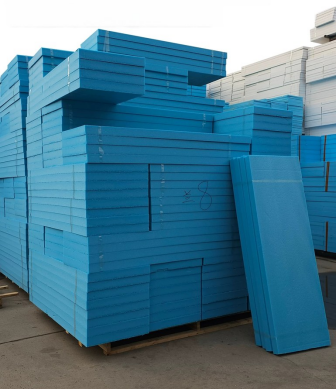
Finished board stacked for curing. Dimensional change after the line is one of the reasons the blowing agent and the cooling screw have to agree on the day the board is made.
-
8. What the screw contributes to the number on the data sheet
Board density, cell size and closed-cell content are usually discussed as formulation and die questions. The screw sets the conditions under which the formulation can work. Uniform melt temperature across the barrel section, complete gas dissolution, and steady pressure at the die are all screw outputs, and all three print directly into the physical properties.
This is also why the energy number on a foaming line looks strange. The cooling stage is removing heat that the melting stage paid for, so a specific energy consumption figure that would be respectable on a pipe line reads badly here — you are measuring a process that deliberately spends energy twice. The useful comparison is the line against itself over time, not against another product.
Trim recycling closes the loop and changes the feed. Edge trim and offcuts are crushed and fed back, and the share has to be fixed rather than left to whatever the crusher produces; outside recycled polystyrene varies more and should be tested before it goes into production. The handling logic is the same as for any regrind-heavy line , with the added constraint that regrind carries moisture and fines into a process that is sensitive to both.
-
9. Blowing agents are a portfolio decision
CO2 is the default because it is cheap, non-flammable and has no ozone depletion potential, but it is usually run with a co-blowing agent to tune solubility and cell structure. Ethanol improves solubility; DME, HFC, HFO, butane, pentane and LPG all appear on real lines. The flammable ones change the safety classification of the whole plant, not just the extruder.
For the hardware, the choice matters in two ways. Solubility determines how much gas the melt can hold at a given pressure, which sets the pressure the screws have to hold. And the pressure itself sets the wear rate. A line designed around a low-pressure agent and later switched to CO2 is a common source of premature screw and seal failure.
-
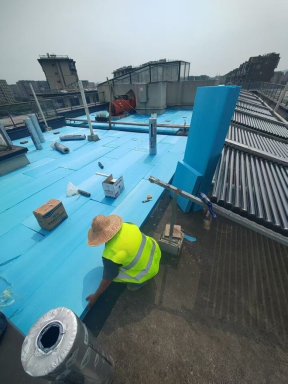
XPS going down on a roof. The insulation value being installed here is fixed by cell structure at the die, not by anything that happens afterwards.
-
10. What to put on the purchase order
A foaming line is usually bought as a system, and the screw and barrel specification gets compressed into a line item. It should not be. The two stages need separate specifications, and the primary needs its gas port geometry defined rather than inherited.
Item What the PO should state Stage Primary (melt, disperse, inject) and secondary (cool, hold pressure) specified separately Geometry L/D and compression ratio per stage; injection port position relative to the melt seal Bore Alloy or bimetallic liner chosen against the flame retardant chemistry, plus talc abrasion Cooling Secondary barrel cooling capacity and channel design; screw core cooling if used Pressure Design pressure for the maximum blowing-agent pressure the line will run Documentation Material certificate, dimensional report, liner bond record, hydrostatic test The information a supplier needs is the list that makes any custom screw and barrel project work: target board density and thickness, output, blowing agent and loading, flame retardant chemistry, and the primary/secondary split. What comes back should be checkable against a written acceptance procedure , and the supplier's claims should survive the checks in the exporter verification guide .
Two smaller points belong on the same sheet. A line that changes flame retardant supplier needs a purging routine written for it, in the spirit of the PVC changeover sequence . And a barrel that is past saving shows it as pressure instability rather than as lost output, which is what the repair or replacement decision should be based on.
-
11. What to send us
For an XPS line the useful start is short: board density and thickness, target output, the blowing agent and its loading, the flame retardant chemistry, and whether the primary stage is twin or single screw. Add the existing screw drawings and the pressure the line currently runs at the die — the pressure tells us more about the wear history than the drawing does.
PIPLL builds screws and barrels for foaming duty in bimetallic and nitrided construction, and the custom engineering route starts from a drawing or a measured part. Capacity and lead time are on the manufacturing page , the sequence from drawing to dispatch under our process , and the application index at applications groups the duty by product. If the line is down, the contact page is the fastest route.
-
Chasing density drift or coarse cells on an XPS line?
What information do you need for a quotation?Board density and thickness, target output, the blowing agent and its loading, the flame retardant chemistry, and whether the primary stage is twin or single screw. Existing screw drawings and current die pressure are also useful.Why specify primary and secondary separately?The primary stage is optimised for melting, dispersion and gas injection; the secondary stage is optimised for heat removal while holding pressure. One geometry cannot do both jobs well.How does flame-retardant chemistry affect the barrel?Post-HBCD systems often run at higher loadings and can be more abrasive or chemically aggressive. The bore alloy must be chosen against the actual FR chemistry, not only against hardness.What is the first sign of screw or barrel wear on an XPS line?Loss of pressure stability that shows up as density drift or width variation, long before flight diameter has been measured. -
✔ XPS Foam Board · Tandem Extrusion Specialist | ✔ Primary & Secondary Screws Specified Separately
✔ Bimetallic · Nitrided · Cooling Geometry | ✔ Gas-Port Design · FR-Chemistry Bore Selection · Pressure Stability -
Plastic Polymer Compounding Parallell Twin Screw Barrel
-
Battenfeld-Cincinnati twinEX Counter-Rotating Parallel Twin Screw Barrel
-
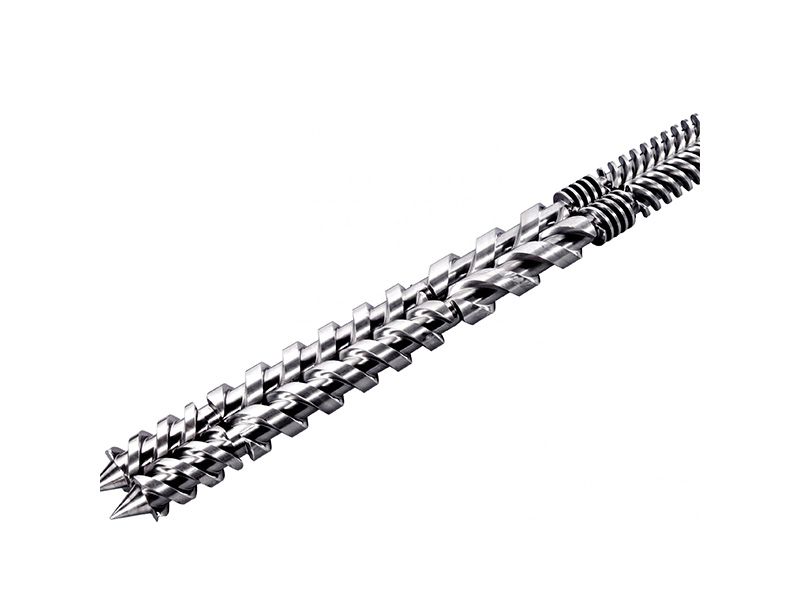
KABRA(Kabra Extrusion Technik)Counter-Rotating Parallel Twin Screw Barrel
-
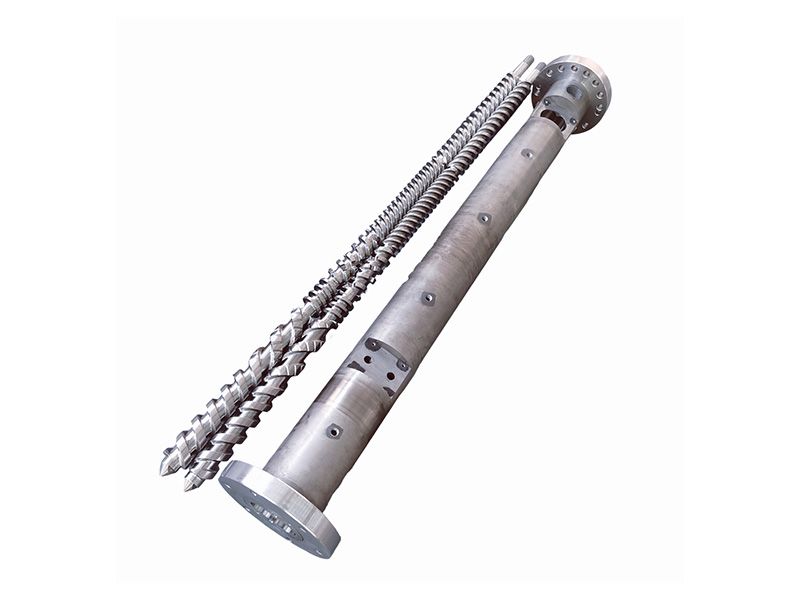
MIKROSAN MCV Counter-Rotating Parallel Twin Screw Barrel
-
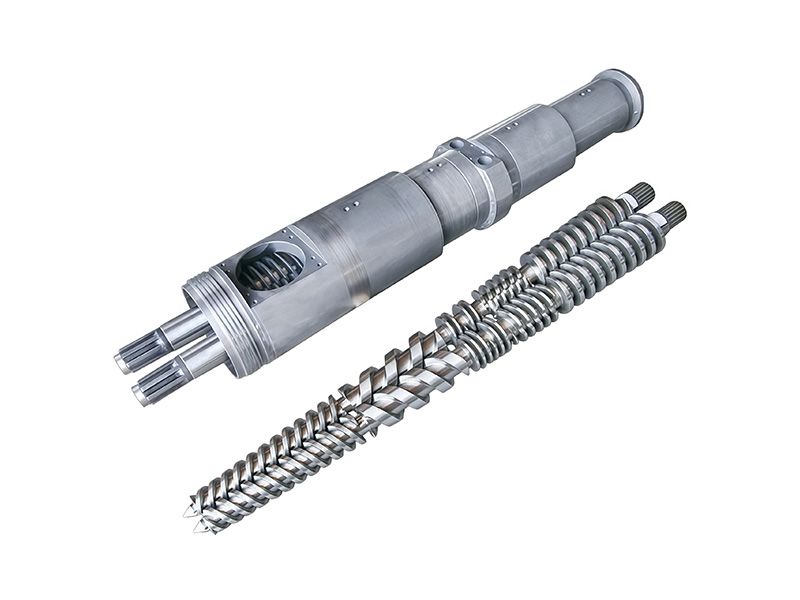
High-Filling Polymer (High-calcium PVC, WPC,SPC) Conical Twin Screw Barrel