Deep vs Shallow Screw Channels and How to Choose — Match channel depth to the output and melt quality your line needs
Two screws fit the same barrel, yet one leaves unmelted particles at the required output while the other runs with a hotter melt. The outside diameter can match even when the channel depths and processing behavior differ.
Choosing deep vs shallow screw channels means balancing intake, melting, shear and pressure delivery. PIPLL helps customers review those requirements before specifying a replacement screw and barrel. The useful question is which geometry will deliver the required kg/h and melt quality on the customer's actual line. PIPLL single screw and barrel range .
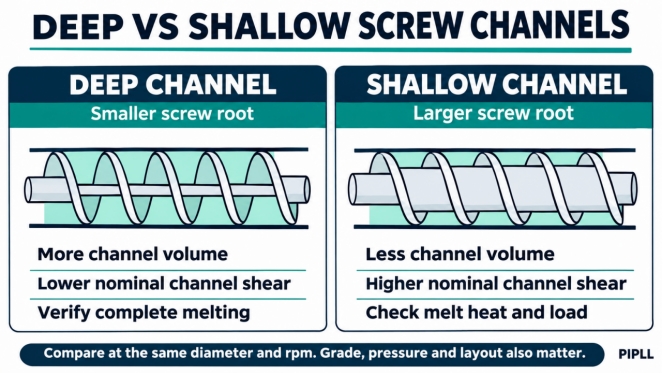
Figure 1. At a matching flight diameter, root diameter changes the channel depth.
Start with the Channel Depth and the Screw Root
At the same flight outside diameter, a smaller root diameter gives a deeper channel. A larger root gives a shallower channel. The extra space in a deep channel increases its geometric capacity per turn when pitch and width are comparable.
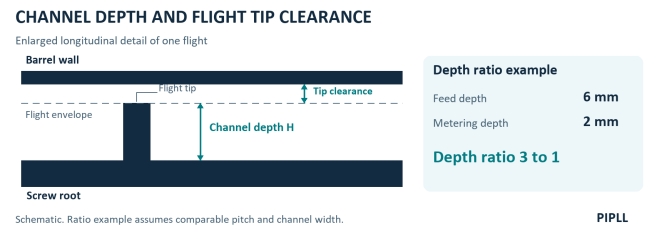
Channel depth is the radial distance from the screw root to the flight's outer envelope. Flight tip clearance is the small gap between the flight tip and the barrel bore. Two screws can have different channel depths and the same tip clearance.
That distinction matters commercially. Changing the root profile changes the process geometry. Replacing worn flights or a worn bore restores the intended running clearance. PIPLL needs the drawing and measurements to establish which change the application requires.
What Changes in the Melt When the Channel Gets Shallower
Deeper Channels Need Enough Melting Capacity
A deep feed channel can accommodate more solid feed, but actual output also depends on feed friction, bulk density, melting capacity and downstream resistance. In molten material, greater depth generally reduces nominal channel shear at the same diameter and rpm.
If intake exceeds the available melting capacity, unmelted material can travel downstream. Heat comes from the barrel and mechanical work throughout the flow, with high shear also possible in flight clearances and mixers. Check the full screw profile and measured melt condition before deciding that depth caused the defect.
Shallower Channels Change Shear and Pressure Flow
In a simplified melt channel, reducing depth increases the velocity gradient at the same surface speed. That can increase viscous heating and help homogenization. It also changes drag conveying capacity and pressure driven backflow within the channel. Net output depends on the balance between these flows and the connected die resistance.
A shallower channel does not by itself reduce flight tip clearance. Leakage across a flight also depends on that clearance, pressure and melt viscosity. The screw's pressure and flow behavior needs assessment as a complete system. Dynisco screw and barrel handbook .
Figure 2. Channel depth and tip clearance are separate dimensions. The depth ratio is an arithmetic example.
Use the Feed to Metering Depth Ratio in Context
For a conventional screw with comparable pitch and channel width, feed depth divided by metering depth approximates the geometric compression ratio. A 6 mm feed depth and 2 mm metering depth give a 3 to 1 depth ratio. The transition length determines how quickly that change occurs.
Specify the ratio together with the melting length, pitch, mixing features and operating rate. A rapid reduction can overload material that has not melted sufficiently. A gentler transition can be appropriate when matched to the melting behavior. Experiments comparing screw designs show that throughput, temperature and pressure consistency can favor different geometries. Single screw design comparison study .
What PIPLL Can Help Customers Solve
Unmelted Particles Limit Saleable Output
If output rises but acceptable product falls, give PIPLL a particle sample, the resin grade, rpm, kg/h and actual melt temperature. We can review feed depth, the transition profile, metering depth and mixing features against the target rate. A proposed change might involve the melting section or a barrier or mixing feature, depending on the application.
The customer gains a geometry proposal tied to a production problem. Agree an acceptance run that checks both the required output and the incidence of unmelted particles.
Yellowing or Excess Melt Heat Limits the Operating Window
For a heat sensitive formulation, compare melt temperature, moisture, residence time, load and product condition. A deeper channel may be one option for reducing shear in a particular section, while slower rpm, different mixing geometry or better cooling may address the limiting condition.
PIPLL's custom design review considers these features together. Ask for the proposed changes in section lengths, depths and mixing features to be identified on the drawing, with the operating conditions used to assess them. That gives the customer a basis for evaluating thermal performance during commissioning. PIPLL custom screw and barrel service .
Output Has Become Less Stable as Components Wear
If a previously successful recipe gradually loses output or stability, check the feed, heaters and die, then measure flight diameter and bore diameter at corresponding axial positions. PIPLL can use those readings with the original dimensions to discuss a matched replacement. This avoids selecting new channel geometry solely from the appearance of a worn screw.
Filled or Abrasive Recipes Shorten Component Life
Geometry and wear protection are separate selections. For filled plastics, discuss the abrasive duty and any corrosion risk with PIPLL when selecting metallurgy. A through hardened screw is one option to assess against the formulation and machine requirements. Agree the material, treatment and inspection requirements for the order. PIPLL through hardened screw options .
Apply the Review to PLA Filament Production
For PLA 3D printing filament extrusion, the screw must supply fully plasticized material with suitable thermal history and steady melt delivery. Moisture, processing temperature and residence time also influence degradation. Evaluate drying and material condition alongside screw geometry when investigating yellowing or reduced viscosity. PLA processing experiment .
PIPLL offers application-specific screw and barrel configurations for PLA filament systems, including geometry and surface treatment choices matched to the extruder. Share the grade, required output and current defect so the discussion starts with your production target. PIPLL PLA filament screw and barrel solution .
When reviewing PLA filament extruder screw design, specify the required filament diameter tolerance, pressure trend, melt temperature and line speed. Die behavior, cooling, puller control and diameter measurement all contribute to the finished tolerance. A shallow metering section is one design variable within that system. PIPLL PLA extrusion applications .
What the Customer Should Receive Before Ordering
Request a dimensioned drawing showing section lengths, channel depths, pitch, interfaces and the agreed running clearance. Confirm the material and heat treatment specification, then agree how the manufactured dimensions and surface condition will be documented. PIPLL publishes a process that includes material checks, heat treatment monitoring and final dimensional inspection. PIPLL manufacturing and inspection process .
Frequently Asked Questions
Does a deeper channel always give more output? Its geometric capacity can be greater, but the line still needs enough melting, drive power, cooling and pressure delivery to produce acceptable material at that rate.
Is a deep channel always best for PLA or PVC? Select depth from the actual grade, architecture and thermal limits. A complete design must also provide adequate melting and control the material's time and temperature history.
Can I compare screws with a caliper alone? Compare outside and root diameters at defined positions with suitable measuring tools and drawings. Barrel bore measurements are also needed to assess running clearance. Have PIPLL review the measurements before ordering a replacement.
Send PIPLL the Problem and the Screw Data
To choose between deep and shallow screw channels, send your machine model, screw drawing or section measurements, resin grade, filler and regrind content, target kg/h, rpm, melt temperature and pressure history. Add defect photos and the quality criterion you want to improve. PIPLL can then discuss the required geometry, mating barrel and material specification with you. Contact PIPLL .
Technical and Sales Contact
Harry Jiang | PIPLL
Email: harry@pipll.com | WhatsApp: +86 182 6854 1152
Website: www.pipll.com


+86 15267878906

1306 W building , NB-IoT Industrial Park, No. 199 Changxing Road, Jiangbei, Ningbo.
 Languages