Extrusion Diameter Variation and How to Stabilize the Line — Trace the fluctuation before changing the screw or the settings
The diameter gauge alarms after a line has been running smoothly. Thick sections alternate with thin sections, and changing rpm or barrel temperature seems to move the problem around. Extrusion diameter variation can start in the melt supply, the haul-off, cooling or the measurement and control system. The first step is to find which signal changes first.
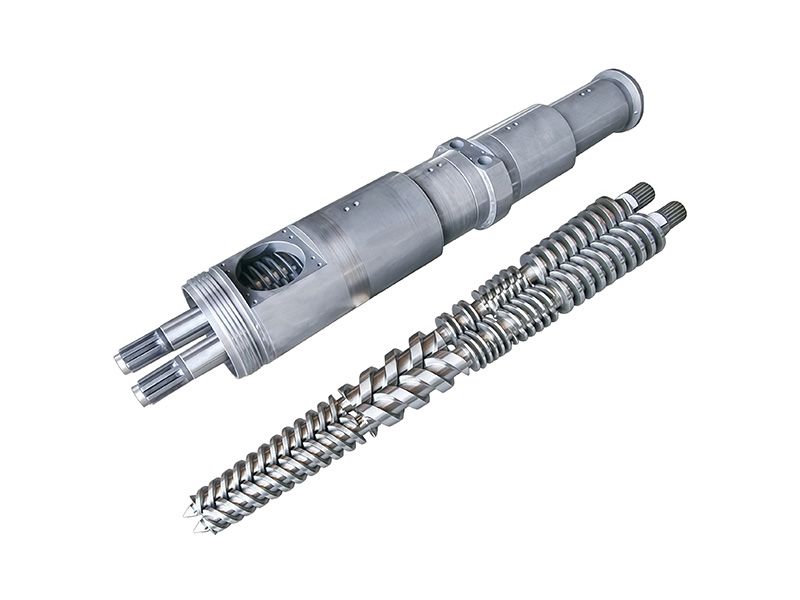
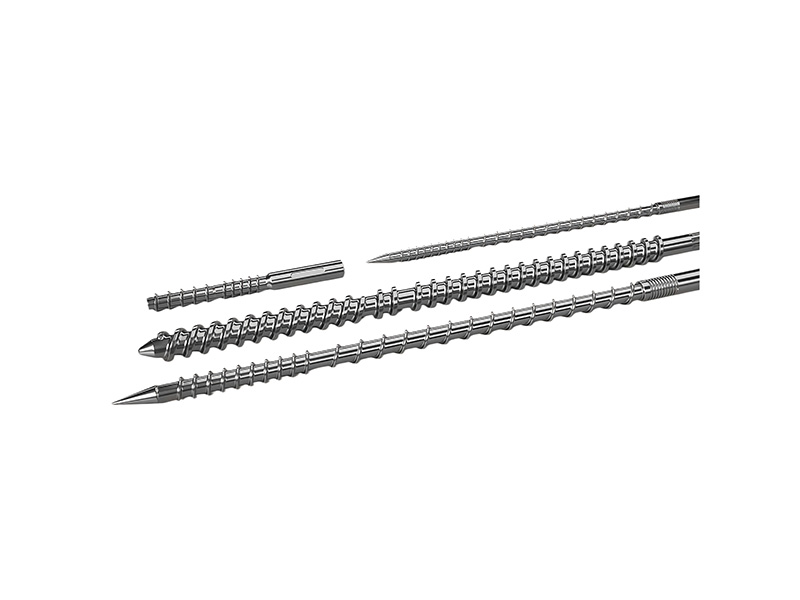
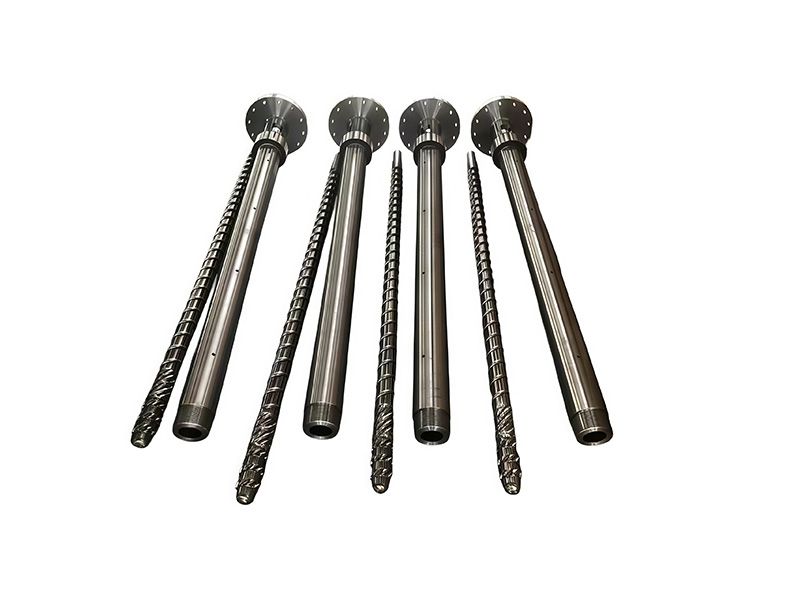
PIPLL can help customers address the screw and barrel contribution through feed geometry, melting capacity, metering design and matched running clearances. Bring the pressure, melt temperature and line speed trends into that discussion so the proposed change targets the production problem. PIPLL single screw and barrel range .
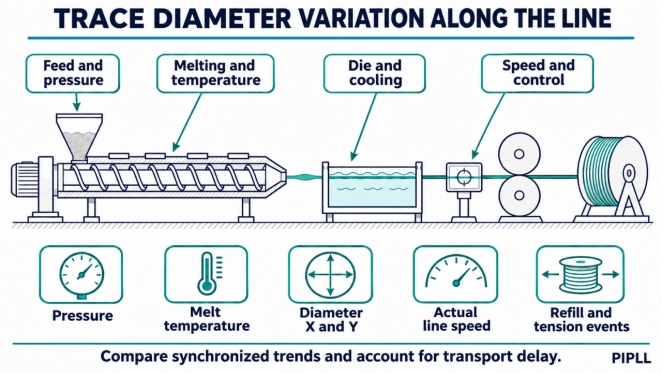
Figure 1. Solid filament line schematic. Cable coating also requires core and wall measurements.
Match Melt Delivery with Actual Line Speed
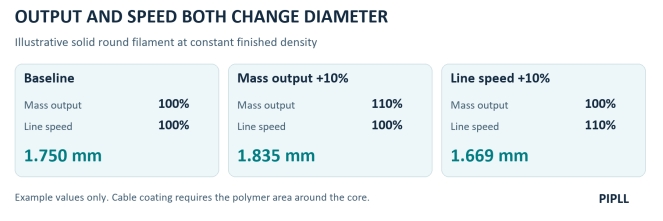
For a solid round strand at constant finished density, cross-sectional area follows mass output divided by line speed. More material at the same speed makes a larger diameter. More draw at the same output makes a smaller diameter.
Cable coating adds another dimension. Polymer fills the area around an incoming core, so outer diameter, core size, wall thickness and eccentricity need consideration together. Pay-off tension matters on a cable line. On a solid filament line, check haul-off and take-up tension instead.
Check Four Parts of the Line
Haul Off Tension and Control
Compare actual product speed with the drive speed indication. Worn belts, insufficient grip, eccentric rollers or a loose transmission can create periodic draw changes. Excessive nip force can distort a soft product. On cable lines, check the pay-off brake, dancer movement and tension stability as well.
Review the diameter control loop with the controls team. A controller that responds too aggressively to delayed measurements can hunt. If a controlled comparison at a fixed speed becomes steadier, investigate loop tuning and actuator behavior. The result supports that investigation, without identifying one PID setting by itself.
Feeding and Melt Supply
Look for bridging, inconsistent regrind size, blend segregation or changes in hopper level. Check feed throat cooling and evidence of sticky pellets. Log loader refills and feeder changes on the same time base as the diameter trend.
A repeated disturbance near a refill event is a reason to inspect the receiver discharge, hopper buffer and feeding arrangement. Verify the relationship over several cycles before changing the screw.
Temperature and Plasticization
Check temperature trends and heater output together. A failed heater, sensor problem or an SSR stuck on can change the melt condition. Measure actual melt temperature at a defined location and compare drive load and pressure at a stable production rate.
For hygroscopic materials, verify residual moisture against the grade's drying requirement. Moisture can cause gas effects or hydrolytic viscosity loss. PLA, for example, can suffer molecular weight loss without visible bubbles. Entrained air, contamination and additive decomposition also deserve investigation when bubbles appear. NatureWorks processing guide .
Die Cooling and Measurement
Inspect die buildup and the melt path, then review drawdown, the air gap and cooling conditions. Unstable drawdown can produce a regular wave even with steady drive speed. Water jets, bubbles or poor product guidance can disturb a soft strand. Change cooling conditions against the material and line requirements.
Check the gauge windows, alignment and product path. Compare diameter in multiple axes where available. Ovality, product movement and real diameter changes require different remedies. SIKORA describes multi-axis measurement of diameter and ovality. SIKORA ovality measurement .
Use Synchronized Trends to Narrow the Cause
Record diameter X and Y, actual line speed, melt pressure, actual melt temperature, rpm and drive load. Mark refills, tension events and control corrections. The sampling rate must be fast enough to capture the fluctuation.
Allow for travel time between the die, bath, gauge and haul-off. Estimate the transport delay from distance and speed, then check it against identifiable events. Cable systems may also need to align incoming and outgoing measurements to the same product position. SIKORA insulating and sheathing measurement catalog .
Figure 2. Illustrative diameter changes follow mass output and line speed at constant finished density.
A 1.750 millimeter solid round filament becomes 1.835 millimeters with ten percent higher mass output, or 1.669 with ten percent higher line speed, all other balance variables held constant.
If pressure changes before diameter, investigate feeding, melting, temperature and outlet resistance while checking the corresponding line speed. A pressure signal can be a useful indicator of an output disturbance.
If pressure looks steady while diameter moves, increase attention to speed, drawdown, cooling and measurement. Also check sensor location, sampling and filtering. Changes in melt viscosity can alter flow without a proportional pressure change, and an installed melt pump can change which disturbances a sensor sees. Dynisco describes why pressure and flow are related through melt behavior. Dynisco extrusion pressure control note .
A regular period helps compare roller rotation, refill cycles, controller response and drawdown behavior. An irregular pattern helps locate intermittent events. Use the timing as evidence to test a cause, then change one variable and allow the process to stabilize.
Frequently Asked Questions
Can speed fluctuate with a steady setpoint? Yes. Check actual product speed, roller grip and transmission behavior, especially if the drive indication remains steady.
When should I suspect screw and barrel wear? Investigate wear when a previously stable recipe gradually loses output or consistency, after checking feeding, heaters and downstream restrictions. Confirm it with dimensional measurements.
How PIPLL Designs for More Stable Melt Delivery
Make Feeding More Consistent
Give PIPLL the pellet or regrind form, blend proportions and the refill history. We can review feed channel geometry, the intake arrangement and feed throat cooling provisions against the material. The aim is to establish reliable intake at the required rate before adding more pumping or mixing capacity.
Match Melting and Metering to the Required Output
PIPLL can review transition length, compression profile and any barrier or mixing section when incomplete or uneven plasticization contributes to the fluctuation. Metering depth and length must suit the resin viscosity and downstream resistance, with mixing selected to balance uniformity, load and melt heat.
The customer should receive a proposed profile tied to the target kg/h, rpm range and melt quality. Agree an operating trial that checks pressure and temperature variation alongside acceptable product output. PIPLL custom screw and barrel service .
Preserve the Fit as the Components Wear
If stability has deteriorated on a previously successful recipe, compare screw flight diameter and barrel bore at matching axial positions with the drawing. A matched replacement can restore the specified running clearance. For abrasive formulations, review a through hardened screw or other wear protection against the actual duty. PIPLL through hardened screw options .
For PLA 3D printing filament extrusion, provide the diameter tolerance, gauge position, line speed and drying data with the screw details. PIPLL offers geometry and material options matched to the extruder and output requirement. Validate the finished diameter with the cooling and haul-off system included. PIPLL PLA filament screw and barrel solution .
For a cable application, add core dimensions, coating material, crosshead information and the pay-off and take-up conditions. These inputs help define the screw and barrel duty for the coating line. PIPLL cable extrusion screw and barrel .
Agree the Drawing and the Acceptance Data
Confirm section lengths, depths, interfaces, running clearance, material and heat treatment on the order. PIPLL's published process includes material checks, heat treatment monitoring and final dimensional inspection. Agree the production validation criteria with the line team before installation. PIPLL manufacturing and inspection process .
Discuss Your Diameter Problem with PIPLL
Send the machine model, screw drawing or measurements, resin grade, required kg/h, diameter target and synchronized process trends. Add a photo of the defect and note when it began. For extrusion diameter variation, those records help PIPLL connect a proposed screw and barrel change to the part of the process that needs improvement. Contact PIPLL .
Technical and Sales Contact
Harry Jiang | PIPLL
Email: harry@pipll.com | WhatsApp: +86 182 6854 1152
Website: www.pipll.com


+86 15267878906

1306 W building , NB-IoT Industrial Park, No. 199 Changxing Road, Jiangbei, Ningbo.
 Languages