A Practical Selection Guide for Parallel, Conical, and Wear-Resistant Twin Screw Systems
Selecting a twin screw barrel begins with the extruder architecture and the processing duty, not with a nominal diameter alone. A parallel twin screw barrel and a conical twin screw barrel serve different machine layouts and process windows; where fillers, reinforced resins, or long running hours create heavy wear, a bimetallic screw barrel may also need to be evaluated as part of the complete assembly.
The correct configuration should support controlled conveying, melting, mixing, pressure development, and stable delivery to the die. It must also fit the installed gearbox interface, center distance, barrel zoning, feed opening, heating and cooling arrangement, and the intended product.
This guide explains how to compare twin screw barrel configurations, what process data to collect, and how to prepare a technically useful replacement or new-project inquiry.
PIPLL supports twin screw barrel projects by reviewing the installed extruder, material behavior, and required production duty before a replacement specification is proposed.
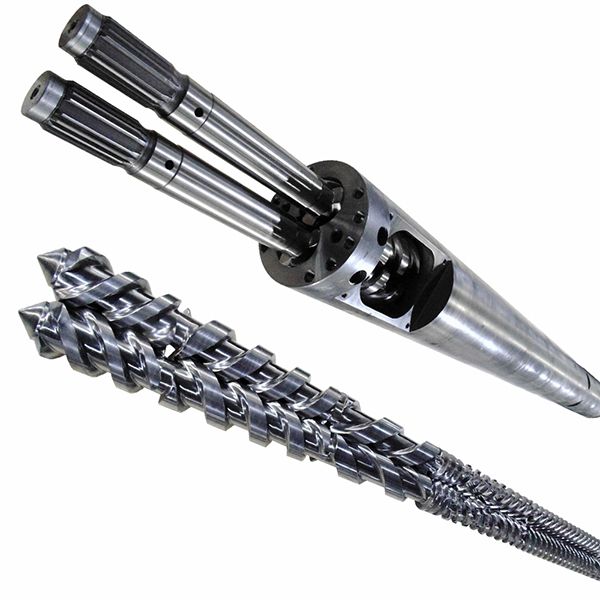
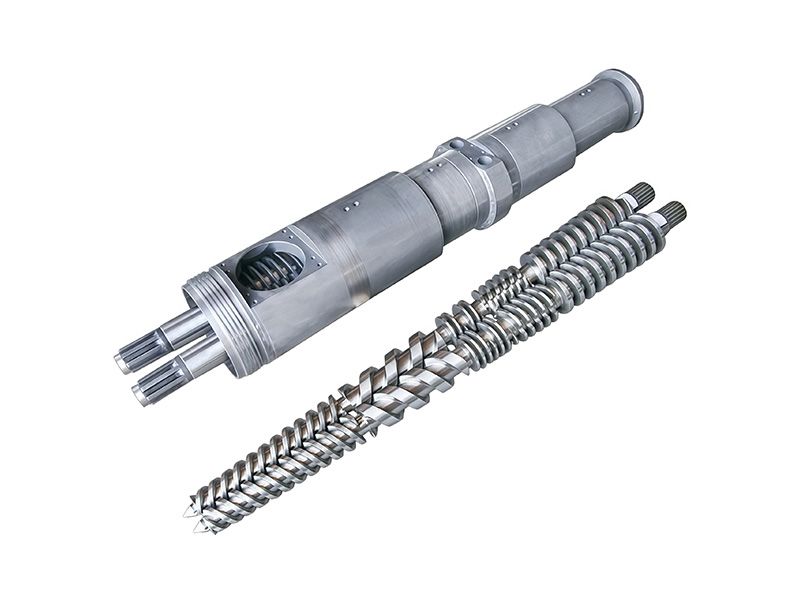
Figure 1. A twin screw and barrel assembly. The correct configuration is selected according to the extruder design, resin formulation, and production objective.
In plastic extrusion, a twin screw barrel is the barrel assembly that houses two intermeshing screws. Together, the screws and barrel provide the mechanical environment for conveying, melting, mixing, venting where applicable, and building pressure before the material reaches the die.
The phrase does not describe one universal product. Twin screw systems can be parallel or conical, co-rotating or counter-rotating, and configured for applications such as compounding, pelletizing, rigid PVC pipe, profile, sheet, or recycling. The machine design determines the fundamental geometry; the material and operating condition then determine the detailed specification.
A parallel twin screw barrel uses two screws with a consistent nominal diameter along the processing length. It is commonly associated with applications where the machine architecture and process call for a parallel layout, including particular compounding and extrusion configurations. A conical twin screw barrel uses screws and bores that taper along the length and is frequently used on counter-rotating PVC processing equipment.
PIPLL reviews whether a parallel twin screw barrel or a conical twin screw barrel matches the original machine geometry before recommending a replacement assembly.
| Selection Point | Parallel Twin Screw Barrel | Conical Twin Screw Barrel |
|---|---|---|
| Machine geometry | Designed for a parallel twin-screw extruder with the applicable center distance and drive interface. | Designed for a conical twin-screw extruder with matched tapered bores and screw geometry. |
| Mixing requirement | Mixing requirement, screw configuration, output range, material formulation, and torque condition. | PVC formulation, plasticization behavior, output target, torque, and the machine's conical interfaces. |
| Replacement requirement | Confirm bore dimensions, center distance, barrel zones, screw ends, and original machine details. | Confirm large and small diameters, cone length, center distance, barrel zones, and gearbox-end connection. |
| Important caution | A parallel assembly should not be substituted for a conical assembly without an extruder redesign. | A conical assembly is not a generic replacement for a parallel twin-screw machine. |
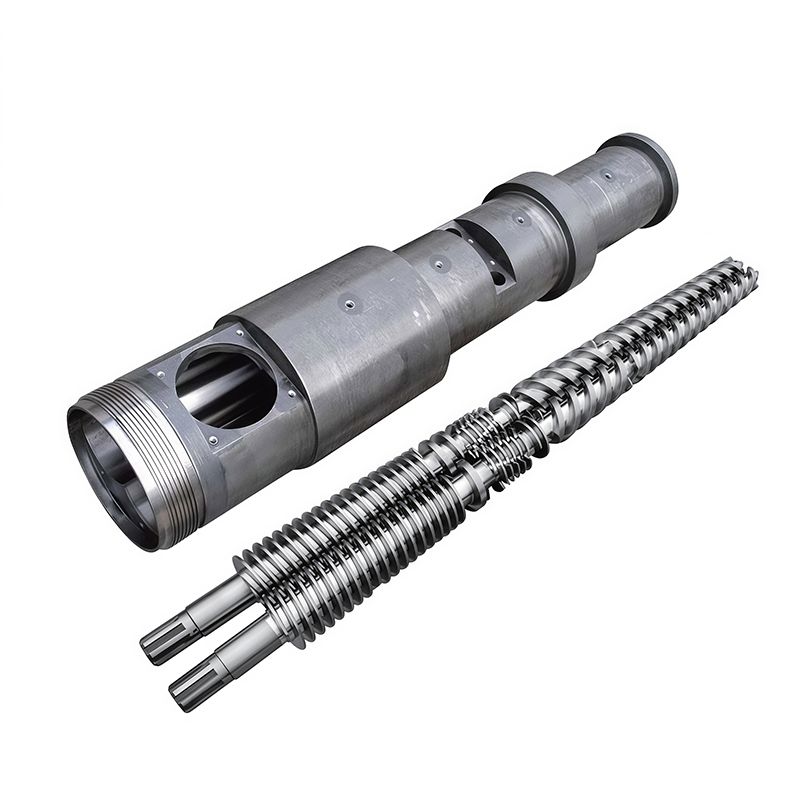
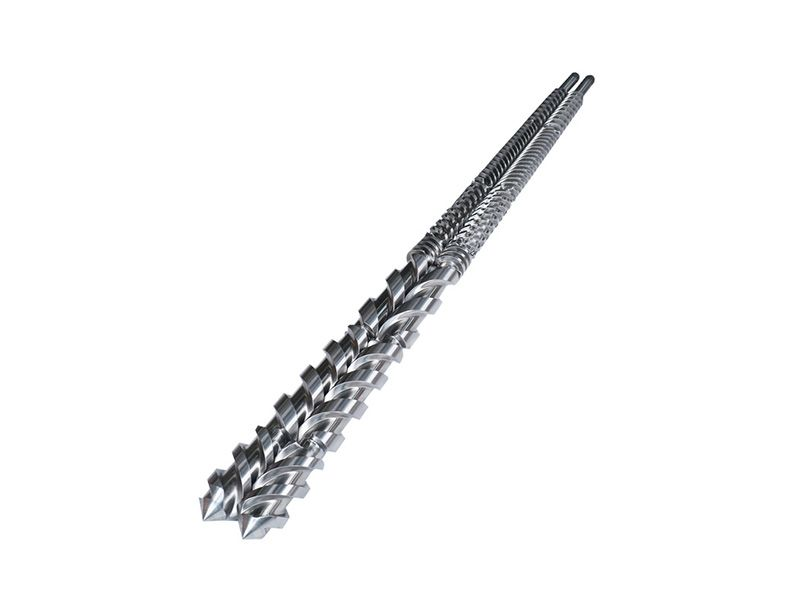
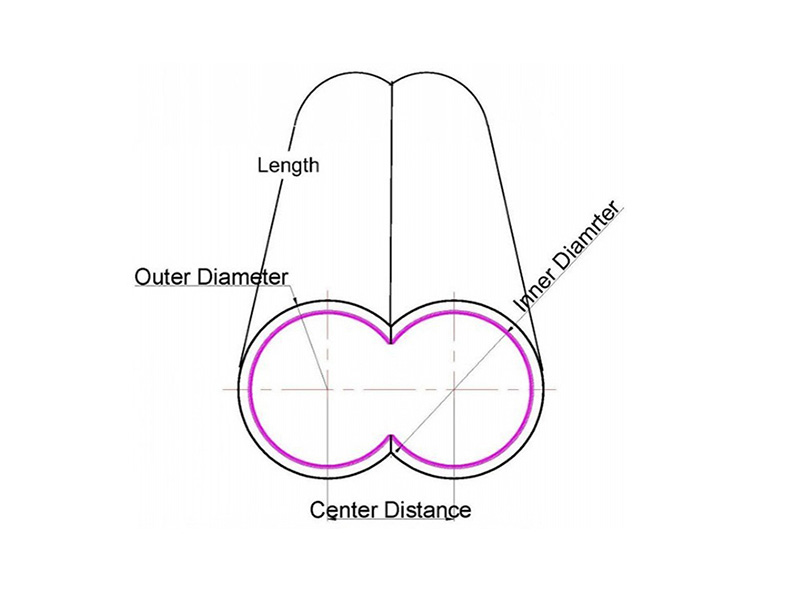
Figure 2. Conical twin screws and matching barrel. The tapered geometry illustrates why this assembly requires a compatible extruder.
Start with the extruder manufacturer, model, and original drawing. A reliable twin screw barrel manufacturer needs the screw diameters, total length, center distance, drive-end details, barrel outside dimensions, feed opening, vent positions, heater zones, thermocouple locations, and cooling arrangement. These features determine whether the assembly can be installed and operated safely.
For a PIPLL twin screw barrel proposal, the drawing and verified measurements help confirm the center distance, barrel zones, screw ends, and drive connection.
State the polymer, filler type and percentage, reinforcing fibers, pigments, recycled content, stabilizers, and any corrosive or abrasive additives. Also state whether the line produces pipe, profile, sheet, pellets, compound, or another product. A polymer name alone does not fully describe the wear, corrosion, flow, or mixing duty.
Current and target output, screw speed, temperature zones, melt pressure, torque behavior, daily running hours, and product quality records show how the system is actually being used. If the line must run at a higher screw speed or a narrower temperature window to maintain its previous output, the cause may involve wear, feeding, formulation, die condition, or process settings in addition to screw geometry.
Wear protection should be selected for the actual duty. Mineral-filled, glass-fiber-reinforced, recycled, or corrosive formulations can change the suitable screw surface and barrel-bore material. The aim is not to overspecify by default; it is to create a matched screw and barrel system with an appropriate service interval and stable, clearance.
Where the processing duty justifies it, PIPLL can review a bimetallic twin screw barrel or another wear-resistant configuration against the material formulation and expected service interval.
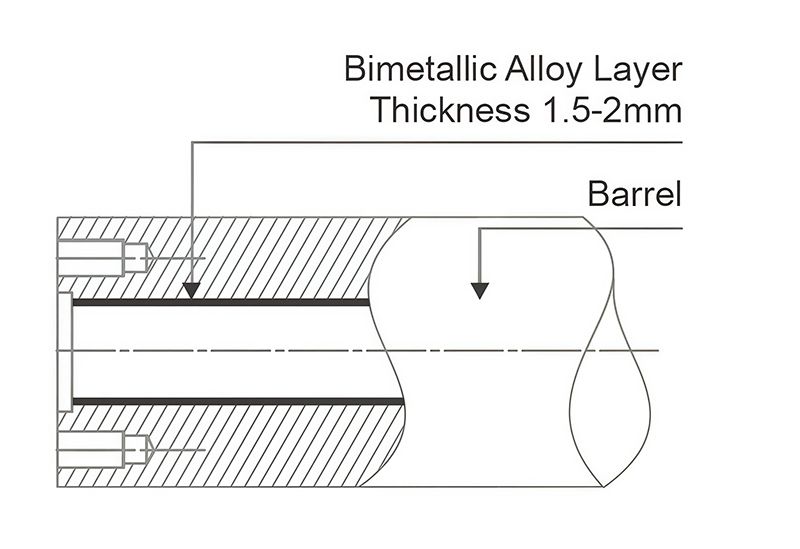
Figure 3. Sectional illustration of an alloy-lined barrel. The marked layer thickness is an example; the project specification determines the actual thickness and alloy.
Manufacturing typically includes material preparation, machining much as the barrel and screw categories, heat treatment or alloy treatment when specified, precision finishing, and dimensional inspection. For an alloy-lined barrel, the alloy system and bore finish must match the general product process.
Before approving production, confirm the final drawing, material proposal, treatment or alloy layer where relevant, critical dimensions, and inspection requirements. A technically complete specification is especially important when replacing older machinery or a component with unknown prior modifications.
A PIPLL manufacturing review keeps the twin screw barrel drawing, material proposal, inspection points, and required machine interfaces aligned before production starts.
These signs do not prove that the twin screw barrel is the only cause of a production problem. Review feeding, temperature control, die condition, and downstream equipment as well. However, measuring the screw and barrel condition is a useful part of a structured evaluation.
A twin screw barrel should be selected as a matched system for the installed extruder and the actual material-processing duty. Parallel and conical configurations are defined first by the machine architecture; the final material, surface, and geometry choices should then follow the formulation, output target, and wear history.
For a replacement project, send the drawing, and verified production results you gathered with the machine. This gives the supplier a sound basis for a technically accurate proposal.
When contacting PIPLL about a twin screw barrel replacement, include the original machine data and operating condition so the proposed configuration can be checked against the actual extrusion line.
Support | PIPLL | Screw and Barrel Solutions for Plastic Extrusion
Polymer processing screw manufacturers with custom twin screw and barrel solutions for PVC, PE, PP, PET, and other polymer extrusion applications.


+86 15267878906

1306 W building , NB-IoT Industrial Park, No. 199 Changxing Road, Jiangbei, Ningbo.
 Languages
