 Languages
-
-
Silicone Extrusion: A Screw That Doesn't Melt Anything
HTV compound arrives as a solid strip. The screw conveys, compacts and builds pressure — and it has to do all of that without letting the barrel get warm.
SILICONE EXTRUSION · COLD FEED · HTV COMPOUND · SCORCH
-
1. Nothing melts
Every plastics screw you have specified was designed around a phase change. Pellets come in cold, melt in the transition zone, and leave as a fluid. Silicone does not work that way. High-temperature vulcanising compound arrives as a mixed, milled strip at room temperature, and it stays a solid all the way through the barrel. The screw conveys it, compacts it, eliminates the air between the folds and builds enough pressure to push it through a die. There is no melting zone because there is nothing to melt.
That single difference inverts the design brief. On a plastics screw, heat is the working tool and the enemy is unmelted polymer. On a silicone screw, heat is the enemy and there is no unmelted polymer to worry about. The material has already been compounded and, depending on the cure system, may already be reactive. Anything the screw adds in the way of shear energy has to be taken straight back out, or the compound starts to cure in the barrel — and that is irreversible.
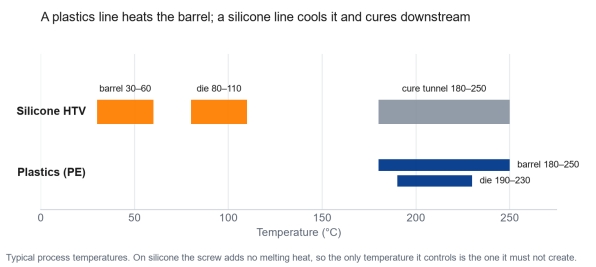
Where the heat sits on the two kinds of line. Plastics heat the barrel and the die; silicone cools the barrel, warms the die slightly, and puts all the heat downstream in the cure tunnel.
The contrast matters commercially because a silicone line is often bought by a processor who already runs plastics, and the instinct is to specify the new screw the way the old one was specified. The product range on the silicone extrusion page covers tube, profile and foam, and each of those has a different downstream, but they share the same cold-feed front end.
A cold-feed line is nearly always single-screw, and the reason is conveyability rather than mixing: a strip has to be gripped and pushed, which a single screw does with a forced feed section and a twin screw does not do well. The PE, PP and PVC selection guide is the nearest thing to a template — and exactly the wrong one to copy.
-
Typical process temperatures. On silicone the screw adds no melting heat, so the only temperature it controls is the one it must not create.
-
2. The barrel is a cooling jacket
On a silicone extruder the barrel is water-cooled in several independent zones, and the setpoints are in the range of 30–60 °C — some designs hold the barrel below 40 °C. The die is the one place that gets warmed, typically to 80–110 °C, to improve flow at the last moment. Compare that with a polyethylene line running a barrel at 180–250 °C and the inversion is complete.
The screw itself is usually cooled as well, through a channel in the core. This is the detail buyers forget, because it is invisible in a quotation: compound that sits in a flight against a warm screw body cures there, and the cured particle then travels down the line and either blocks the screen or prints into the product as a hard spot. Core cooling is not an option on this duty, and a screw supplied without it cannot be retrofitted cheaply.
Temperature control has to be fast as well as accurate. The compound entering the feed zone is at whatever temperature the strip happened to be, which is not controlled at all, so the barrel zones are compensating for an input that moves. Zones that respond slowly produce exactly the local overheating the design is trying to avoid. The general logic of zone-by-zone control applies, but here every zone is a cooling zone.
The geometry side of the same question is settled before the chiller is sized. Deep channels put more compound against the cooled wall per unit of shear, while a barrier profile is the wrong answer on this duty because it is designed to add work. Where the line is vented, the vent port checks apply with more force than usual.
-
3. Compression ratio 1.2 to 1.5, and why copying 3:1 ruins the run
A general-purpose polyethylene screw runs a compression ratio around 3:1, and that number exists to do work: it compacts the bed, generates pressure and produces the shear heat that finishes melting. On silicone all three are unwanted. The compound is already dense, the pressure is set by the die, and the shear heat is the failure mode.
Cold-feed silicone screws therefore run low compression, in the region of 1.2–1.5:1, with deeper channels and a shorter body than a plastics screw. The channel depth is what gives the compound somewhere to go without being worked hard — the same trade-off described under deep versus shallow channels , pushed to its extreme. Where a harder compound needs more compaction, the ratio moves up towards 2:1, but it does not approach a plastics value.
Parameter Plastics screw (PE) Silicone cold-feed screw Compression ratio about 3:1 about 1.2–1.5:1 L/D 24–32:1 10–12:1 typical; 16–18:1 for high-tear grades Barrel temperature 180–250 °C, heated 30–60 °C, water-cooled Die temperature similar to melt 80–110 °C, warmed Screw cooling optional standard, through the core What the screw does melts and pumps conveys, compacts, builds pressure Failure mode unmelted polymer, degradation scorch, air entrapment, pulsation Length follows the same logic. Ten to twelve diameters is normal; twelve to fourteen suits 40–60 Shore A compounds; sixteen to eighteen is used where high tear strength or fluorosilicone needs a longer mixing section. Beyond about twenty diameters the residence time starts to cost more in scorch risk than the mixing gains. That is the opposite of the usual L/D and compression advice , and it is the single most common mistake when a screw is specified from a plastics template.
Because the screw cannot fix a worn flight, the wear check matters more here than the geometry choice: checking wear without a teardown takes twenty minutes and tells you whether the pressure loss is the screw or the screen. If it is the screw, the repair or replacement decision on a low-compression body is usually replacement, because the channel depth is the specification.
-
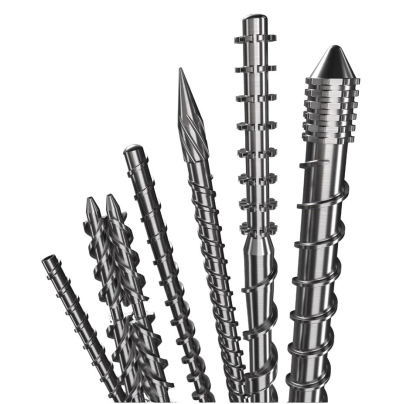
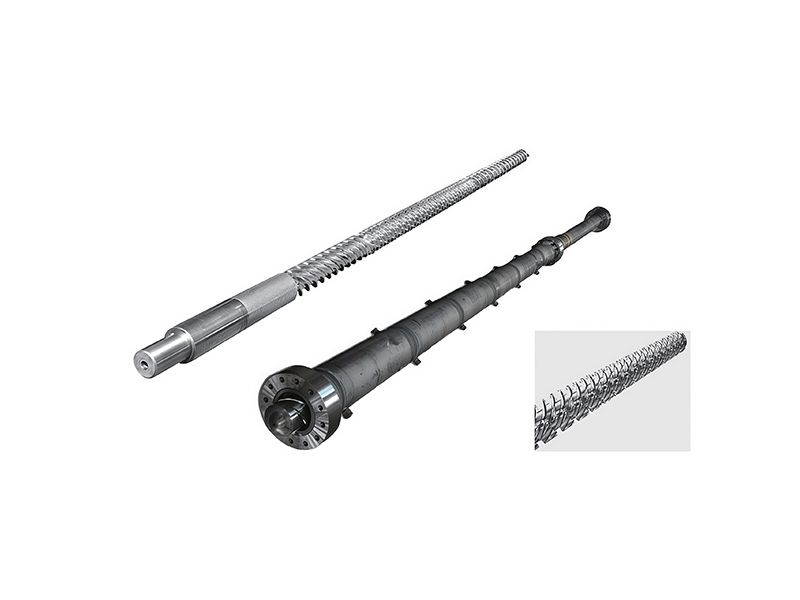
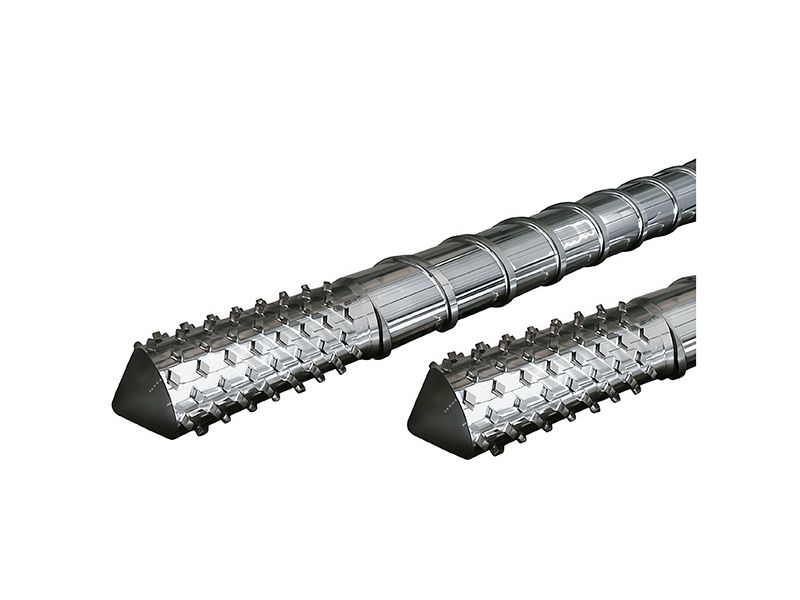
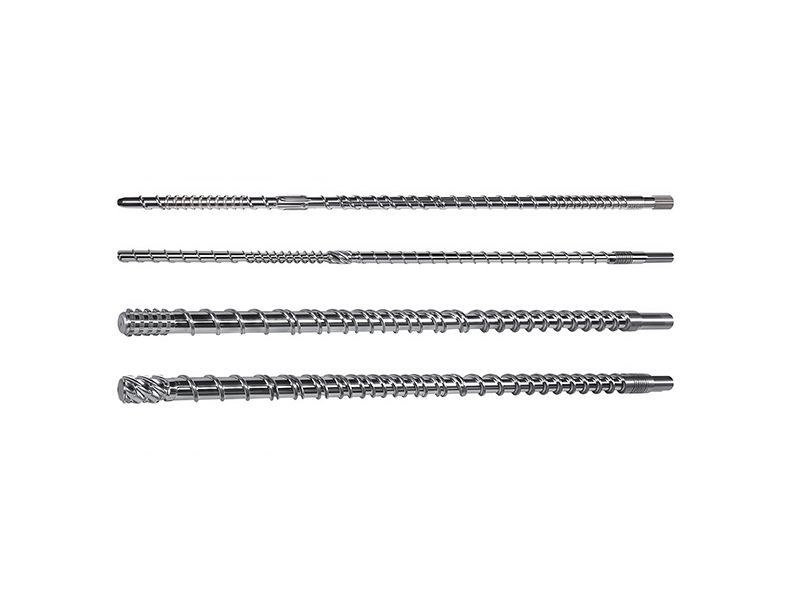
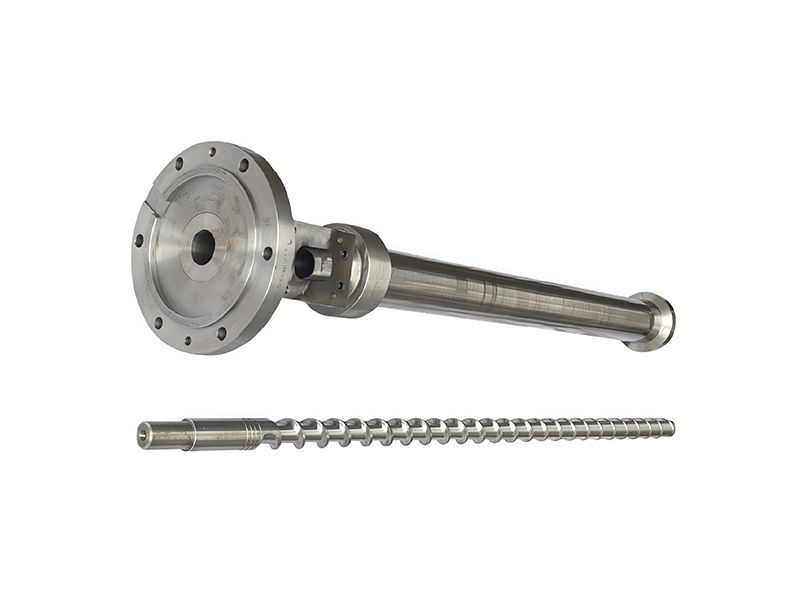
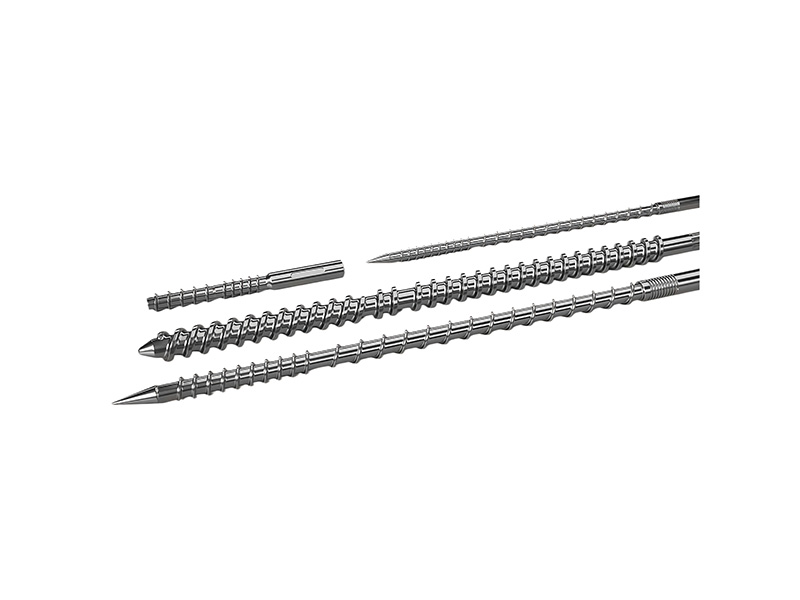
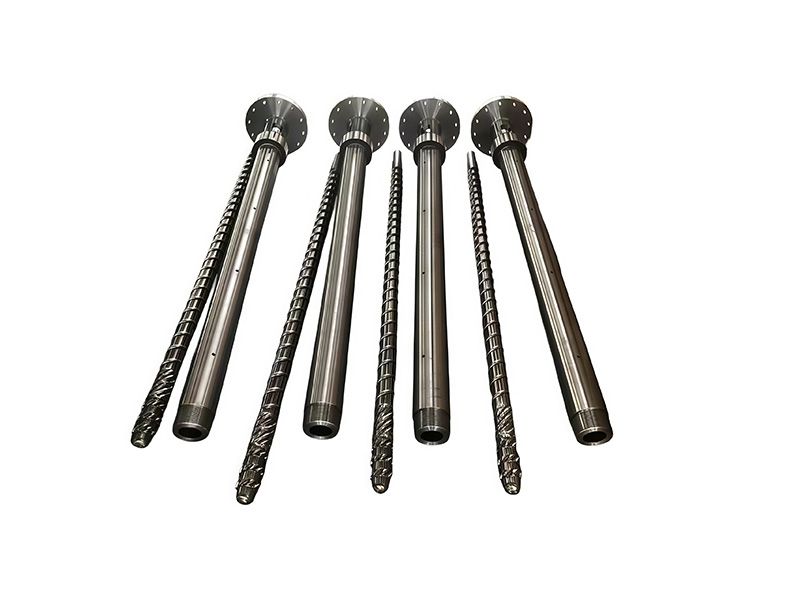
A single screw body for elastomer duty. Short, deep-channelled and low compression — the opposite of the plastics screw it is often mistaken for.
-
4. Feeding is half the machine
A silicone strip does not flow into a hopper. It has to be pulled in, and that is the job of a pair of feed rollers that grip the strip and force it into the flights. The rollers are driven independently and synchronised with the screw, because the ratio between feed rate and screw speed is what determines whether the flights are full. A starved flight conveys unevenly and the product varies in section.
The feed zone geometry is compound-specific. Soft compounds need a different throat and channel depth from hard ones, and a screw that runs well on 40 Shore A can starve on 70. This is why the feed section is usually quoted together with the hardness range rather than as a generic dimension. Air entrapment starts here too: a strip that folds over as it enters carries air into the barrel, and that air becomes porosity in the product or a bubble that collapses the pressure.
Pulsation that originates at the feed shows up as dimensional variation downstream and is frequently misdiagnosed as a die problem. The diagnostic sequence for surging and unstable output is the right starting point, with the feed rollers as the first suspect rather than the last.
Feed synchronisation is also the first thing to check on a line that runs well and then starts drifting: the maintenance routine covers the mechanical side, the surging diagnosis covers the process side, and diameter variation is what the operator actually sees.
-
5. The filter plate is also the pressure regulator
Between the screw and the die sits a filter plate carrying a screen pack. It does two jobs that are usually described as one. It removes contamination — cured particles, foreign matter, unmixed filler — which matters more on silicone than on most polymers because a single hard particle becomes a reject in a medical tube. And it builds back pressure, which is what makes the flow uniform enough to hold a tolerance.
Screen choice is therefore a balance rather than a maximum. A finer screen filters better and raises pressure, which raises the load on the screw and the temperature of the compound passing through. A coarser screen protects the compound and lets more through. On a line running tight tolerances the screen is changed on a schedule, not on failure, because a partly blinded screen changes the pressure without anyone touching a setpoint.
The plate also straightens the flow, breaking up the rotational component the screw imparts and delivering the compound to the die in a more axial pattern. That is why concentricity improves when the plate is correct, and why a line with a worn or mismatched plate produces tube that is round enough at the die and oval after curing.
The plate is a wear item that gets treated as a consumable and specified as an afterthought. It belongs in the acceptance inspection scope for a new line, and a spare should be on the shelf rather than ordered when one blinds. The custom project brief is the place to state the screen size the process needs.
-
6. Cure happens downstream, not in the barrel
The extrudate leaving a silicone die is not a finished product. It has almost no green strength — it will sag under its own weight and deform if touched — and it only becomes rubber once it has passed through the vulcanising tunnel, typically hot air or microwave, running somewhere around 180–250 °C. The entire thermal budget of the process sits in that tunnel, not in the extruder.
Commissioning is a matching exercise: screw speed, feed rate, haul-off and tunnel speed move as one system, and a screw that surges makes the downstream impossible to tune. That is why residence time matters even on a line this short.
The cure system itself constrains the window. Peroxide-cured compounds, the 2,4-dichlorobenzoyl peroxide type in particular, have a comparatively wide processing window and tolerate more variation in barrel temperature. Platinum addition-cure compounds are the opposite: low odour, suitable for food and medical use, and narrow. A few degrees of local overheating is enough to start the addition reaction in the barrel. Platinum cure is also inhibited by sulphur, tin and amines, so contamination from a previous compound on the same line is a cure failure, not a cosmetic defect.
Peroxide cure (e.g. DCBP) Platinum addition cure Processing window comparatively wide narrow; sensitive to local overheating Barrel temperature tolerance forgiving a few degrees matters Odour and by-products noticeable low Food and medical use limited standard choice Inhibited by acidic fillers, some pigments sulphur, tin, amines Line changeover risk moderate high — residue can stop the cure entirely -
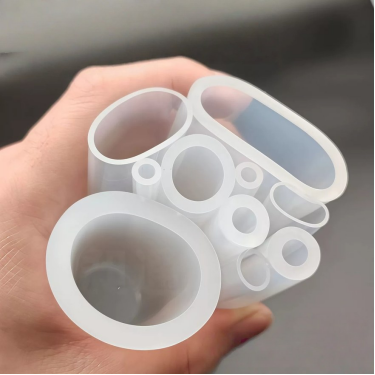
A multi-lumen silicone tube section. Tolerances at this scale are held by pressure stability at the die, which starts with a screw that does not surge and a compound that has not started to cure in the barrel.
-
7. Die swell, and the tolerance that follows from it
Silicone swells as it leaves the die. The compound is compressed inside the channel and relaxes on exit, so the die opening has to be cut smaller than the finished section by an amount that depends on compound hardness, die temperature and output rate. This is not a correction anyone can calculate from a data sheet; it is established on the line and then held by keeping the conditions constant.
The tolerance figures quoted for this duty are tight — around ±0.02 mm on section, with wall thicknesses below 0.1 mm in some medical tubing — and they are achievable only when everything upstream is steady. Swell that changes because output changed will move the section outside tolerance no matter how good the die is. The measurement and correction loop for diameter variation is the relevant one, and on silicone the laser gauge is usually closed-loop to haul-off rather than to screw speed.
Tolerance is quoted to the customer and delivered by the line, so it is worth writing down what the line can actually hold. The custom project brief should carry the section tolerance, and how to choose a manufacturer is where the supplier's ability to work to it gets tested. The application index groups the duty by product family.
-
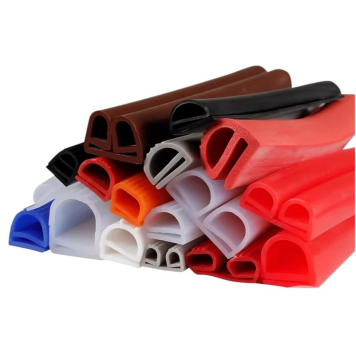
Silicone profiles in several compounds and colours. Section accuracy depends on die swell staying constant, which in turn depends on the screw delivering a steady pressure rather than a steady average.
-
8. Scorch is the failure that ends the run
Scorch is premature vulcanisation inside the barrel. It starts as a skin on the flight or a lump in a dead spot, and from there it either blocks the screen, blocks the die, or sheds hard particles into the product. Unlike a worn screw, it does not develop gradually — once a line starts producing cured particles, the run is over until it is cleaned out.
What you see What it usually is Where to look Hard spots or grit in the extrudate Cured particles from the barrel or screw core Flight roots, screw tip, any dead spot Rising head pressure with no setpoint change Screen blinding, often from cured material Filter plate and screen pack Surface roughness or a torn skin Local overheating, or compound too cold to flow Barrel zone setpoints against actual compound temperature Porosity or bubbles in the section Air carried in at the feed Feed rollers, throat geometry, strip folding Oval or eccentric tube Pressure pulsation, or a mismatched filter plate Feed synchronisation, plate and screen Because scorch is thermal and cumulative, residence time is the variable that matters most. A screw that is too long, a channel that is too shallow, a barrel zone that is slow to respond, or a shutdown that leaves compound sitting hot all produce the same result. The wider maintenance routine for these lines should treat barrel temperature stability as the primary health indicator, ahead of output or power draw.
When scorch has already happened, the question is whether the barrel survived it. Cured material pulled off a flight can take the surface with it, which is a bimetallic or nitrided question rather than a cleaning question. The nitrided barrel guide and the service life note both assume the barrel is not being run hot, which is exactly the assumption that fails here.
-
9. Medical and food grades change the metal, not just the paperwork
Platinum-cured silicone for medical and food contact is specified for what it does not contain as much as for what it does. The hardware has to support that: no carbon steel in the melt path, no dead spots that hold compound between batches, polished and radiused flow surfaces, and a screw that empties itself when the line stops. A barrel that is metallurgically adequate for an industrial profile can still be unacceptable here.
The reasoning is close to the one applied to stainless and sanitary extrusion , and the material choice usually runs to stainless or a nickel-based alloy rather than a hardened tool steel. The comparison between surface options is set out in the bimetallic material selection guide , though on this duty cleanability often decides before wear resistance does.
The product families diverge downstream from a common front end: silicone tube for medical and transfer duty, silicone profile for sealing, and the foam variants at foam profile and foam tube . Cable insulation runs on the same principle through the cable extrusion screw and shares the cold-feed logic.
-
10. Colour changes, purging and the screw that empties itself
Silicone sticks. A screw designed for plastics relies on the next batch of pellets to push the last one out, and that does not happen with a compound that is being conveyed as a solid. Colour changes on a silicone line are therefore a hardware question: the screw needs a geometry that can be emptied, sometimes a floating or withdrawable design so it can be pulled and cleaned, and a purge routine that is written down rather than improvised.
The sequence has more in common with PVC changeover than with a polyolefin line, because both involve a material that will degrade or cure if it sits. On platinum-cured compounds the stakes are higher: residue from a sulphur-cured batch can inhibit the cure on the next run entirely, which turns a colour change into a scrapped shift.
This is where the elastomer family overlaps. Rubber extrusion runs on the same cold-feed principle with different compounds — EPDM profiles, for instance, through rubber profile — and the same purging discipline applies. Where a processor runs both, the TPE range adds a third behaviour again, because thermoplastic elastomers do melt.
Where a plant runs silicone and rubber on the same floor, the rubber tube range and the silicone lines share a purge discipline but not a compound, and cross-contamination is the usual cause of a cure that will not start. The exporter verification guide is worth a read before ordering a second screw for that reason alone.
-
11. What to send us
A silicone screw specification starts with the compound, not the machine: hardness in Shore A, the cure system, filler type and loading, and whether the line changes colour or compound regularly. Then the product: tube, profile or foam, section size, wall thickness, tolerance, and the output the downstream can absorb. Add the existing screw drawing and the barrel temperature profile currently in use.
PIPLL builds screws and barrels for cold-feed elastomer duty, including low-compression profiles and core-cooled screws, and the custom engineering route works from a drawing or a measured part. The general single-screw range is at single screw barrel , with the pipe and tube variant at pipe and tube screws . Capacity is on the manufacturing page and the sequence under our process ; the contact page is the fastest route if a line is already down.
-
Losing runs to scorch on a silicone line?
Send the compound hardness and cure system, the product section and tolerance, and your current barrel temperature profile. We will come back with a low-compression, core-cooled screw geometry sized for the compound rather than copied from a plastics template. PIPLL manufactures screws and barrels for silicone, rubber and TPE cold-feed extrusion. -
✔ Compression ratio and L/D set for the compound, not for PE
✔ Screw core cooling as standard, not an option
✔ Geometry that empties itself on colour change