 Languages
Food and Feed Extrusion Screw Barrel: Stainless Steel, Sanitary Design and Starch Cooking
-
Food and Feed Extrusion Screw Barrel: Stainless Steel, Sanitary Design and Starch Cooking
A food extruder is a chemical reactor with a screw inside it. Starch gelatinises, protein denatures, and the barrel has to be cleaned to a microbiological standard between runs. That changes the alloy, the surface finish, the screw geometry and the wear mechanism — none of which is covered by a plastics specification. This guide sets out the metallurgy, the sanitary design criteria, the specific mechanical energy behind the screw configuration, and the process window for snacks, cereal, pet food and textured protein.
-
FOOD EXTRUSION SCREW BARREL · FEED EXTRUSION SCREW AND BARREL · SANITARY STAINLESS SCREW DESIGN · STARCH GELATINISATION AND SPECIFIC MECHANICAL ENERGY
-
1. What makes food extrusion a different problem
In plastics extrusion the screw melts, homogenises and pressurises. The product is the shape that comes out of the die, and the melt is a means to that end. In food extrusion the melt is the product: starch granules lose their crystalline order, protein molecules unfold and re-aggregate, and the texture of the finished piece is fixed by how much mechanical energy and water it received inside the barrel. The die shapes it, but the screw cooks it. The same three-zone sequence is described for polymer in the single screw barrel overview .
-
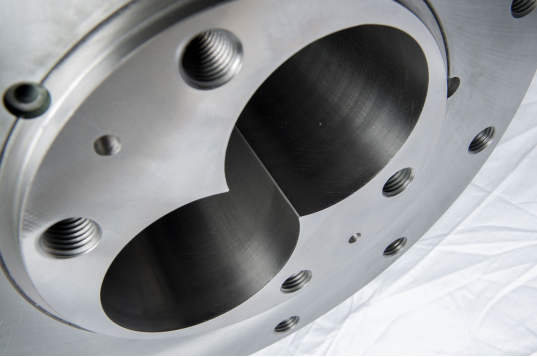
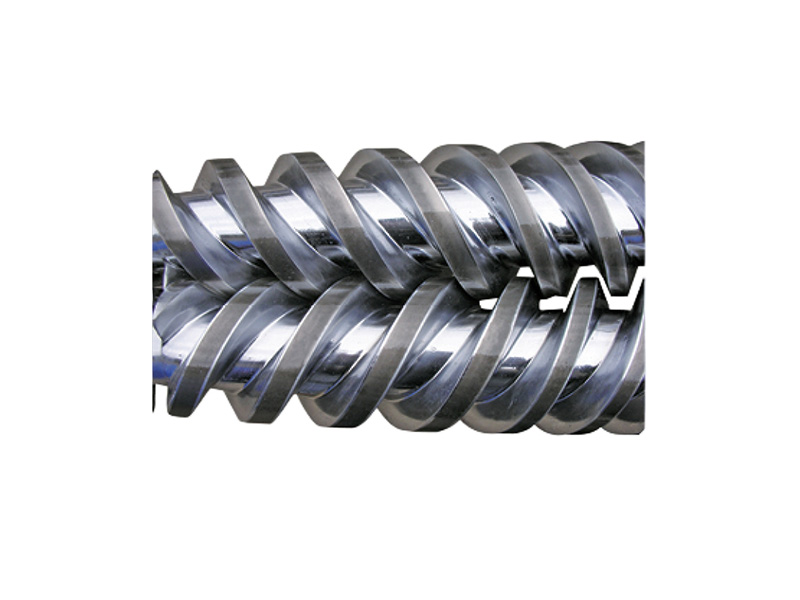
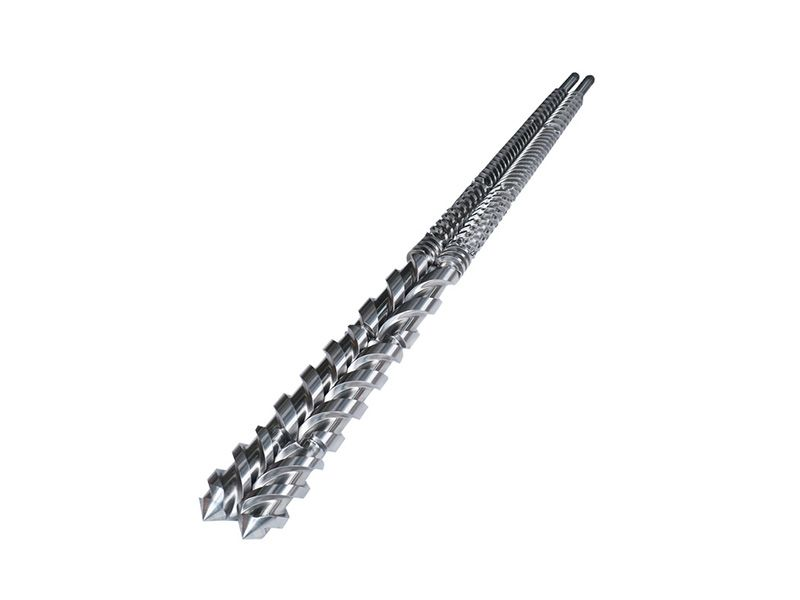
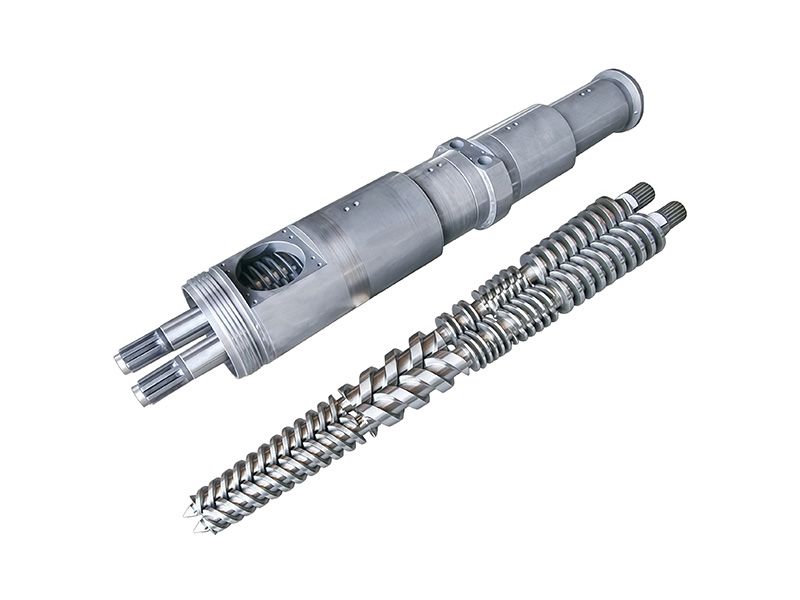
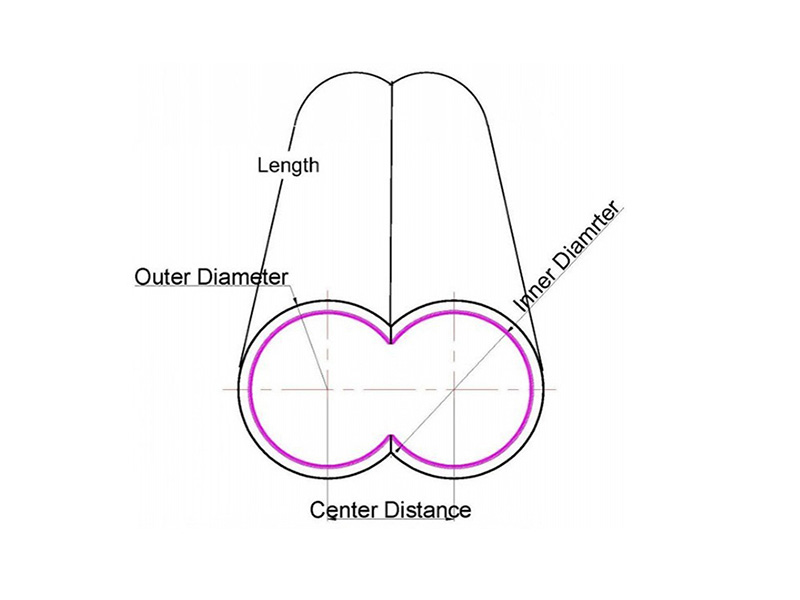
A parallel twin-screw barrel. Food and feed lines are built on the same co-rotating platform as plastics compounding — the difference is in the alloy, the finish and the cleanability, not in the kinematics.
-
Three consequences follow, and they drive every design decision in this article.
• Water is an ingredient, not a contaminant. Plastics processors spend money removing moisture; food extruders inject steam and water on purpose, typically to 14–30 % in-barrel moisture depending on product. That means the barrel needs steam injection ports, a vent, and an alloy that tolerates continuous wet service at 150–180 °C. The options are set out in the bimetallic barrel range .
• Energy input is the recipe. Specific mechanical energy — SME, expressed in Wh/kg — is the single number that correlates with expansion, degree of cook and texture. It is set by screw configuration, screw speed and feed rate, which makes the screw geometry a formulation variable rather than a machine detail. The element families are in the screw element catalogue .
• The machine has to be cleaned to a microbiological standard. A plastics line can run for months between deep cleans. A pet food or meat analogue line may be wet-cleaned daily, and a pathogen finding in a dead zone is a recall, not a quality complaint.
Aspect Plastics extrusion Food and feed extrusion Purpose of the screw Melt, homogenise, pressurise Cook, texturise, then shape Moisture Removed before processing Added as steam or water, 14–30 % Barrel alloy Nitrided 38CrMoAlA is standard 316L, 2205 duplex or hardfaced stainless Surface finish Functional Hygienic — Ra ≤ 0.8 µm, often electropolished Cleaning regime Purge compound Dry clean, wet clean or CIP, often daily Governing metric Output and melt temperature Specific mechanical energy and degree of cook Dominant failure mode Flight wear Corrosion, burn-on and kneading-block wear together It is worth saying plainly that the hardware is not exotic. A co-rotating twin-screw food extruder is the same machine family as a plastics compounding extruder — same self-wiping profile, same modular shaft, same torque transmission. What changes is the material specification and the hygiene engineering around it. The machine comparison is on the parallel twin-screw barrel pages .
KEY INSIGHT — If you specify a food extruder barrel the way you specify a plastics one, you will get a barrel that processes correctly for six months and then fails a swab test. Corrosion resistance and cleanability are not finish options — they are the design brief.
-
2. The metallurgy problem: stainless is soft, nitrided is not cleanable
Plastics screws are nitrided because nitriding is cheap, gives a 900–1,100 HV surface, and resists abrasion well. The nitriding guide explains why that is the right answer for filled polymer. It is the wrong answer for food, for three separate reasons. The nitrided option is examined in detail in the nitrided and bimetallic comparison .
• Caustic cleaning attacks the case. A 1–2 % sodium hydroxide CIP cycle at 60–80 °C will strip or embrittle a nitrided layer over time, and the damaged areas then corrode preferentially. The alternative alloys are compared in the bimetallic barrel guide .
• Chlorides pit it. Feed premixes contain 0.3–1 % salt, plus trace mineral sulphates and chlorides. Once the case is breached, pitting proceeds into the base steel and the pits become product traps. Material selection for that case is in the bimetallic material guide .
• It cannot be brought back to a hygienic finish. Re-polishing a nitrided surface removes the case. A stainless barrel can be re-polished and re-passivated in place. The case itself is applied by gas nitriding .
So food work moves to stainless — and stainless is soft. Annealed 316L sits at roughly 150–200 HV, less than a fifth of a nitrided case. The engineering answer is not to accept the wear but to choose the grade and the surface treatment together. The polymer-side equivalent is in the hardfacing alloy grades .
Material Typical hardness PREN Good for Watch out for 304 / 1.4301 150–190 HV ≈ 18 Dry-product lines, low chloride, low salt Pitting above about 50 ppm chloride in the cleaning water 316L / 1.4404 150–200 HV ≈ 25 General food contact, salt-bearing feed, most wet-cleaned lines Still marginal for high-chloride CIP; cold-worked grades are better 2205 duplex / 1.4462 250–300 HV ≈ 35 High-chloride feed, erosion-corrosion at the die Welding discipline; not ideal above about 300 °C 17-4PH / 1.4542 (H900) 40–44 HRC ≈ 17 Screws needing wear resistance plus corrosion resistance Lower PREN than 316L; not for high-chloride service Nitronic 50 / 1.3964 ≈ 250 HV ≈ 34 Wear-resistant stainless for shafts and couplings Cost; availability in bar stock Ni-based hardfacing on 316L 55–60 HRC — Kneading blocks and flight lands in abrasive feed Thermal expansion mismatch; coating must be qualified for food contact PVD CrN or DLC on stainless 1,500–2,000 HV (thin) — Product-contact sliding surfaces, cleanability Micron-scale thickness; no help once the substrate wears -
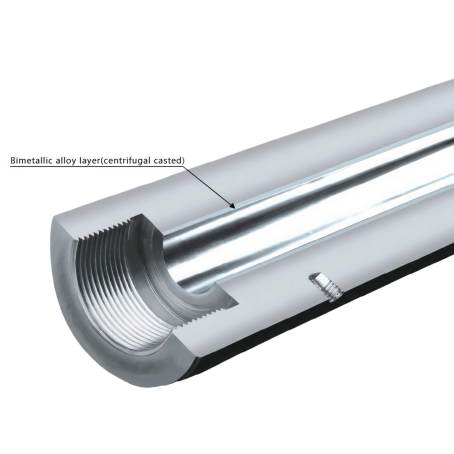
Pouring a hardfacing alloy into a barrel shell. In food work the hardface has to be selected for corrosion resistance as well as hardness, which rules out several of the standard plastics alloys.
-
PREN is the pitting resistance equivalent number, calculated as Cr + 3.3 Mo + 16 N. It is a rough ranking rather than a guarantee, but it explains why 316L survives a feed line that destroys 304, and why duplex is specified when the cleaning water is recycled and the chloride level creeps up over the years. Chlorinated polymers are the other place this matters, and CPVC extrusion is the closest polymer-side comparison.
The choice is not only about the barrel. Screws, shafts, couplings, breaker plates and die bodies all sit in the same environment, and mixing a nitrided screw into a stainless barrel just moves the corrosion to the cheapest part of the assembly. The alloy selection guide covers the compatibility rules in more detail, and the bimetallic and nitrided comparison is the right starting point if you are translating a plastics specification across.
-
3. Surface finish, dead zones and cleanability
Cleanability is a geometry problem with a surface finish on top. A rough surface holds a biofilm that chemical cleaning will not remove; a dead zone holds product that never sees the cleaning chemical at all. Both are design failures, and neither can be fixed by cleaning harder. The product-contact surfaces are described on the barrel with internal liner sleeve page .
Zone Target Ra Reason Barrel bore, product contact ≤ 0.8 µm, 0.4 µm for high-care lines Biofilm retention; also reduces burn-on Screw flights and kneading blocks ≤ 0.8 µm, electropolished where possible Product smears into polishing marks and carbonises Die face and breaker plate ≤ 0.4 µm Highest shear, highest temperature, worst burn-on Non-product surfaces ≤ 3.2 µm Cleanable but not product contact Welds in the product zone Flush, ground, Ra ≤ 0.8 µm, passivated Weld scale is a corrosion initiation site • No threaded joints in the product zone. Threads are crevices by definition. Use clamped, flanged or sanitary couplings.
• Internal radii of 3 mm minimum, and no square-cornered pockets. Every corner is a place where product sits and nothing flows.
• No blind holes or dead legs. Thermowells should be flush with the bore or fully welded from the outside.
• Self-draining geometry. If the line is wet-cleaned, every low point needs a drain, and the barrel should slope to it.
• No copper, brass or zinc in contact. Food acids and cleaning chemicals attack them, and the corrosion products are a contamination risk. The alloy options are listed on the bimetallic extrusion barrel page .
• Gaskets and seals compliant with the food-contact framework — EPDM, PTFE or platinum-cured silicone, with the declaration of compliance on file. The rest of the pack is described in the documentation checklist .
The regulatory baseline is worth stating because it is often assumed rather than checked. In the EU the framework is Regulation (EC) 1935/2004 with GMP under 2023/2006; in the United States it is FDA 21 CFR Parts 175–177 for food-contact materials; in China it is GB 4806.1 with GB 4806.9 for metallic materials. A material certificate is not a declaration of compliance — ask for the declaration, and check that it covers the actual cleaning chemicals and temperature range. The factory side of that paperwork is on the manufacturer profile page .
-
4. Screw configuration: where the energy comes from
In a food extruder the screw is the heat exchanger. Barrel heaters set the wall temperature, but most of the energy that cooks the product comes from viscous dissipation — mechanical work converted to heat in the melt. That work is measured as specific mechanical energy:
SME (Wh/kg) = (torque × screw speed) / feed rate, with torque in Nm, speed in rad/s and feed rate in kg/s, converted to watt-hours. A line running 800 kg/h at 900 Nm and 400 rpm is putting roughly 80 Wh/kg into the product, which sits in the middle of the snack range. Energy input on a high-speed extrusion line is calculated the same way.
Product Typical SME (Wh/kg) In-barrel moisture Product temperature Direct-expansion snacks 40–120 14–22 % 140–180 °C Breakfast cereal 60–150 15–25 % 150–190 °C Pet food, dry expanded 50–130 20–30 % 110–150 °C Aquatic feed 60–140 22–30 % 110–150 °C Textured vegetable protein 80–200 30–50 % 140–180 °C Modified starch 30–100 18–28 % 120–160 °C Those ranges are indicative and product-specific — a single recipe can move 30 % either way. They are useful because they tell you what the screw has to deliver, and therefore how the elements should be arranged. The conveying and kneading families are catalogued in the twin-screw element guide .
Element Function in a food line Where it goes Conveying, 60–90° pitch Feed and transport at low fill Feed zone, and between processing zones Conveying, 30–45° pitch Builds fill length and residence time Before a kneading block, to starve or flood it deliberately Kneading block, 30° Gentle distributive mixing, low SME Protein texturisation, delicate products Kneading block, 60–90° High shear, starch gelatinisation Cooking zone, the main SME source Reverse flight element Melt seal, raises fill and pressure Before the vent, and before the die Shearlock / narrow disc Intensive local shear Dispersion of minor ingredients The arrangement matters more than any single element. Putting the high-shear blocks early raises SME before the starch has hydrated; putting them late, after the water has been absorbed, gives a different product from the same energy input. The screw element guide covers the conveying and kneading families in detail, and the same vocabulary transfers directly to food work.
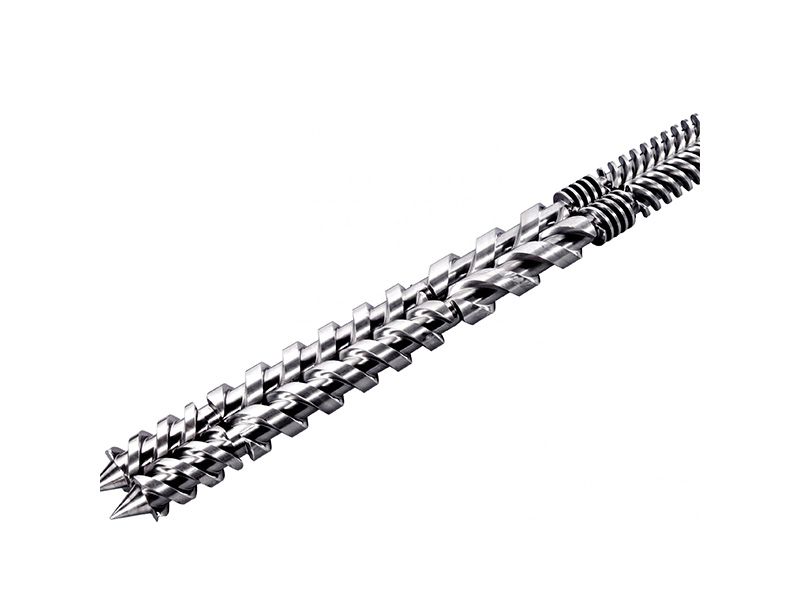
For a first specification, it helps to think in terms of three zones: a feed zone that conveys without compaction, a cooking zone of 60–90° kneading blocks where the SME is generated, and a metering zone with reverse elements that builds die pressure and strips volatiles. The twin-screw element selection article walks through the same three-zone logic from the plastics side.
-
5. Twin screw or single screw
Both are used, and the choice is driven by the product rather than by output. The mechanical comparison is in single screw versus twin screw .
Co-rotating twin screw Single screw Typical L/D 24–40 20–30 Screw speed 200–600 rpm 80–300 rpm Moisture tolerance High — up to 50 % Lower; steam tends to cause slip Recipe flexibility High; modular elements can be re-arranged Fixed geometry Mixing Excellent, including distributive and dispersive Adequate for homogeneous recipes Wear pattern Kneading block tips and barrel at the high-pressure zone Flight lands, feed zone Typical products Pet food, TVP, cereal, modified starch Snacks, pasta, simple cereal, confectionery Co-rotating twin screw dominates pet food and textured protein because both need high moisture and flexible energy input. The parallel twin-screw range and the conical range are the two platforms to compare; conical machines are usually chosen where the feed is bulky and the available floor space is short, and they handle high torque at low speed well. The platform differences are set out on the conical twin-screw pages .
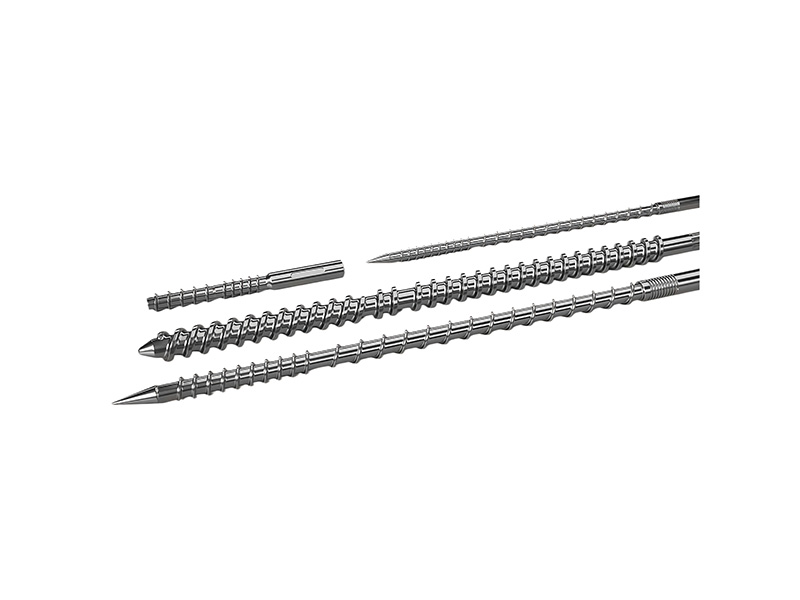
Single screw food extruders are still the cheapest way to make a direct-expansion snack. They rely on a grooved feed section and a compression ratio of 2.0–3.0 to generate the pressure, and on steam injection downstream for moisture. The high-speed single screw used for pipe and cable is a different animal — the food version runs slower and with a much lower compression ratio, because wet, sticky starch does not behave like a polymer melt. The plastics comparison is in the high-speed HDPE pipe guide .
KEY INSIGHT — Do not size a food line from a plastics screw drawing. The compression ratio, the feed section and the mixing strategy all change once the feed is 20 % water and the product is supposed to expand at the die. The single versus twin comparison is a reasonable starting point, but the numbers have to be re-derived for a wet, cookable feed.
-
6. The process window
The window is narrower than it looks, and it is bounded by chemistry rather than by the machine. The temperature limits on a PVC extrusion line are a useful contrast, because that is the other resin with a chemistry-bounded window.
Zone Temperature What is happening Limit Feed 40–70 °C Conveying, first hydration Above 80 °C the feed becomes sticky and bridges Hydration / mixing 70–110 °C Water uptake, starch begins to swell Too fast a ramp leaves dry cores inside the particle Cooking 120–180 °C Gelatinisation, protein denaturation Above about 190 °C, Maillard browning and burn-on accelerate Vent / devolatilisation 100–140 °C Steam and volatile removal Product must be above the saturation temperature or the vent floods Die 130–190 °C Final cook, expansion on exit Die pressure 2–10 MPa; higher collapses expansion Two numbers govern most of the trouble. The first is the glass transition of the starch-water system: below it, the product is a glass and it will not expand; above the gelatinisation temperature with sufficient water, it becomes a melt. The second is the die pressure. Expansion on exit is driven by the pressure drop and the flash-off of superheated water, so a die that is too restrictive gives a dense, glassy product even though the SME was correct. Die and breaker-plate detail is covered in the replacement guide .
Venting deserves its own note. Food extruders use a vent to remove steam and volatile flavour compounds, and the same mechanical rules that apply to a vented plastics barrel apply here — except that the vent in a food line is also a hygiene risk, because it is a path into the product zone. A vent that floods is both a process failure and a contamination event.
-
7. Wear and corrosion in service
Food and feed streams are less abrasive than glass-fibre compounds but more corrosive, and the combination produces a wear pattern that is different from anything in plastics. The plastics baseline is in the life expectancy guide .
Mechanism Where it acts What drives it Mitigation Chloride pitting CIP-wetted zones, vent, die face Salt in feed, chloride in cleaning water 316L minimum, duplex for high chloride, control water quality Caustic attack of the case All wetted surfaces 1–2 % NaOH at 60–80 °C No nitrided parts in the product zone Abrasion Kneading block tips, flight lands Limestone, bone meal, mineral premix Hardfacing or duplex; replace blocks rather than rebuild Burn-on and carbonisation Die face, last kneading block, vent Protein and reducing sugars above 160 °C Lower surface temperature, polish, shorten residence time Erosion-corrosion Die land, reverse elements High-velocity wet slurry Duplex or higher PREN; reduce local velocity Fatigue Shaft at the first kneading block Torque cycling with a starved feed Torque limit, feed control, shaft radius -
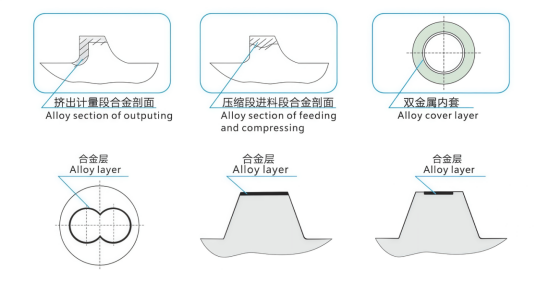
The alloy layer in section. In food service the liner has to be judged on both its thickness and its corrosion allowance, because a liner that is thick enough for wear can still be too thin once pitting is taken into account.
-
The single most expensive failure in a food plant is not wear, it is burn-on. Protein and sugar at 160–190 °C on a hot surface will carbonise into a dark deposit; the deposit then spalls, and black specks appear in the product. In a retail food line that is a recall trigger, and it is frequently diagnosed as a cleaning failure when the real cause is a local hot spot or a dead zone in the screw. The black-specks inspection procedure written for ABS extrusion applies almost unchanged.
Corrosion is the slow one. It starts as discolouration in a crevice, becomes a pit, and the pit then holds product through the cleaning cycle. By the time it is visible on a swab test the barrel is usually past re-passivation and into replacement. The maintenance guide covers the inspection intervals that catch it earlier, and the wear-check method is the right template for recording bore and flight dimensions between shutdowns.
-
8. Sanitary design checklist
Use this as a pass/fail list at the drawing review stage. Every item is cheaper to fix on paper than on a commissioned line. The same review discipline is applied to custom screw projects .
# Requirement Pass criterion 1 Product-contact alloy declared 316L minimum, mill certificates on file, food-contact declaration issued 2 Surface finish Ra ≤ 0.8 µm measured on the bore and flights; ≤ 0.4 µm on the die face 3 Internal radii ≥ 3 mm everywhere in the product path 4 Threaded fasteners None in the product zone 5 Dead legs and blind holes None; thermowells flush or fully welded 6 Drainability Every low point drains; barrel slopes to the outlet 7 Barrel split line Gap ≤ 0.05 mm under operating temperature; no product ingress 8 Screw-to-barrel clearance Uniform along the length; self-wiping profile verified 9 Vent and steam ports Steam traps fitted, no condensate pooling, removable for cleaning 10 Seals and gaskets Food-contact compliant, removable, no crevice behind the seal 11 Dissimilar metals No copper, brass or zinc in contact; galvanic pairs isolated 12 Cleanability verification Riboflavin or ATP test after a cleaning cycle, documented Item 12 is the one that gets skipped and the one that matters. A riboflavin spray test shows where the cleaning chemical did not reach, and it will find dead zones that no amount of visual inspection will. Run it before the line is signed off, not after the first environmental swab fails. Book it alongside the maintenance schedule .
-
9. What to send for a quotation
A food extruder barrel is quoted from the process, not only from the drawing, because the alloy and the screw configuration both depend on what is being cooked. The ordering route is set out in the eight-point twin-screw checklist .
• Machine make and model, screw diameter, L/D and centre distance.
• Barrel drawing, including the split-line geometry, jacket connections and vent positions.
• Product type and target capacity in kg/h. The limits are on the production capacity page .
• Recipe outline: starch source, protein source, fat and fibre levels, and the mineral or premix load.
• In-barrel moisture and the steam injection rate.
• SME target and the current screw configuration, if the line already exists.
• Cleaning regime: dry clean, wet clean or CIP, with the chemicals and temperatures used.
• Required compliance: FDA, EU 1935/2004, GB 4806, or a customer-specific standard.
• Wear or corrosion history, with photographs of the failed surfaces. What happens after that is described in the repair or replacement guide .
The cleaning regime is the item most often left out, and it is the one that decides the alloy. A barrel specified for dry cleaning in 316L will fail within a year on a line that is caustic-CIP'd twice a day. The replacement project guide shows how the same information pack is used for a like-for-like rebuild, and the OEM drawing route applies when the original manufacturer no longer supports the machine.
-
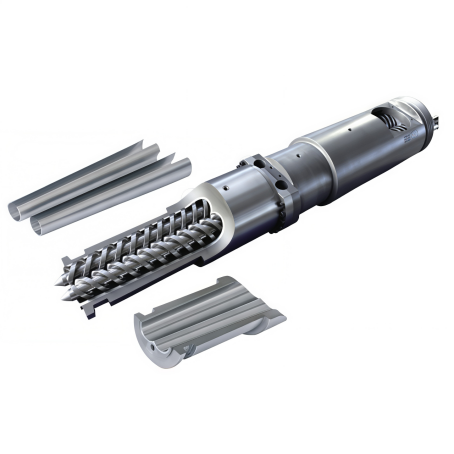
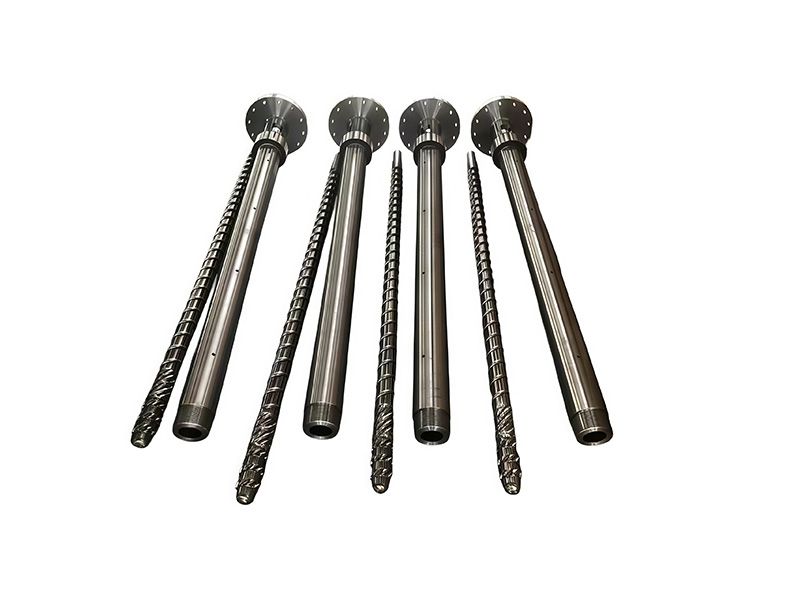
A barrel with an internal liner sleeve. Replaceable liners are attractive in food service because the product-contact surface can be renewed without scrapping the jacketed body — provided the liner material meets the same hygiene requirement.
-
Where the barrel body is sound and only the product-contact surface has degraded, a lined or sleeved barrel is often the economic answer. The constraint is the liner alloy: it has to be available in a food-contact grade, and the shrink-fit temperature has to be compatible with the jacket. The bimetallic barrel page covers the liner options from the plastics side; for food, substitute a stainless or duplex liner for the standard hardfacing. Renewing a worn barrel rather than replacing the body is the other option.
Lead time and documentation are part of the specification in this market. Ask for the material certificates, the surface-finish report and the dimensional report with the shipment, not afterwards — a barrel that arrives without them cannot be released to production in most food plants. The supplier verification checklist lists the documents worth requesting before the order, and the manufacturing overview shows which stages generate them.
-
10. Frequently asked questions
Can a plastics extruder barrel be converted to food use?
Sometimes, but the economics rarely work. The barrel body and jacket can usually be retained; the screw, the liner and every product-contact surface cannot, because nitrided steel is not acceptable in a caustic-cleaned food line. By the time the screw, liner, seals and documentation are replaced, a new barrel is often the cheaper route. The economics are worked through in repair or replace .Is 304 good enough, or do I need 316L?
304 is adequate for dry, low-salt products with good-quality cleaning water. Anything with added salt, mineral premix, or recycled CIP water should be 316L at minimum, and high-chloride feed is better served by 2205 duplex. The decision should be made on the chloride level in the cleaning water, not on the product alone. The same pitting logic applies to PVDF and other fluoropolymers , which are specified for aggressive media.Why does my product burn on at the die even though the barrel temperature is correct?
Usually because the die is hotter than the barrel setpoint — shear in the die land adds energy that the thermocouple does not see. Check the actual die-face temperature with a contact probe, then reduce SME upstream or open the die. Polishing the land and shortening the residence time in front of the die also helps. The same die-pressure trade-off appears on a pipe and tube line .How often should the screws be replaced?
It depends far more on cleaning regime than on tonnage. In dry-cleaned snack lines with 316L screws, five to eight years is common. In wet-cleaned pet food with mineral premix, kneading blocks may need replacement in two to three years and the screw shafts may last twice that. Inspect on condition, and record dimensions at every shutdown. The record sheet is described in how long a screw barrel lasts .Do I need a vent?
If the product contains more than about 20 % water and the die pressure is high, yes. The vent removes steam that would otherwise flash violently at the die and give an uneven expansion. It also gives you a point to remove volatile off-notes. It has to be designed as a hygienic feature, not just a hole in the barrel. Vent-port design is covered in the vented barrel notes .If you are specifying a food or feed line and the barrel is the open question, send the product description, the moisture level and the cleaning regime. Those three inputs decide the alloy, the finish and the screw configuration, and they are enough to start a specification review. The application pages show how the same review runs for polymer families, and the capacity page covers what can be built in a single pour or a single screw blank.
-
Need a Food or Feed Extrusion Screw and Barrel Quoted?
Send the product description, the moisture level and the cleaning regime. Those three inputs decide the alloy, the finish and the screw configuration.
Eric Dong | Co-founder | Email: eric@pipll.com | WhatsApp: +86-15267878906 | Website: www.pipll.com