When an HDPE or PE extrusion line needs more output, processors often focus first on screw speed, motor power or a longer L/D ratio. But one of the most important design choices may be much closer to the hopper: the feed section of the barrel.
A grooved feed barrel can dramatically change how solid pellets enter and move through a single-screw extruder. For the right polyolefin application, it can improve solids conveying and make output less sensitive to downstream backpressure. For the wrong material or operating strategy, however, it can create excessive torque, feed-zone pressure and unnecessary complexity.
So which is better — a grooved feed barrel or a smooth bore barrel? The answer depends on the resin, output target, feedstock consistency and screw design.
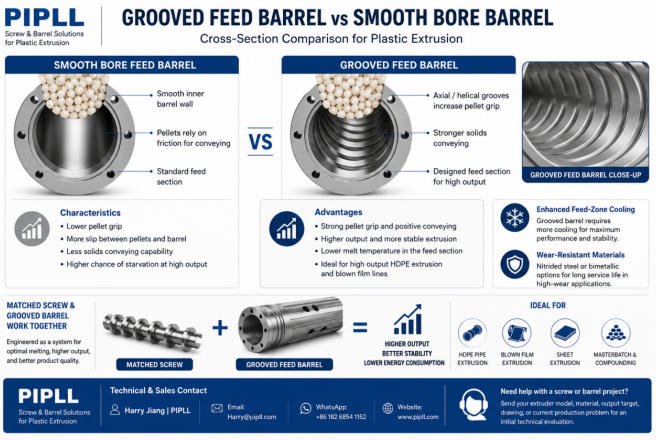
A grooved feed barrel has machined grooves in the feed section near the hopper. These grooves increase friction between the pellets and barrel wall, reducing pellet slippage and helping the screw generate stronger forward solids conveying.
The grooved section is normally temperature-controlled because feed-zone temperature strongly affects friction, pellet softening and conveying behavior.
A smooth-bore barrel has no such grooves in the feed zone. Solids conveying depends more heavily on the friction relationship between the polymer, screw surface and smooth barrel wall.
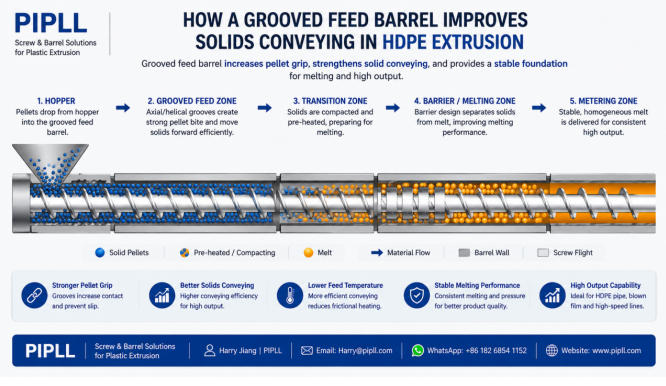
Polyethylene pellets can slip or rotate in the feed section instead of being efficiently pushed forward. Grooves give the solid bed more resistance against the barrel wall, allowing the screw to develop stronger conveying action.
In a properly designed grooved-feed system, much of the pumping action is established in the feed zone. This can make specific output more stable as downstream resistance changes.
Grooved feed is widely used in demanding polyolefin applications such as HDPE pipe and HMW-HDPE blown film because the feed section can deliver a high solids rate to the melting section.
Because solids conveying is strengthened at the feed section, the downstream screw geometry can be designed around the required melting, mixing and temperature-control task — provided the screw is sized to accept the feed rate.
| Factor | Smooth Bore Barrel | Grooved Feed Barrel |
|---|---|---|
| Feed-zone surface | Smooth | Machined grooves in feed section |
| Solids conveying | More dependent on resin/screw/barrel friction balance | Stronger pellet-to-barrel grip |
| Typical positioning | General-purpose and flexible processing | Dedicated high-output polyolefin applications |
| Backpressure sensitivity | Usually higher | Can be lower when properly designed |
| Torque demand | Generally lower | Often higher because solids feed rate is higher |
| Feed-zone cooling | Conventional control | More critical to groove performance |
| Feedstock variability | Generally more forgiving | Requires more consistent pellet size and feed behavior |
| Screw matching | Important | Critical — screw must accept the groove-generated feed rate |
This is why grooved feed should not be sold as a universal high-output upgrade. It is an integrated feed-system decision.
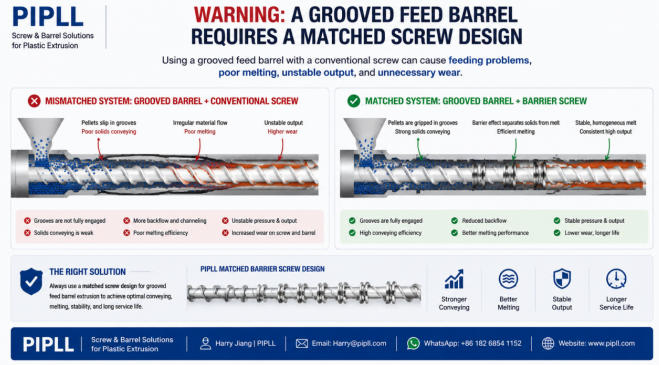
A grooved feed barrel can force substantially more solid material into the extruder. If the screw was originally designed for a smooth-bore feed system, the melting section may not have enough capacity to process that additional solids rate.
Possible results include excessive torque, high pressure near the end of the grooved section, incomplete melting, high melt temperature or unstable production.
The feed section, screw channel depth, transition geometry, barrier section, mixing section and drive capacity must be reviewed as one system.
Grooved feed works by controlling friction. If the feed zone becomes too warm, pellets may soften and lose the frictional behavior needed for strong conveying. If operating conditions are poorly controlled, feed stability can also suffer.
For this reason, the groove geometry, feed-zone cooling, resin type and screw design should be evaluated together rather than treated as independent features.
| Application | Typical Fit |
|---|---|
| HDPE pressure pipe | Strong candidate for grooved feed when high output is required |
| HMW-HDPE blown film | Common high-output grooved-feed application |
| PE sheet / board | Can benefit when resin and throughput are consistent |
| PE extrusion blow molding | Possible depending on machine and resin |
| Mixed-polymer production | Often better suited to smooth bore for flexibility |
| Variable regrind feed | Requires careful evaluation; smooth bore may be more forgiving |
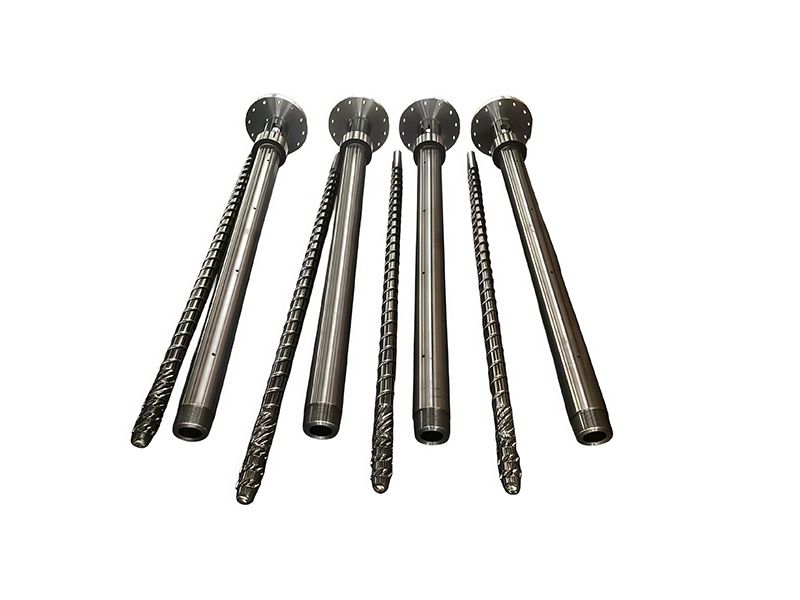
PIPLL can manufacture replacement and customized single-screw and barrel assemblies for PE/HDPE pipe, blown film, sheet and other polyolefin extrusion applications.
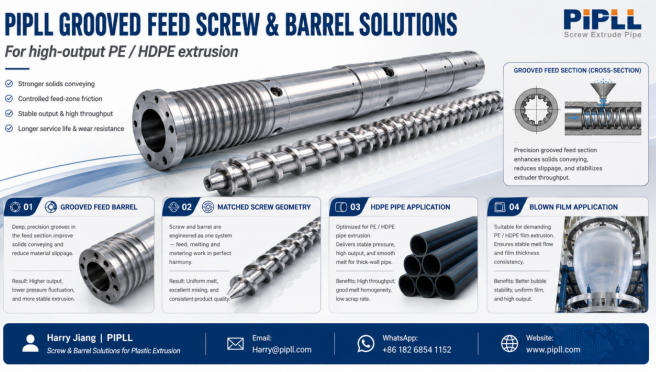
A grooved feed barrel can be highly effective for dedicated, high-output PE and HDPE extrusion because it strengthens solids conveying and can support a more stable feed rate.
But the grooves are only one part of the system. The screw geometry, drive torque, feed-zone cooling, material consistency, melting capacity, die and downstream equipment all have to match the higher solids throughput.
For a flexible line processing many materials, a smooth-bore barrel may remain the better choice. For a dedicated HDPE or HMW-HDPE line where solids conveying limits output, a properly engineered grooved-feed system can be a more effective solution.
Need help with a screw or barrel project? Send your extruder model, material, output target, drawing, or current production problem for an initial technical evaluation.


+86 15267878906

1306 W building , NB-IoT Industrial Park, No. 199 Changxing Road, Jiangbei, Ningbo.

 Languages
