 Languages
High-Speed Screw Barrel: HDPE Pipe Output Explained
High-Speed Single Extruder Screw Barrel: Where the HDPE Pipe Output Actually Comes From
A high-speed line is not a standard screw turned faster. The screw geometry, the feed section and the barrel construction all change — this is what each one buys you, and what it costs.
HIGH SPEED SINGLE EXTRUDER SCREW BARREL · HDPE PIPE EXTRUSION · HIGH OUTPUT BARRIER SCREW · WEAR-RESISTANT SCREW AND BARREL
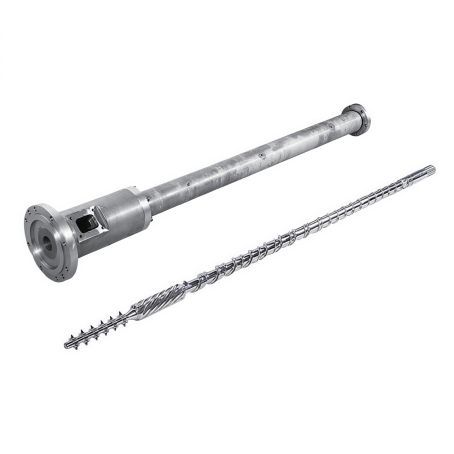
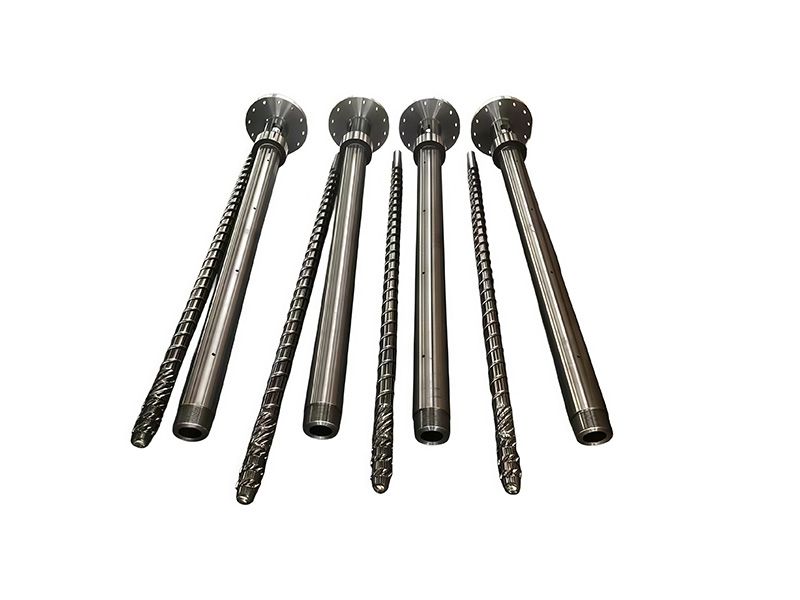
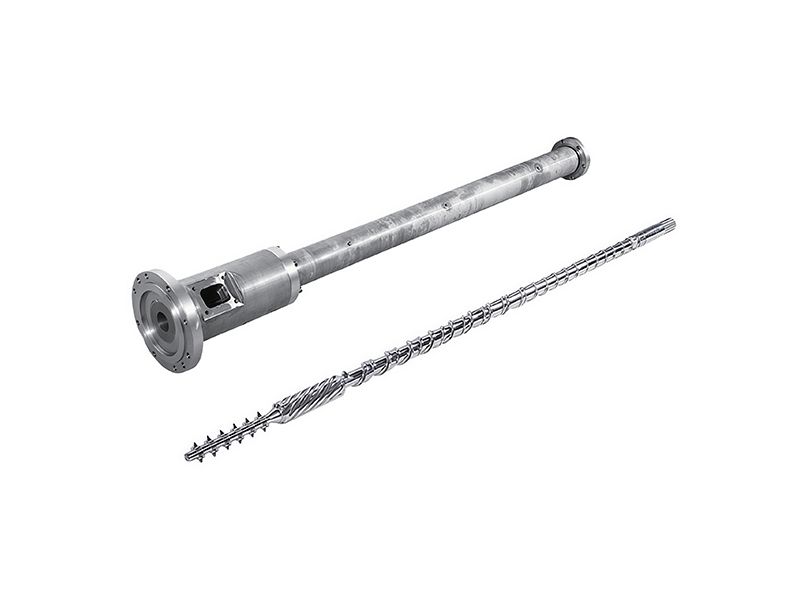
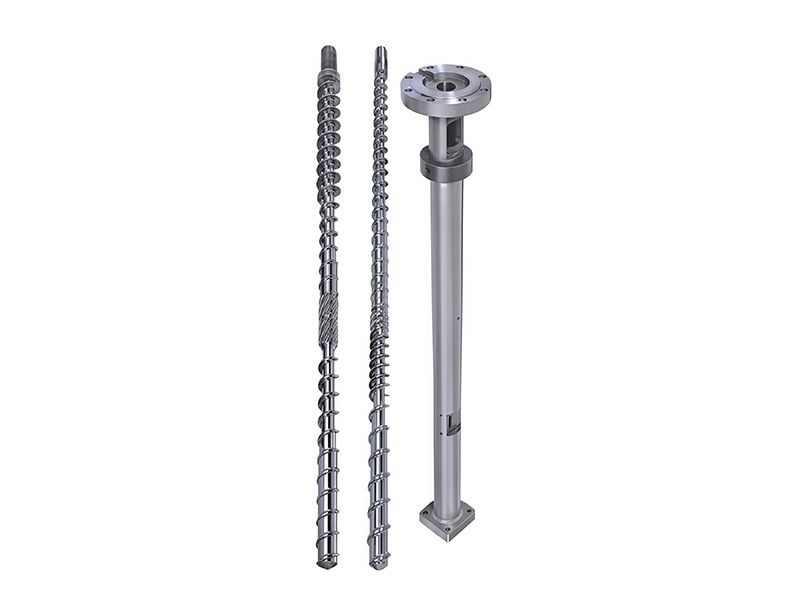
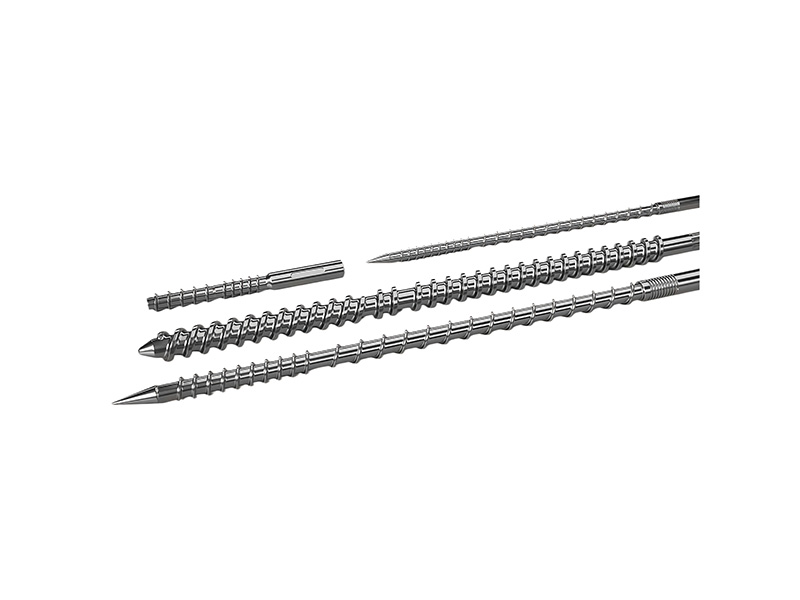
A single screw and barrel set for pipe extrusion. The flange, feed throat and flight section are all sized around the same number: the output the line has to hold, hour after hour.
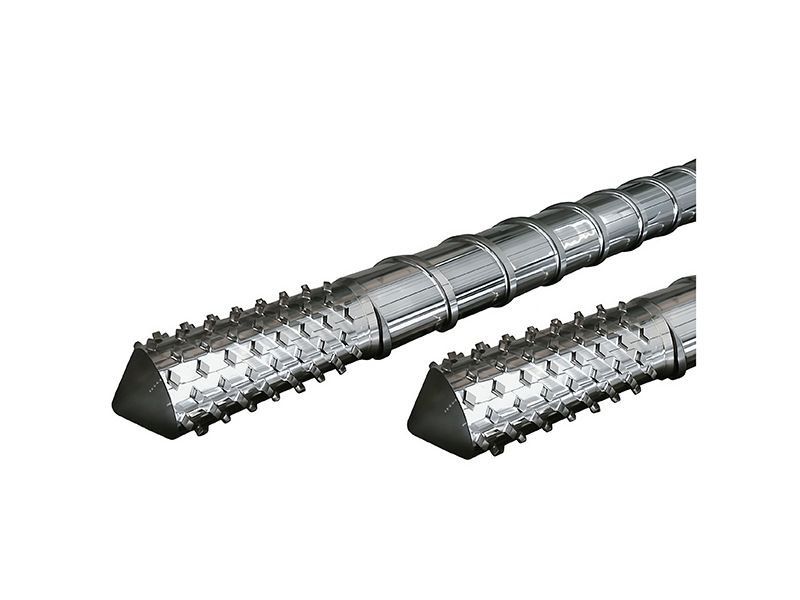
- 1. What “high speed” actually means on a single screw lineA conventional single screw extruder runs somewhere between 30 and 90 rpm at an L/D of 25–30:1. A high-speed line runs the same screw diameter at 100–150 rpm with an L/D of 33–40:1, and it needs three things a conventional line does not: a feed section that can actually deliver solids at that rate, a screw long enough to finish melting before the metering zone, and a barrel built to survive the tonnage that follows.Treating “high speed” as a motor and gearbox upgrade is the mistake. Output stops rising linearly long before the motor runs out of power, and it stops for a mechanical reason, not an electrical one.KEY INSIGHT High speed is a feed-section decision first and a motor decision last. If the solids cannot be conveyed into the first flight at the rate the screw is turning, extra rpm only adds shear and melt temperature — not output.2. The three levers of output — and which one runs out firstThree things set the output of a single screw line, and they fail in a predictable order.· Screw speed — raises output until the feed section saturates or the melt temperature hits the resin limit. This is the first lever to run out.· Feed capacity — the rate at which solids enter the first flight. This is what a grooved, cooled feed throat buys you, and it is the real constraint on a high-speed line.· Melt quality — the one that stops you after the other two. Output that arrives with unmelt, gels or excessive melt temperature is not output; it is scrap with extra steps.The practical sequence is therefore: fix the feed section, then lengthen the screw, then wind up the speed. Doing it the other way round produces a line that reaches its nameplate output for a fortnight and then starts producing black specks at the die — the failure path described in screw barrel maintenance and troubleshooting .3. Screw geometry for high-output HDPEThe three standard high-speed series are built on L/D 33, 38 and 40. They are usually supplied as a matched pair with a bimetallic barrel , because the tonnage that justifies the speed is also the tonnage that wears a nitrided bore out. Higher L/D buys melting and mixing length; it also buys torque, residence time and a longer barrel. The table below shows indicative configurations across the range.
Series Screw diameter Screw speed Motor Indicative output L/D 33 Φ45 mm 10–150 rpm 20–30 kW 100–120 kg/h L/D 33 Φ65 mm 20–150 rpm 45–90 kW 150–350 kg/h L/D 33 Φ90 mm 20–110 rpm 160–185 kW 550–700 kg/h L/D 33 Φ120 mm 20–90 rpm 280–315 kW 950–1 100 kg/h L/D 33 Φ150 mm 20–75 rpm 355–400 kW ≈ 1 500 kg/h L/D 38 Φ65 mm 20–150 rpm 110 kW 350–450 kg/h L/D 38 Φ90 mm 20–110 rpm 250 kW 1 000–1 100 kg/h L/D 38 Φ120 mm 20–90 rpm 400 kW 1 500–1 600 kg/h L/D 38 Φ150 mm 20–75 rpm 450 kW 1 800–2 000 kg/h L/D 40 Φ75 mm 20–150 rpm 200 kW 700–850 kg/h L/D 40 Φ90 mm 20–110 rpm 315 kW 1 250–1 350 kg/h L/D 40 Φ120 mm 20–90 rpm 450 kW 1 900–2 000 kg/h - Indicative configurations for a high-speed single screw HDPE line. Always confirm against the machine builder, the die head and the resin actually being run — pipe head pressure drop alone can move these figures by 10% or more.Three geometry decisions matter more than the rest:· Feed depth — shallower on a high-speed screw, because a deep feed channel cannot be filled at high rpm and simply wastes volume.· Barrier flight — separates the solid bed from the melt so the unmelted polymer cannot short-circuit to the metering zone. This is the single change that most often fixes erratic extrusion output .· Mixing section — a Maddock or distributive section, and on HDPE pipe often a mixer head, to flatten the melt temperature across the melt stream.4. The feed section: starving, grooving and coolingOn HDPE, the feed section is the bottleneck. HDPE pellet has lower friction against a smooth barrel wall than LDPE or LLDPE, which means the solids slip instead of being dragged into the first flight. Grooving the feed throat raises that friction and the throughput with it. It is also the part of the build that shows most clearly in process documentation , because the groove geometry and the cooling circuit have to be specified together.
Feed section type Effect on throughput Effect on melt quality Where it fits Smooth bore Limited by wall friction; saturates early Stable but output-capped Conventional lines, low to moderate output Grooved, uncooled Higher feed rate Grooves run hot, polymer can stick and degrade Rarely the right answer Grooved with forced cooling Highest sustainable feed rate Stable feed, predictable melt High-speed HDPE pipe and film lines Grooved with cooling and wear inserts Highest feed rate with a long life Stable Abrasive HDPE compounds and recycled feedstock - KEY INSIGHT A grooved feed throat without forced cooling is a downgrade disguised as an upgrade. The grooves generate friction heat, the polymer melts in the groove, and the feed rate falls back to smooth-bore behaviour — with a degradation risk added on top.5. Melt quality at speed: the shear budgetEvery additional rpm puts more shear into the melt, and shear is heat. The job of a high-speed screw is to deliver the melting energy the solids need without pushing the melt past the temperature the resin will tolerate — which on HDPE pipe means holding the measured melt within roughly 205–225 °C while the screw turns at 100–150 rpm.That is why high-speed HDPE screws are usually run as low-temperature extrusion: the mechanical work of melting is matched to the thermal energy added by the bands, so neither has to over-deliver. Three design choices carry most of the load:· Barrier flights keep solid and melt apart, so the melting rate is set by the geometry rather than by chance.· Mixing elements flatten the temperature profile; without them the melt is hotter at the flight tip than at the root.· Venting, where the resin or the feedstock justifies it, removes moisture and volatiles before they reach the die.6. Barrel construction for HDPE pipe dutyHigh speed means more tonnes per year through the same bore. The construction decision is therefore about how much abrasion the alloy has to absorb over the life of the barrel, and what happens when regrind or filler is added to the mix — the arithmetic covered in the bimetallic or nitrided comparison .
Construction Surface hardness Wear resistance Indicative life Where it fits Nitrided 38CrMoAlA HRC 52–55 Good 3–5 years Virgin HDPE, moderate output Standard bimetallic alloy HRC 58–62 Excellent 5–7 years General HDPE pipe duty, occasional regrind Tungsten carbide bimetallic HRC 65–68 Superior 7–10 years High-output lines, high-filler or recycled HDPE SKD11 internal liner sleeve HRC 60–62 Excellent 5–8 years Highly abrasive compounds where the wear zone should be replaceable PIPLL builds single screw and barrel sets for HDPE pipe from Φ20 mm to Φ500 mm, up to 12 m long, on a 38CrMoAlA base with a centrifugally cast alloy layer of 2–3 mm on bimetallic construction, and an internal liner sleeve where the wear zone should be replaceable. The alloy layer is a thickness budget on the inner surface only — everything outside it is structure, and the two are dimensioned together, not separately.
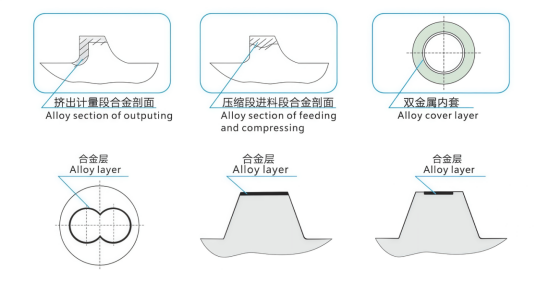
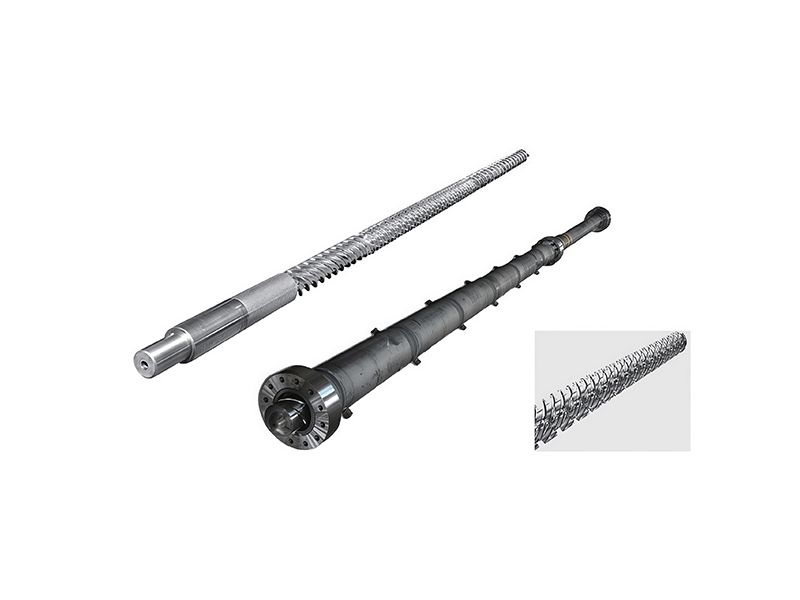
Alloy layer placement on the metering, compression and feed sections, and on a bimetallic liner. Coverage decides where the barrel is allowed to wear.
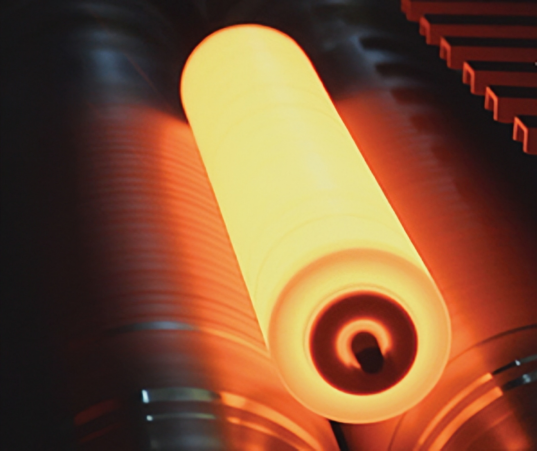
Centrifugal casting fuses the alloy to the backing tube. Bond quality, not nominal thickness, is what decides whether the layer stays where it was put.
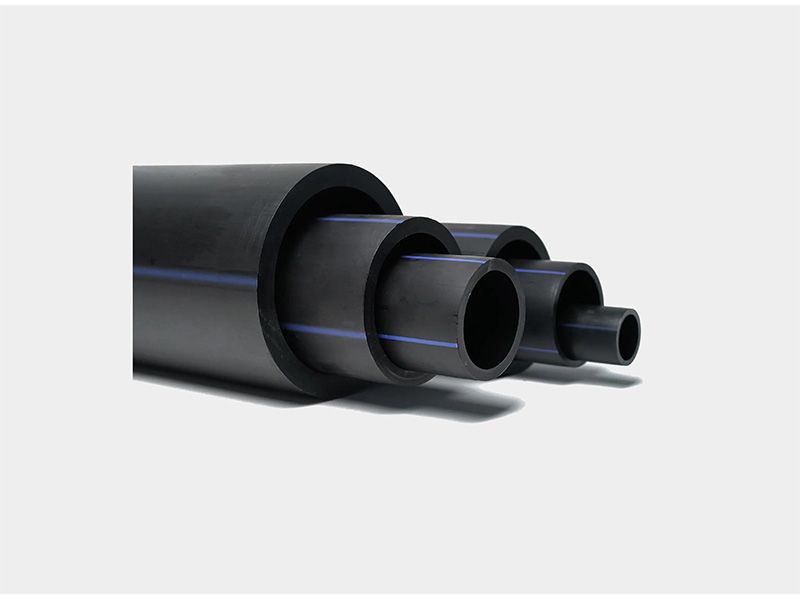
- 7. Matching the screw to the pipe: Φ20 to Φ500The screw diameter follows the pipe outside diameter and the output the line has to hold. The mapping below is a starting point for a high-speed HDPE pipe line; the pipe and tube extrusion page covers how the head and downstream equipment are matched to it.
HDPE pipe OD Typical screw diameter Typical L/D Indicative output Φ20–63 mm Φ45–60 mm 30–33:1 120–250 kg/h Φ75–160 mm Φ65–75 mm 33–38:1 250–450 kg/h Φ200–315 mm Φ90 mm 33–38:1 550–800 kg/h Φ355–500 mm Φ120 mm 36–40:1 900–1 200 kg/h - Above Φ315 mm the pipe head pressure drop starts to dominate the screw design conversation. At that point the screw is sized against the head, not the other way round.
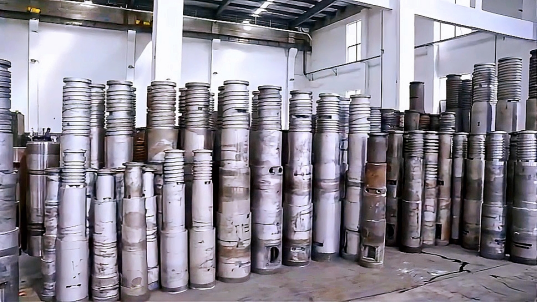
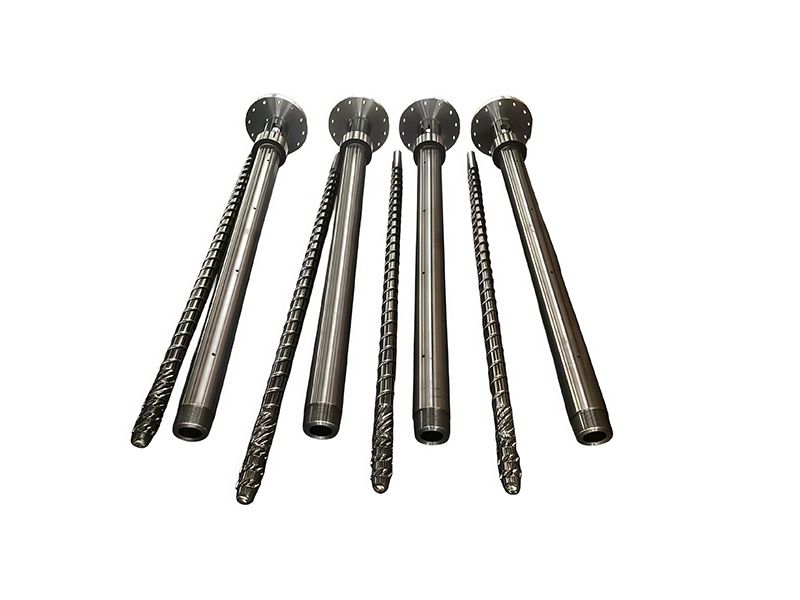
Barrels in the workshop, standing on end. Bore straightness and roundness are decided long before the flange is machined — and they are what the screw is actually running against.
- 8. Film blowing and other high-speed single screw jobsThe same logic carries into film. A high-speed single screw for HDPE or LLDPE film blowing uses the same feed principle and a similar L/D, with two changes: more mixing, because film defects are optical, and tighter melt temperature control, because gauge variation follows melt temperature variation almost directly.· Blown film — mixing and melt temperature uniformity dominate; a barrier screw with a Maddock section is the common configuration.· Cast film — higher output per screw diameter is achievable, and the cooling roll, not the screw, sets the ceiling.· Pipe and profile — feed section and wear protection dominate, because the tonnage per year is highest here.· Recycling and pelletising — variable bulk density makes feed depth the critical dimension, and wear protection stops being optional; the recycling granulation build is the reference case.· High-filler compounds — WPC and mineral-filled grades demand both a barrier screw and a carbide-protected bore.9. What drives the price of a high-speed screw and barrelTwo quotes for the same screw diameter can differ by a factor of two or more. The difference is structural, and the information checklist for a replacement project is what keeps the comparison honest.
Driver Effect on price What it buys you Feed section machining (grooved, cooled throat) High Whether high speed is usable at all Screw geometry complexity (barrier plus mixing) Moderate–high Melt quality at speed, and fewer optical defects L/D (33 / 38 / 40) Moderate Enough melting length for the output you are asking for Base material grade Moderate Moderate Core strength and fatigue life of the screw body Barrel construction (nitrided / bimetallic / carbide) High Wear life at high filler and regrind loads Alloy layer thickness and bond quality Moderate The service interval in abrasive duty Grinding and honing precision Moderate Clearance stability and steady output over the whole life Inspection standard Moderate Whether a defect leaves the factory or not Interface machining and screw–barrel matching Moderate Installation downtime and first-run scrap Lead time and production volume Variable Total project cost, not unit price - 10. Frequently asked questionsCan I convert an existing line to high speed?Sometimes — the barrel and the gearbox are usually the limits, not the screw. A conversion normally means a new screw and a matched barrel with a grooved and cooled feed throat, and a check on whether the gearbox and thrust bearing were specified for the higher speed. Quoting the screw alone is how conversions turn into disappointments.Does a higher L/D always mean more output?No. L/D buys melting and mixing length, which is what lets you raise screw speed without losing melt quality. If the feed section cannot deliver solids at the higher rate, the extra length simply adds residence time.When does bimetallic pay for itself on HDPE?Once regrind , filler or high annual tonnage enters the picture. On virgin, unfilled HDPE at moderate output, a correctly nitrided barrel will usually see out the overhaul interval. The bimetallic argument gets stronger the moment the feedstock stops being clean and consistent — see the bimetallic screw barrel guide .What single measurement should I take before ordering?Screw flight OD and barrel ID at the same axial positions, taken as a pair. Everything else — alloy family, L/D, feed design — is a specification decision. That one pair of readings is what makes the specification answerable.Related PIPLL resourcesNeed help specifying a high-speed single extruder screw barrel?Send the pipe range, the output you need to hold, the machine and gearbox details, and your current screw and barrel measurements. We will come back with the screw geometry, the L/D and feed-section design, the barrel construction, and a matched set quoted as one pair. PIPLL is an extruder screw and barrel manufacturer working in Φ20–500 mm.