Matching Extruder Screw Geometry and Lubricants
By Harry Jiang | PIPLL
When a formulation runs well on a laboratory extruder but develops black specks, unstable output or poor fusion on a production line, the problem may lie in the match between extruder screw design, the lubricant package and operating conditions. This PIPLL guide explains how screw L/D ratio and compression ratio can guide troubleshooting without treating either number as a standalone answer.
Extruder Screw Length to Diameter Ratio
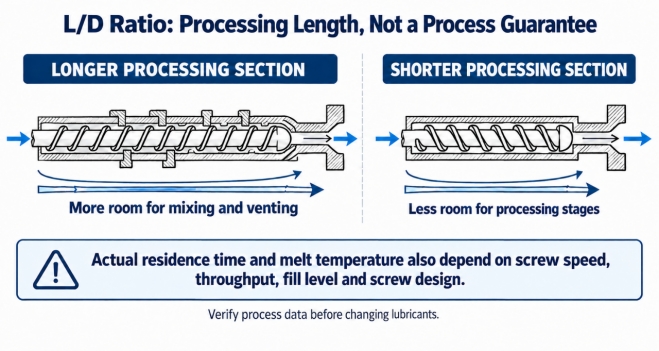
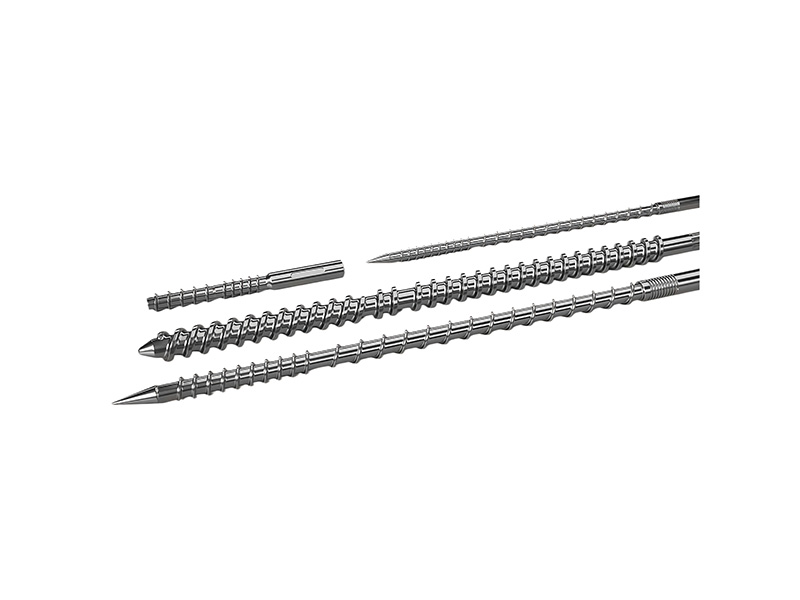
The extruder screw L/D ratio is the effective screw length divided by its outside diameter. A longer processing section can make room for melting, mixing and venting, but the actual residence time and melt temperature also depend on screw speed, throughput, fill level, element design and barrel settings. A higher screw L/D ratio should therefore be treated as a reason to review the whole process history, not as proof that a material will overheat.
Figure 1. A longer processing section offers more design space but does not set residence time on its own.
On a long twin-screw compounding line, investigate whether high-shear elements, low throughput, barrel temperatures or vent configuration are contributing to excess melt temperature. The lubricant package may matter, but changing it before measuring these conditions can hide the real cause.
On a shorter screw, there is less physical room for feeding, melting and homogenization. Watch for incomplete melting, output fluctuation and a narrow operating window. For PVC extrusion , external lubricant can reduce metal-to-material friction and affect the onset of fusion; too much may delay fusion or weaken conveying. Internal lubricant primarily changes friction within the material. These are useful distinctions, but their effect depends on the resin, stabilizer package and lubricant chemistry.
Single Screw Compression Ratio and Channel Depth
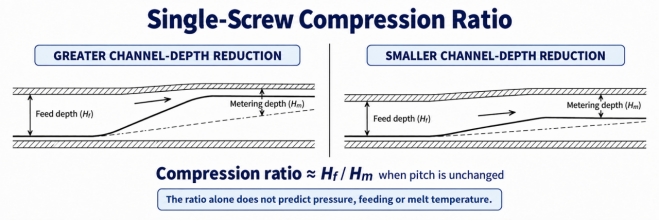
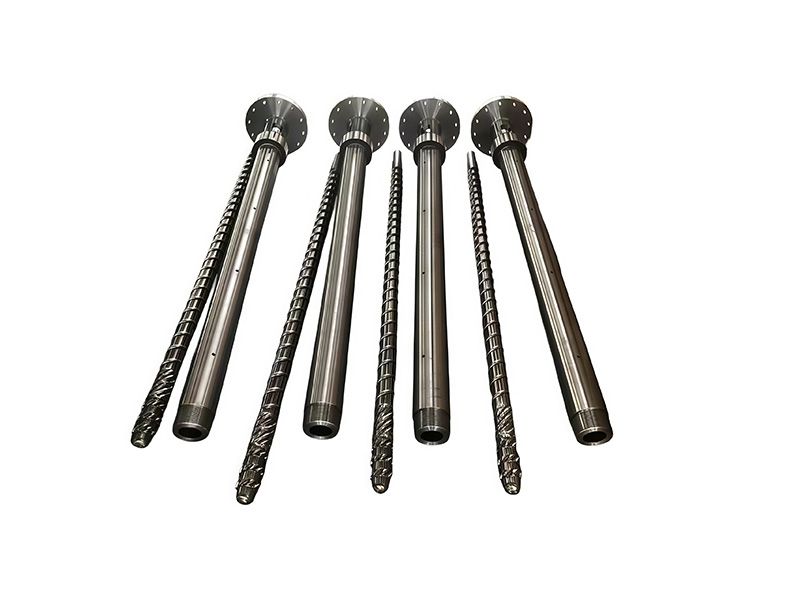
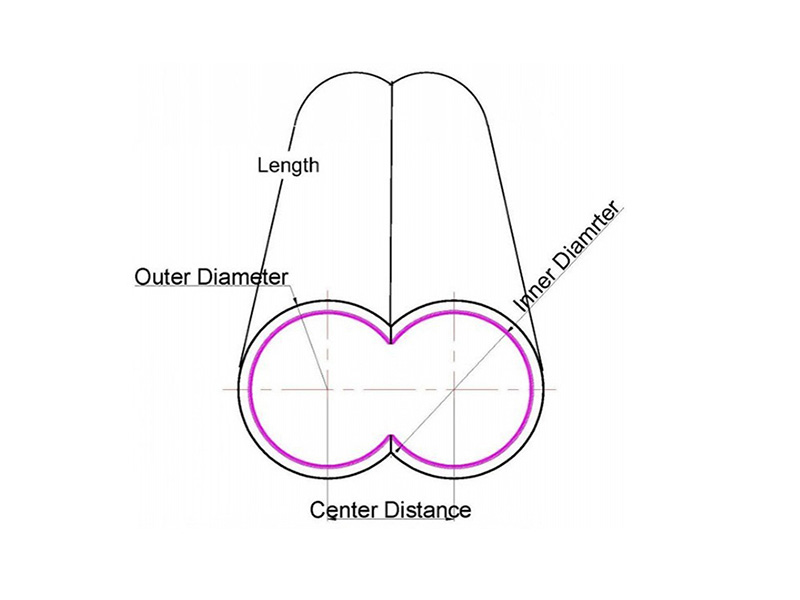
For a conventional single screw with constant pitch, the extruder screw compression ratio is often approximated by feed-channel depth divided by metering-channel depth. A greater channel-depth reduction changes compaction and the path to melting. It does not, by itself, guarantee higher pressure, better feeding or a hotter melt. Channel width, pitch, flight clearance, resin and operating conditions also matter. Twin-screw compounding requires a different geometry and fill-level analysis.
Figure 2. Channel-depth reduction is one part of single-screw compression geometry.
If a screw change coincides with extrusion feeding problems, compare the old and new channel geometry alongside feed-throat conditions, resin bulk density, lubricant level and throughput. If degradation appears, check measured melt temperature and pressure before deciding whether a lubricant adjustment is warranted.
Two Production Cases
Case One A Laboratory Formulation Changes Behavior on a Larger Line
A formulation ran cleanly on a laboratory twin-screw extruder with L/D 36 and 0.5% external lubricant. On a production line with L/D 44, operators observed material at the vent, yellowing and occasional black specks. The line change increased the available processing length, but L/D alone cannot establish the cause. Different screw elements, throughput, fill level, vent conditions and melt temperature may also explain the change.
The practical next step is to record melt temperature, motor load, throughput and vent behavior, then compare the two screw configurations. If the data point to a lubricant or thermal-stability issue, trial a controlled change in wax type or dosage and review downstream barrel settings. Change one variable at a time.
Case Two Output Falls After a Screw Replacement
After a replacement screw reduced the stated compression ratio from 3.2 to 2.2, the production team kept the formulation and temperature settings unchanged. They reported feed bridging, unstable conveying and roughly 30% lower output. That sequence makes the geometry change a strong lead, but it does not prove that external lubricant alone caused the loss.
Compare the old and new feed and transition zones, inspect the feed throat, and check whether the existing lubricant level is suitable for the new screw. Any change to feed-zone temperature should be based on material behavior and measured data; raising it indiscriminately can make bridging or premature melting worse.
A Practical Review Sequence
| Review step | What to compare |
| Record the baseline | Resin grade, formulation, lubricant type and dosage, screw drawing, L/D, channel depths, screw speed, throughput, temperature profile, melt temperature, pressure and motor load. |
| Identify the change | Separate a formulation change from a screw, barrel, die or operating-condition change. A lab-to-production transfer often changes several variables at once. |
| Run one controlled trial | Choose one variable from the observed symptom and process data. Compare output stability, melt temperature and product quality against the baseline. |
If you are reviewing an existing extruder screw and barrel specification, send the drawing and a short description of the resin, output target and operating symptom to PIPLL. We can provide a no-cost initial specification check and identify the dimensions worth verifying before discussing a replacement.
Technical and Sales Contact
Harry Jiang | PIPLL
WhatsApp +86-18268541152 | Email harry@pipll.com


+86 15267878906

1306 W building , NB-IoT Industrial Park, No. 199 Changxing Road, Jiangbei, Ningbo.

 Languages