 Languages
Parallel Twin Screw Barrel: The Four Main Types and How to Choose One
Parallel Twin Screw Barrel: The Four Main Types and How to Choose One
Rotation direction and intermeshing give four architectures — and each one is built for a different job on the line.
Parallel Twin Screw Barrel · Twin Screw Types · Extrusion and Compounding
1. What a parallel twin screw barrel actually is
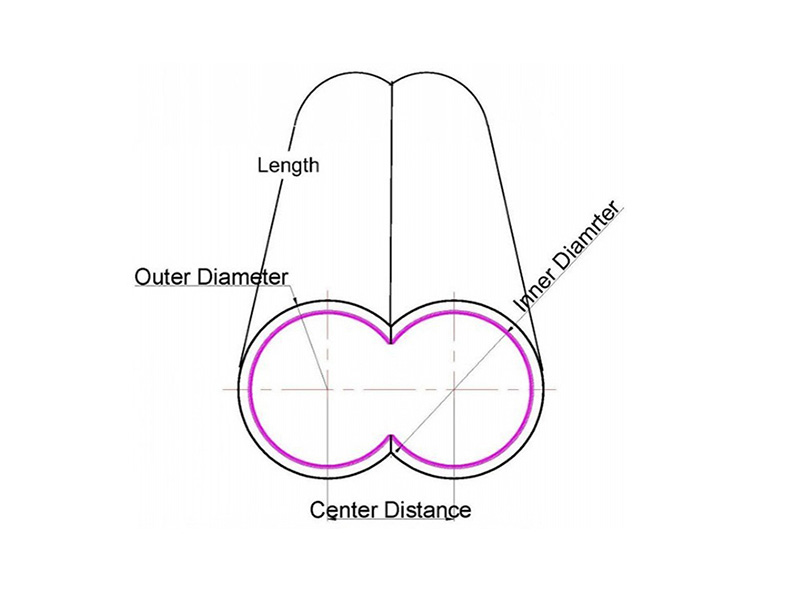
A parallel twin screw barrel holds two screws in two closely matched bores that stay parallel along the whole processing length. Unlike a conical design, the screw diameter does not change from feed to discharge.
The important consequence is that the barrel is never a stand-alone spare part. Screws and barrel work as a matched set, and the dimensions that join them have to agree:
· Centre distance between the two bores
· Screw profile and flight geometry
· Radial clearance between screw and bore
· Feed opening position and size
· Heating and cooling layout
· Connection and gearbox interface
Parallel twin screw systems are used across a wide span of production: PVC pipe and profile , polyolefin pipe and film , WPC and SPC board , pelletizing and compounding lines. The same barrel shape serves all of them, which is exactly why the internal architecture — not the external dimensions — decides whether it performs. Our application overview lists the polymer groups we build for.
KEY INSIGHT The machine architecture decides the duty. The barrel only executes it — which is why the first question is never 'how long', but 'what kind of twin screw is this'.
2. Two axes define every twin screw design
Twin screw machines are commonly described by brand or by application, which hides the fact that they are built from two independent choices. Once you separate those choices, the whole family becomes easy to read.
Axis Options What it decides Rotation direction Co-rotating / counter-rotating How material travels: mixing path versus enclosed chambers Intermeshing Intermeshing / non-intermeshing How strongly the screws engage: shear level and positive conveying Geometry Parallel / conical Feed intake, torque distribution and how the barrel is replaced Combine the first two axes and you get the four practical architectures: co-rotating intermeshing, counter-rotating intermeshing, non-intermeshing counter-rotating and non-intermeshing co-rotating. The third axis, geometry, is a separate decision — a conical twin screw barrel and a parallel barrel can share the same rotation direction and still behave very differently.
This is not academic. The classification predicts what a machine can and cannot do, and it is the reason two quotes for the 'same size' barrel can describe completely different components. A supplier who manufactures both families will ask which architecture you are running before discussing dimensions at all.
3. Co-rotating intermeshing: the compounding workhorse
Both screws turn the same way. Material follows a figure-of-eight path around the two screws, transferring continuously from one channel to the other, and the flights wipe each other as they turn.
That combination produces intensive distributive and dispersive mixing, which is why co-rotating intermeshing machines dominate compounding, masterbatch and reactive extrusion. When a formulation has to be uniform — pigments, additives, glass fibre, fillers — this is the geometry that delivers it.
· Compounding and masterbatch, including filled and glass-reinforced compounds
· Reactive extrusion and functional additive production
· Formulations where dispersion quality decides the product
· Recycled and mixed feedstock that needs homogenising
Because mixing is aggressive by design, abrasive formulations on this architecture are usually run with bimetallic screws and barrels. The mixing quality is not the limiting factor — surface wear is. Our notes on high-CaCO3 compounding and calcium carbonate in plastics cover that side of the problem.
4. Counter-rotating intermeshing: closed chambers and positive conveying
Here the screws turn in opposite directions, so the flights mesh and trap material in a series of closed C-shaped chambers that are pushed axially along the barrel. Because the material is enclosed and moved mechanically rather than dragged, conveying is positive and pressure build-up is strong.
PIPLL's counter-rotating parallel range is built around a fully interlocking conjugate design that forms those sealed C-chambers. That is what makes direct PVC powder feeding practical: the closed chambers eliminate the bridging and slipping that a non-positive conveying geometry runs into with powder. Overall shear stays low and gentle, which matters for a polymer as heat-sensitive as PVC.
PIPLL counter-rotating parallel twin screw barrel Range Screw diameter Φ45 – Φ300 L/D ratio 16 – 40 (customisable) Base material 38CrMoAlA premium alloy steel Surface options Bimetallic barrel and screw, nitriding, electro-chromising Typical duty Pipes, profiles, boards, WPC, SPC flooring, pelletizing Replacement sets are built to match the major machine builds rather than to a generic standard, because the interface dimensions differ from one manufacturer to the next. Reference pages for the most common ones include the KraussMaffei KMD series , Battenfeld-Cincinnati twinEX , Bausano MD , Theysohn XTS and Weber DS series , with Kabra , Mikrosan MCV and Luigi Bandera 2B HTS also covered.
· Rigid and filled PVC pipe and profile
· WPC and SPC flooring where dimensional stability is critical
· Pelletizing and recycling lines
· Heat-sensitive or high-viscosity formulations
5. Non-intermeshing: high free volume and gentle handling
In a non-intermeshing design the two screws do not engage at all. Geometrically it is closer to two single screws sharing one barrel, and material transport relies on drag and friction rather than positive displacement.
Transport efficiency is lower and leakage flow is higher, but free volume is large and shear is minimal. That trade makes non-intermeshing geometry useful for devolatilisation — where volatiles need room to escape — and for shear-sensitive compounds that would be damaged by an aggressive mixing section.
Where the requirement is simply gentle conveying plus a stable melt, a well-configured single screw barrel is often the more economical answer, and for recycling duty specifically a recycling and granulation screw does the same job with fewer moving parts.
6. Parallel or conical: the third axis
Parallel and conical twin screws are often compared as if one were simply better. They are different machine configurations, and the difference shows up first at the feed end.
Parallel twin screw Conical twin screw Screw form Constant diameter along the length Tapered — larger at the feed, smaller at discharge Feed intake Standard feed opening Large intake area, good for low-bulk-density powder Torque Distributed along the screw length High torque available at the feed end Maintenance Modular, easy to reconfigure Conical dimensions must be matched as a pair The practical difference is where each geometry earns its place. Conical machines with a tapered feed section handle low-bulk-density PVC powder particularly well and are the standard choice for small and medium rigid PVC pipe and profile lines — see the general purpose PVC conical twin screw barrel . Parallel machines hold a constant diameter, which suits high-output and multi-formulation plants where longer processing zones and modular configuration matter more.
One rule matters more than any comparison table: a replacement part has to match the installed extruder type. A conical barrel cannot be substituted into a parallel machine, or the reverse, without a machine redesign. We cover that replacement logic in detail in the parallel twin screw barrel PVC guide .
KEY INSIGHT Choose the architecture when you buy the machine. When you replace the screw and barrel, match what the machine already is.
7. Matching the architecture to the duty
Read the table below from the duty backwards. Most selection mistakes come from picking a familiar geometry and then asking it to do a job it was never designed for.
Duty Usual architecture Why Compounding, masterbatch, filled compounds Co-rotating intermeshing Intensive mixing; self-wiping flights Rigid PVC pipe and profile Counter-rotating intermeshing Closed chambers, positive conveying, low overall shear WPC and SPC flooring Counter-rotating intermeshing High filler loadings and dimensional control Recycled flake and film Co-rotating intermeshing Mixed feedstock needs homogenising Devolatilisation Non-intermeshing Large free volume, minimal shear Two adjacent rows can look similar on paper and behave very differently in production. Recycled flake and virgin extrusion, for instance, differ less in polymer than in consistency of feed — one needs homogenising power, the other needs stable conveying. That is the level at which the architecture has to be chosen, and it is why selection starts with the material history rather than with a screw diameter.
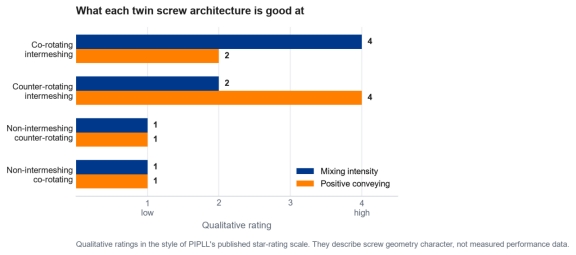
What each twin screw architecture is good at. Ratings are qualitative and describe geometry, not measured performance.
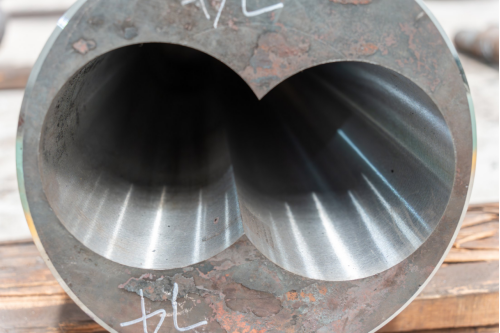
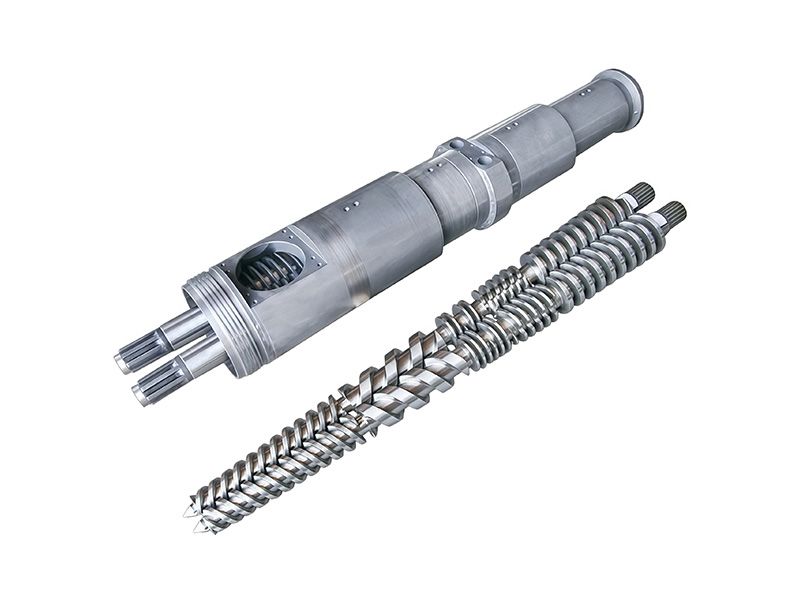
A parallel twin screw barrel bore: two matched bores held in one barrel body. Centre distance and bore geometry have to agree with the screws before anything else is decided.
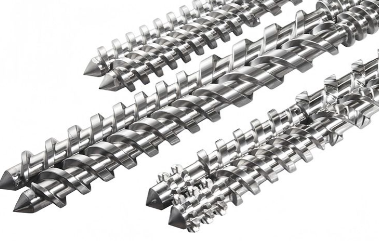
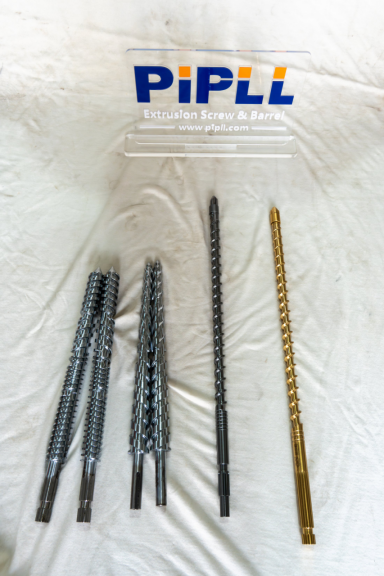
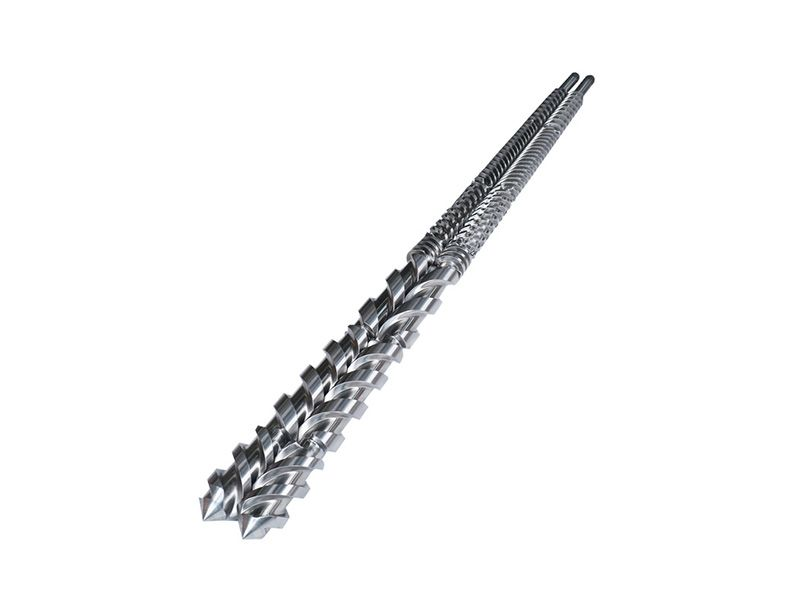
A matched parallel twin screw pair. Screws and barrel are designed as one set, not as independent spare parts.
- 8. Wear, corrosion and the barrel material decisionOnce the geometry is right, service life is decided by what the material does to the metal surface. Two mechanisms dominate. Abrasive fillers — calcium carbonate, talc, glass fibre — grind at the flights and bore. Corrosive compounds attack the same surfaces chemically. PVC with high filler loading does both at once.PIPLL publishes four bimetallic alloys for this reason, and the choice is a trade between wear resistance, corrosion resistance and working temperature rather than a search for the hardest available surface.
Alloy Wear Corrosion Layer Hardness Max temp PIPLL01 (Fe-Ni-Cr-B) Very good Good 2–3 mm HRC 58–65 ≤400°C PIPLL02 (Ni-Cr-Co-B) Good Very good 1.5–2 mm HRC 50–58 ≤450°C PIPLL03 (Ni-Cr-Co-V-B) Very good Very good 1.5–2 mm HRC 55–60 ≤450°C PIPLL04 (Ni-WC-Cr-B) Excellent Very good 1.5–2 mm HRC 55–65 ≤600°C Screws staged for final inspection. Alloy grade and flight geometry are recorded against the barrel set they will be matched to.
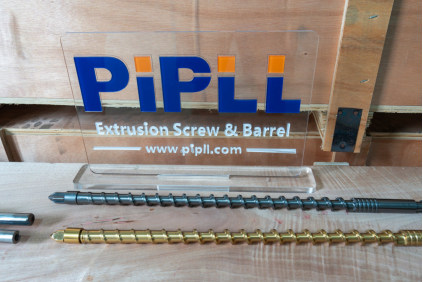
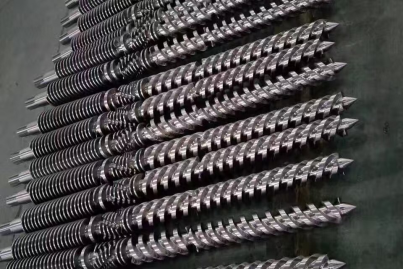
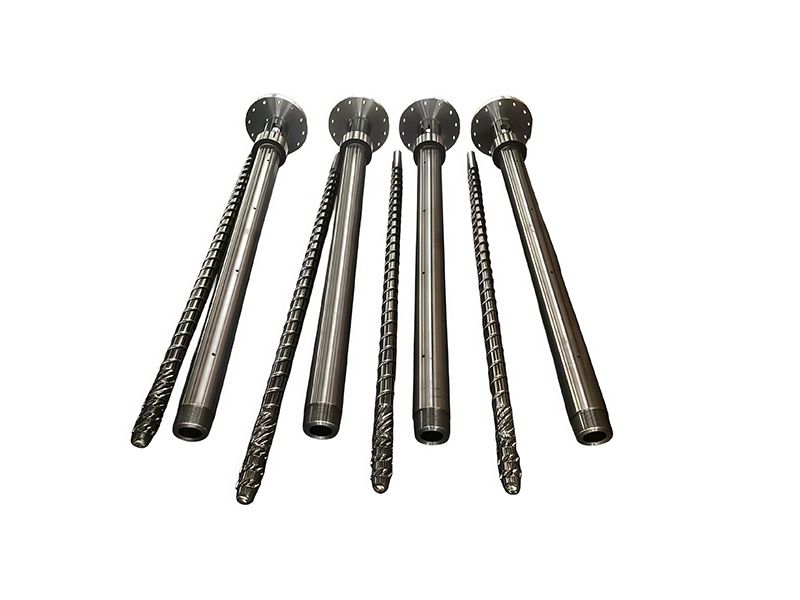
Bimetallic screws in production. The alloy logic that protects the barrel bore applies to the screw flights as well.
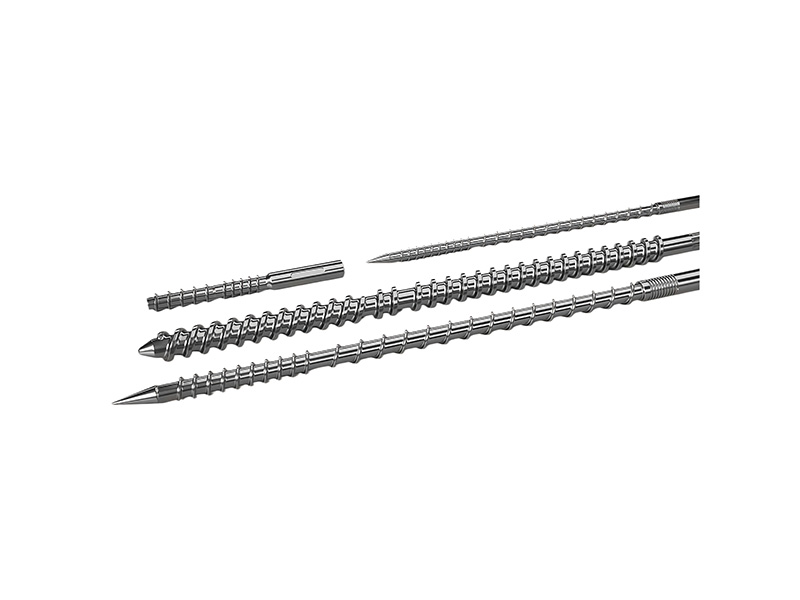
For unfilled and lightly filled duty, a nitrided screw and barrel is usually the cost-effective answer: a 0.4–0.6 mm nitrided layer at HV900–1100, which PIPLL publishes as 2–3 years of service in low-fill applications. Where abrasive filler loading is continuous, the bimetallic barrel and its matched bimetallic extrusion screw carry the cost of the alloy layer for a longer service interval. The trade-off between the two constructions is set out in our note on bimetallic and nitrided screw barrels , and the alloy-by-application logic in bimetallic alloy selection .
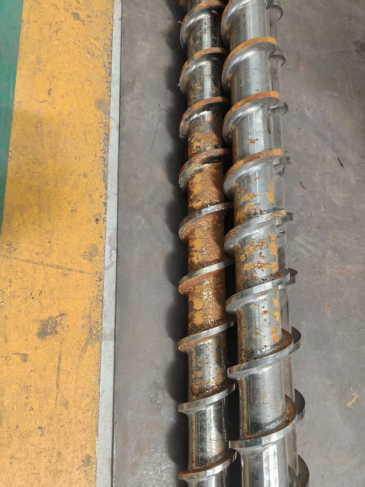
A retired screw showing combined wear and corrosion. Localised damage like this usually points at formulation and temperature, not simply at running hours.
KEY INSIGHT Match the alloy to the actual formulation and operating temperature. A harder surface is not automatically the right answer.
9. What to send for an accurate quote
A parallel twin screw barrel cannot be quoted accurately from a screw diameter alone. The more of the following you can supply, the fewer assumptions have to be made.
· Extruder manufacturer, model and application
· Original screw and barrel drawing, if available
· Screw diameter, total length and L/D ratio
· Centre distance and key connection dimensions
· Formulation and approximate filler percentage
· Current output, screw-speed range and melt pressure
· Material of the existing screw and barrel
· Photos, measurements and the production problem you are seeing
If no drawing exists, a worn screw or barrel sample with detailed photographs and key measurements can still support an initial technical evaluation. Our custom screw manufacturing process is built around exactly that situation, the manufacturing workflow covers how a drawing becomes a finished pair, and the production capacity behind it is what makes short lead times on standard specifications possible. The same information checklist applies to custom replacement projects of any size.
10. Keeping the assembly alive
Service life depends on duty far more than on the calendar. PIPLL's general PVC conical range is published as 2–3 years in low-fill applications; abrasive, heavily filled and corrosive duty shortens that, and bimetallic construction extends it.
Wear is rarely uniform, and it is worth measuring before it becomes a quality problem. Output that needs a higher screw speed for the same result, drifting melt pressure and growing dimensional variation are the usual first signals.
· Check wear without pulling the line apart: inspection without teardown
· Unstable output that is not a screw problem: extruder surging
· When the decision is repair or replace: replacement guide
· Liner-based construction for repeated wear: barrel with internal liner sleeve
· High filler loading in practice: high-CaCO3 compounds
A parallel twin screw barrel is a consumable that pays for itself either very slowly or very quickly. Specified against the real duty — geometry first, then alloy, then dimensions — it runs for years with predictable output. Specified against a size alone, it becomes a recurring maintenance line item.
Need help specifying a parallel twin screw barrel?
Tell us the machine, the formulation and the duty and we will recommend a geometry and an alloy. PIPLL manufactures parallel and conical twin screw barrels and single screws for extrusion and compounding lines, including compatible replacement sets for the major machine builds.
· Counter-rotating parallel barrels from Φ45 to Φ300, L/D 16–40
· Compatible sets for KraussMaffei, Battenfeld-Cincinnati, Bausano, Theysohn, Weber, Kabra, Mikrosan, Bandera and other major builds
· Bimetallic, nitrided and through-hardened options for abrasive and corrosive duty
Contact Us Now
Eric Dong | Co-founder | eric@pipll.com | WhatsApp: +86-15267878906 | www.pipll.com