Plastic mixed with stone?
It sounds strange, but it happens every day in plastic processing.
That “stone” is usually calcium carbonate (CaCO3) — one of the most widely used mineral fillers in plastics.
To someone outside the plastics industry, adding mineral powder may look like a simple way to make plastic heavier or replace expensive resin. In a properly engineered formulation, however, calcium carbonate is much more than cheap weight. Its type, particle size, particle-size distribution, surface treatment, purity, dispersion and loading level can all influence processing and final product performance.
Used correctly, CaCO3 can help reduce formulation cost, increase stiffness, improve dimensional stability and modify processing behavior. Used poorly, it can contribute to brittle products, unstable extrusion and accelerated wear of screws and barrels .
So the real question is not simply, “Why put stone into plastic?” It is: “Which calcium carbonate should be used, at what loading, and how should the extrusion system be matched to it?”
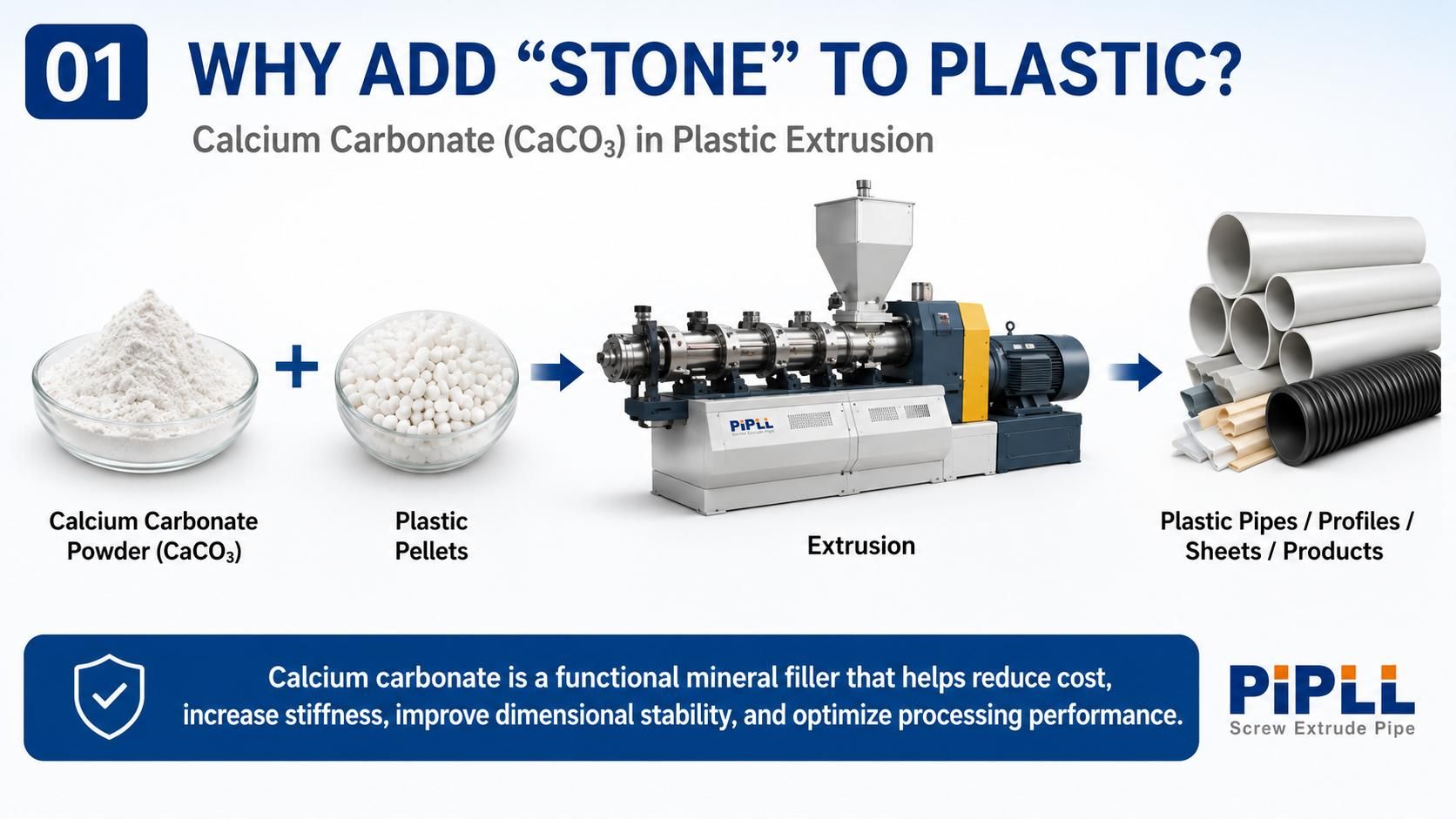
Calcium carbonate is often called a filler, but “filler” does not mean it has no technical function.
In a well-designed plastic formulation, CaCO3 can act as a functional mineral additive. Depending on the polymer, grade and formulation, it may help:
The effect is formulation-dependent. Adding more CaCO3 does not automatically produce a better or cheaper product. Mechanical properties, dispersion, process stability and equipment wear all have to be considered together.
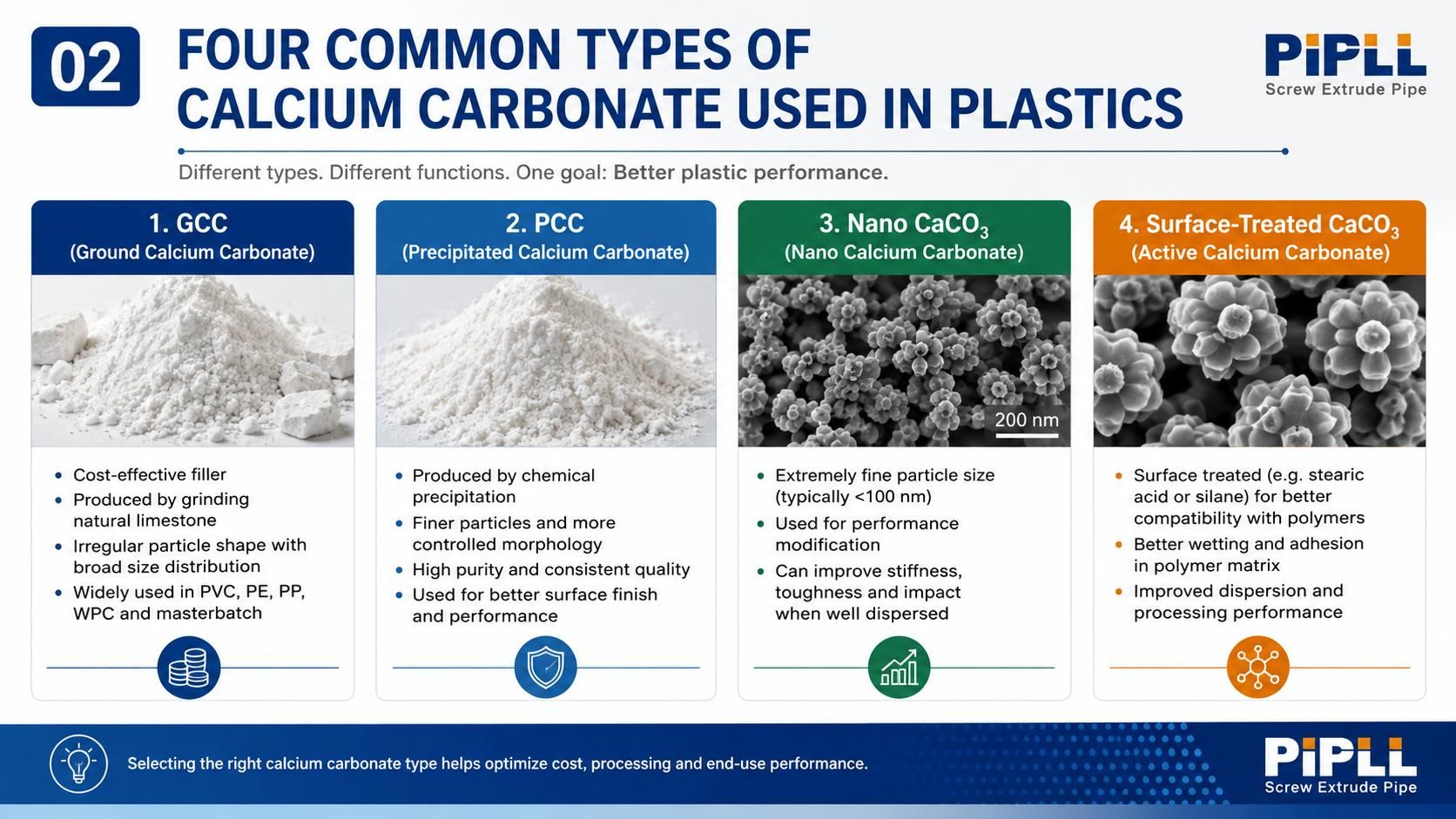
Not all calcium carbonate is the same. For plastic processors, four categories are especially useful to understand.
Ground Calcium Carbonate (GCC), often called heavy calcium carbonate in China, is produced by mechanically grinding natural limestone, calcite or marble and classifying it to a controlled particle-size range.
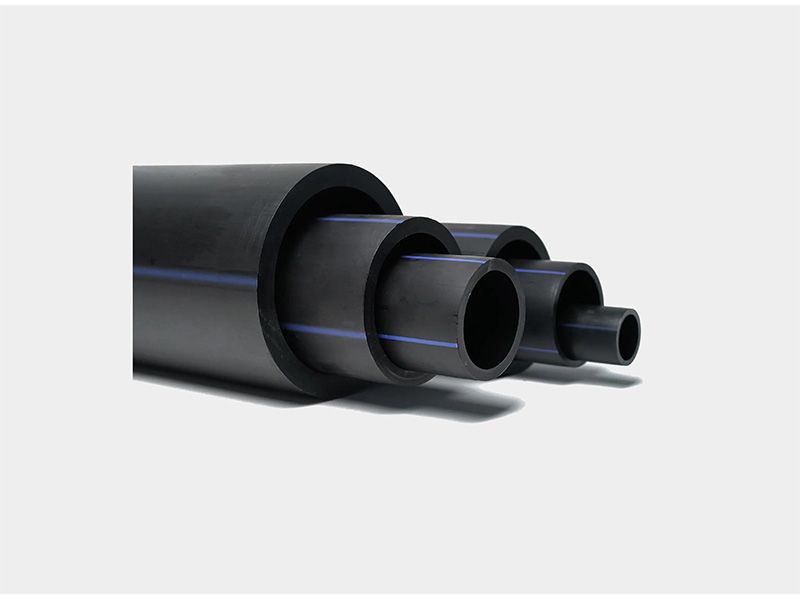
Its biggest advantage is cost efficiency. GCC is widely used in PVC pipes and profiles, PE and PP products, sheets, boards, WPC and filler masterbatch.
For many conventional applications, a properly selected GCC grade offers a practical balance of cost, stiffness, processability and product requirements.
Precipitated Calcium Carbonate (PCC), commonly referred to as light calcium carbonate in China, is produced through a controlled chemical precipitation process.
Compared with conventional GCC, PCC can provide more controlled particle size, morphology and particle-size distribution. This makes it useful where processors want finer particles, more controlled surface characteristics or a more consistent appearance.
PCC is generally more expensive than standard GCC, so the decision should be based on the performance target rather than the assumption that finer is always better.
Nano calcium carbonate uses very fine particles and is intended for applications where the filler is expected to do more than reduce formulation cost.
When the grade, surface treatment and dispersion are properly matched to the polymer, nano-CaCO3 can be used to modify stiffness, toughness, impact behavior, dimensional stability and surface properties.
But nano-sized particles are not automatically superior. Their high surface area also makes agglomeration and dispersion more challenging. Poor dispersion can prevent the expected performance benefits.
Calcium carbonate is inorganic, while most polymer matrices are organic. Surface treatment — commonly with fatty-acid-based systems such as stearates — can make the particle surface more compatible with polymer processing.
Proper treatment can help improve dispersion, reduce agglomeration, improve processing behavior and optimize the filler–polymer interface.
In simple terms, surface treatment gives the mineral particle a more polymer-friendly “coat.” That is why two CaCO3 grades with similar chemical composition and nominal particle size can behave very differently in the same extrusion process.
Polymer resin is usually more expensive than mineral filler. Replacing part of the resin with calcium carbonate can reduce formulation cost per unit of finished product, which is particularly attractive in high-volume products such as PVC pipe, profile, board, sheet and masterbatch.
But material cost is only one part of the equation. If excessive or poorly selected filler causes quality losses, unstable processing or faster equipment wear, the apparent saving can disappear.
Mineral fillers commonly increase stiffness and hardness. This is one reason calcium carbonate is widely used in rigid products and polyolefin compounds where dimensional control is important.
However, properties do not all move in the same direction. Depending on particle size, treatment, dispersion and loading, higher filler content can also reduce impact performance or elongation. The correct formulation is therefore a balance, not a race to maximize filler percentage.
Calcium carbonate can help improve dimensional stability in suitable polymer systems, which is useful for profiles, boards, sheets and rigid molded or extruded components.
Again, the result depends on the complete formulation and processing conditions rather than CaCO3 alone.
Particle size, particle-size distribution, morphology and surface treatment all influence how CaCO3 disperses and interacts with the polymer. Fine or surface-treated grades may provide different rheological, surface and mechanical behavior from coarse untreated grades.
For technical purchasing and formulation work, particle size in micrometers, D50/D97 or particle-size distribution is usually more informative than relying only on “mesh” as a quality indicator.
Plastic manufacturers should not choose calcium carbonate only by price.
A low-cost filler with excessively coarse or inconsistent particles, hard mineral impurities, poor surface treatment, agglomeration, moisture or unstable quality can create problems that cost far more than the initial saving.
Possible product problems include:
· Poor surface finish
· Reduced impact performance or brittleness
· Uneven filler dispersion
· Unstable dimensions or product quality
Possible processing and equipment problems include:
· Higher processing load
· Unstable extrusion
· Local pressure or shear concentration
· Accelerated screw and barrel wear
· Shorter maintenance intervals
Research on CaCO3-filled melt-processing systems has shown that abrasive wear increases as filler loading increases, and that larger median particle size and mineral impurities can also increase wear. This is why filler quality, loading and equipment specification should be evaluated together — especially in high-filler production.
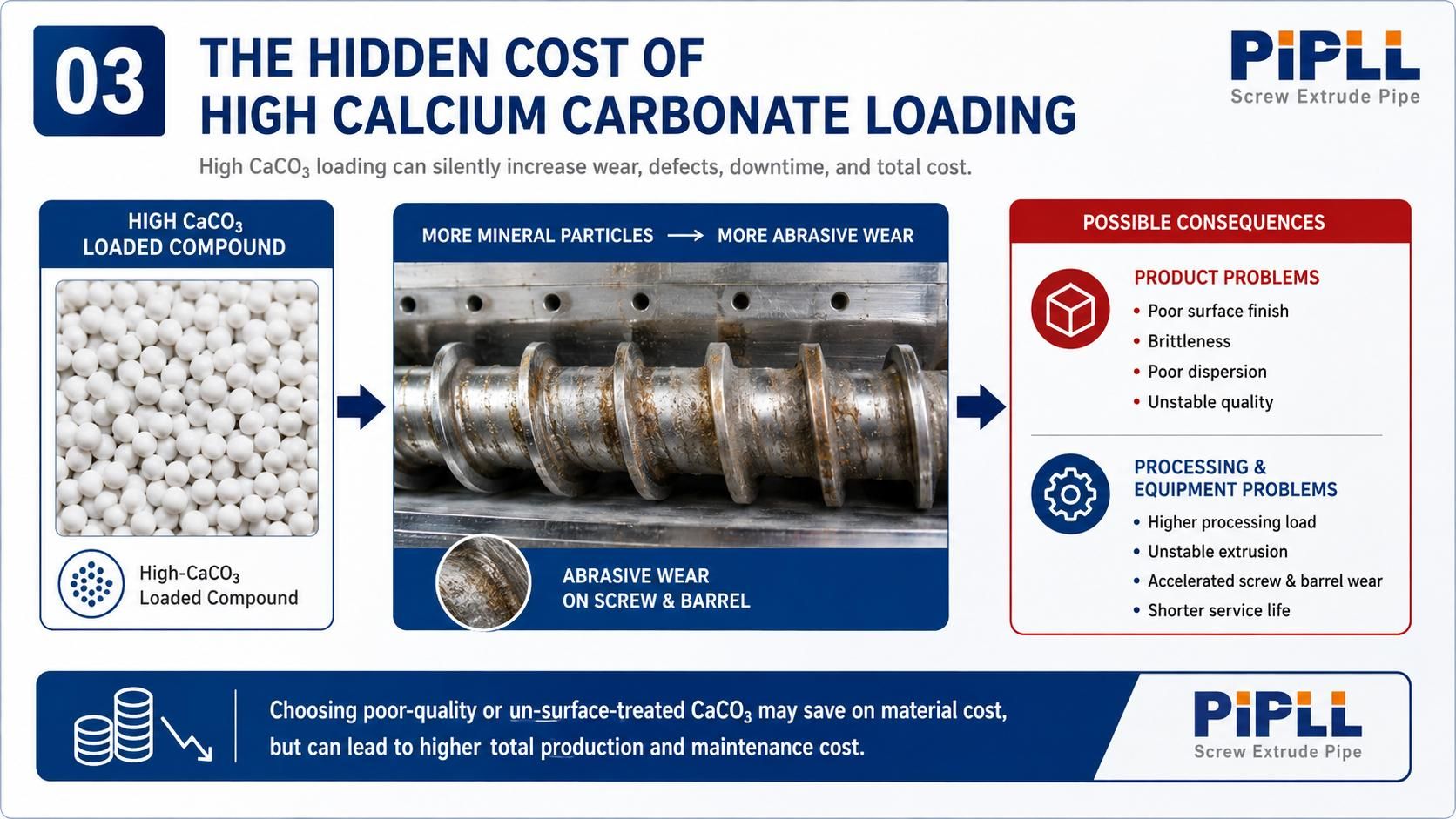
Calcium carbonate can reduce formulation cost, but the extruder sees millions of mineral particles passing through the screw channels and working clearance hour after hour.
As filler loading rises, the process can become more demanding. Wear depends on more than CaCO3 hardness alone: loading level, particle-size distribution, impurities, dispersion, polymer, screw design, pressure, screw speed and operating conditions all matter.
This is especially relevant in high-filled PVC, WPC, mineral-filled PE/PP and filler masterbatch production.
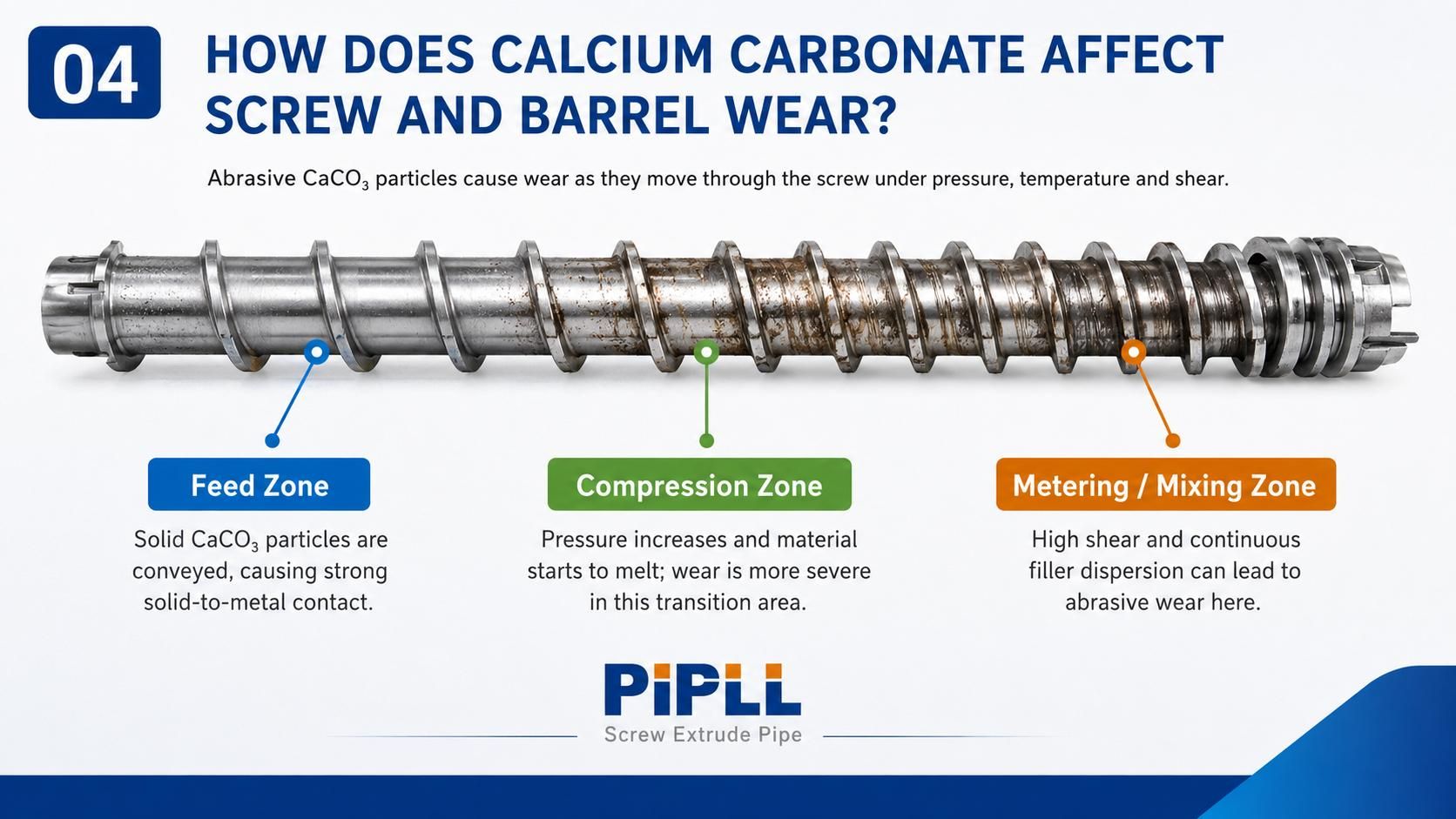
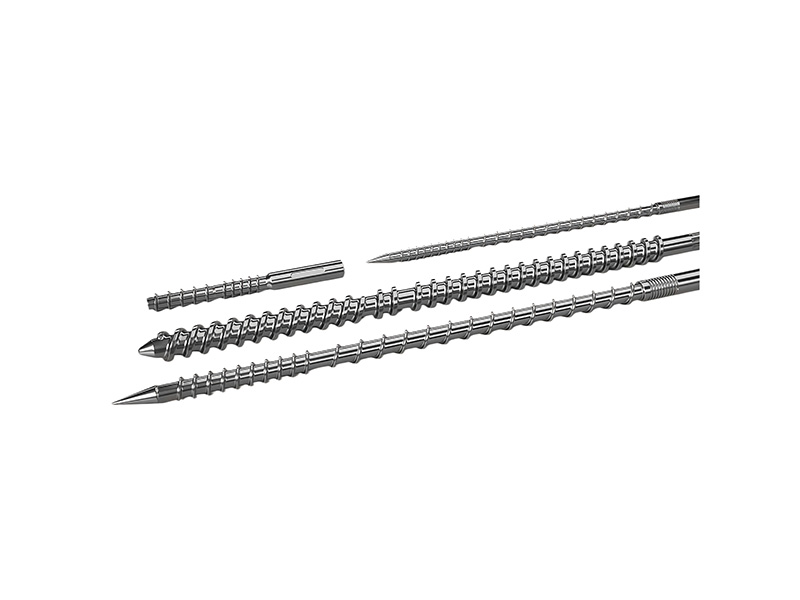
The primary concern is abrasive wear. Mineral-filled material moves through the screw and barrel under pressure, temperature and shear. Over long production periods, abrasive particles and hard impurities can gradually remove material from the screw flights and barrel working surface.
Wear is not necessarily uniform. Depending on the formulation and screw design, processors may see concentrated wear in the feed, transition/compression or mixing areas.
As screw flight diameter decreases and barrel bore increases, the working clearance can grow. This can reduce pumping efficiency and make stable output harder to maintain.
These symptoms can have other causes, so wear should be confirmed by inspection and measurement rather than assumed from one production symptom alone.
Not every calcium-carbonate application automatically requires a bimetallic screw barrel.
For lower-filler or less abrasive conditions, a well-manufactured nitrided screw and barrel may still provide a good balance between cost and service life.
As filler loading, impurities, operating hours and abrasive conditions increase, a more wear-resistant working surface becomes increasingly valuable. Bimetallic or other wear-resistant configurations can be considered for demanding high-filled applications.
This is particularly relevant for high-CaCO3 PVC pipe and profile, WPC, mineral-filled PE/PP, filler masterbatch and recycled compounds containing mineral content.
INTERNAL LINK: Link the phrase “nitrided or bimetallic screw barrel” to PIPLL Blog — Bimetallic or Nitrided Screw Barrel: When You Should NOT Upgrade to Bimetallic.
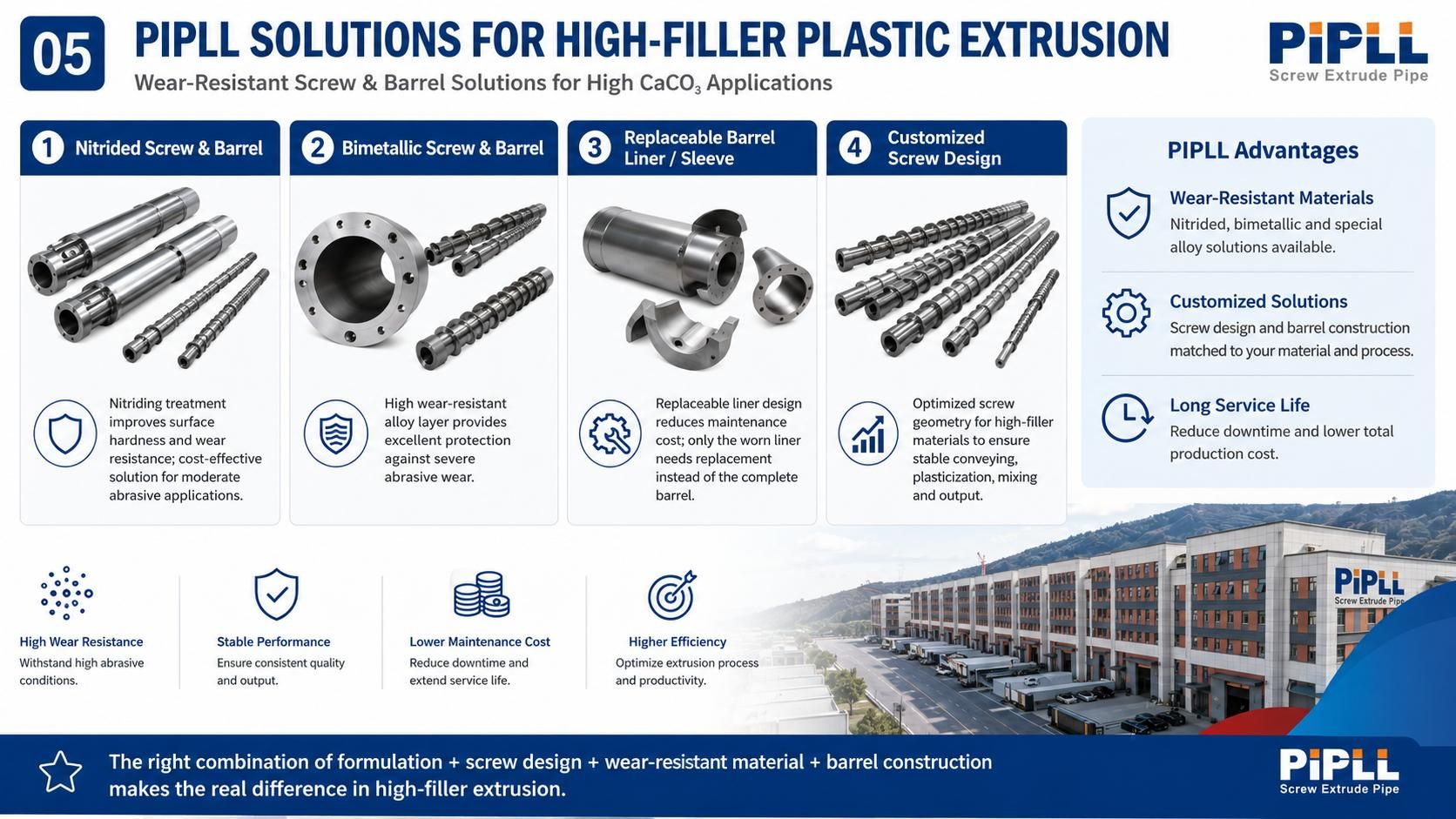
PIPLL does not recommend a screw and barrel only from the polymer name. For high-CaCO3 processing, the actual working conditions should be evaluated.
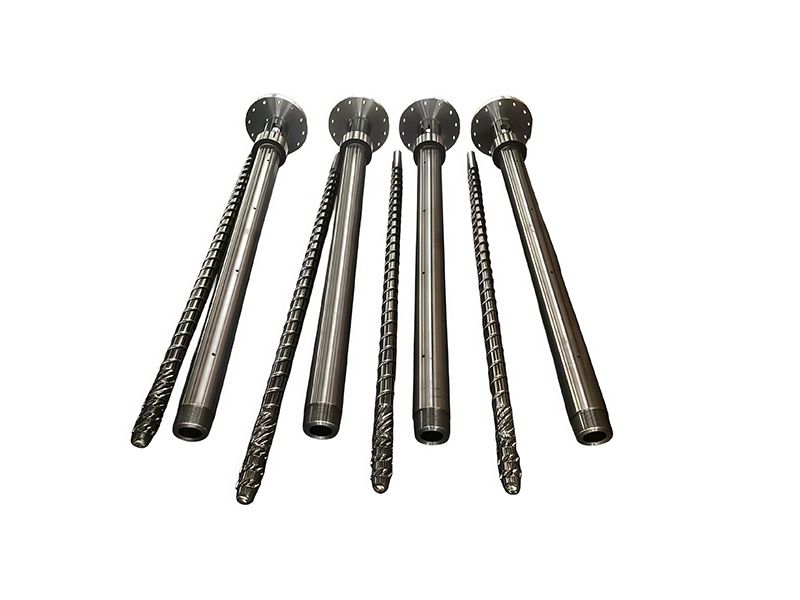
For abrasive high-filler applications, PIPLL can provide nitrided, bimetallic and customized wear-resistant screw and barrel solutions. The objective is not simply to choose the hardest material, but to match the wear protection to the filler type, loading, polymer, output, screw speed, operating temperature and expected service life.
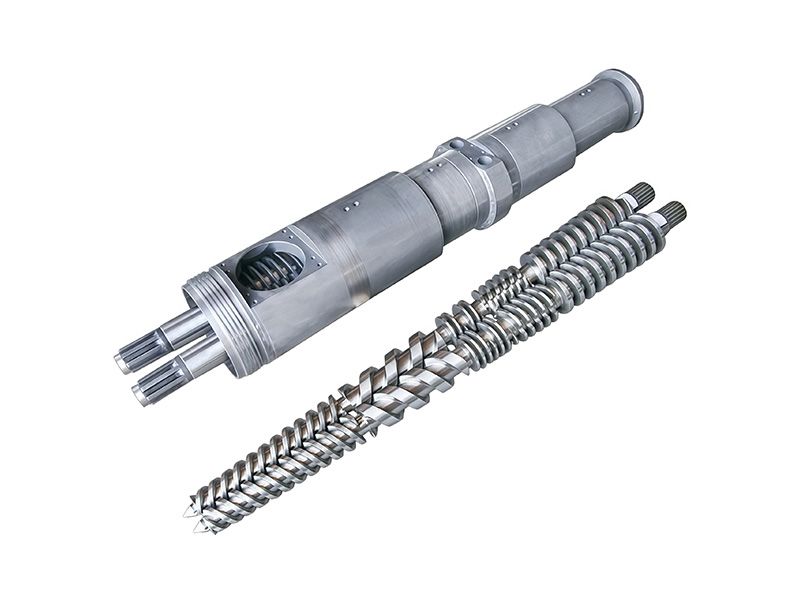
For demanding applications, a bimetallic barrel can provide a wear-resistant alloy working surface designed for long-term contact with abrasive compounds. The appropriate alloy system and construction should be selected according to the actual process rather than treated as a universal upgrade.
Where the barrel design and wear pattern allow it, PIPLL can provide liner or sleeve concepts so that the high-wear working area can be serviced without necessarily replacing the entire barrel. This can be particularly attractive for continuous high-filler extrusion where maintenance cost and downtime matter.
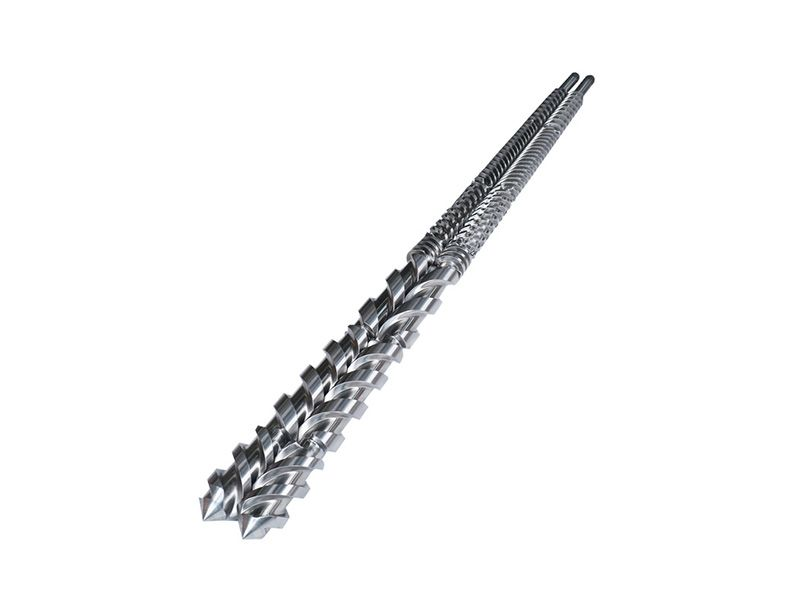
Wear resistance is only part of the solution. Screw geometry also affects conveying, melting, filler dispersion, pressure, shear and melt temperature.
A poorly matched screw design can create excessive shear, local pressure peaks, unstable output or concentrated wear. For high-filler applications, PIPLL can evaluate the screw configuration together with the wear-resistant material system.
The engineering target is to balance:
The engineering target is to balance:
If you process calcium-carbonate-filled plastics and are experiencing premature screw and barrel wear, the following information helps PIPLL evaluate the application:
| Information | Why It Matters |
|---|---|
| Polymer | PVC / PE / PP / WPC / Others |
| CaCO3 Content | Helps evaluate filler loading and abrasive conditions |
| CaCO3 Grade / Particle Size | Particle-size distribution, treatment and impurities affect processing and wear |
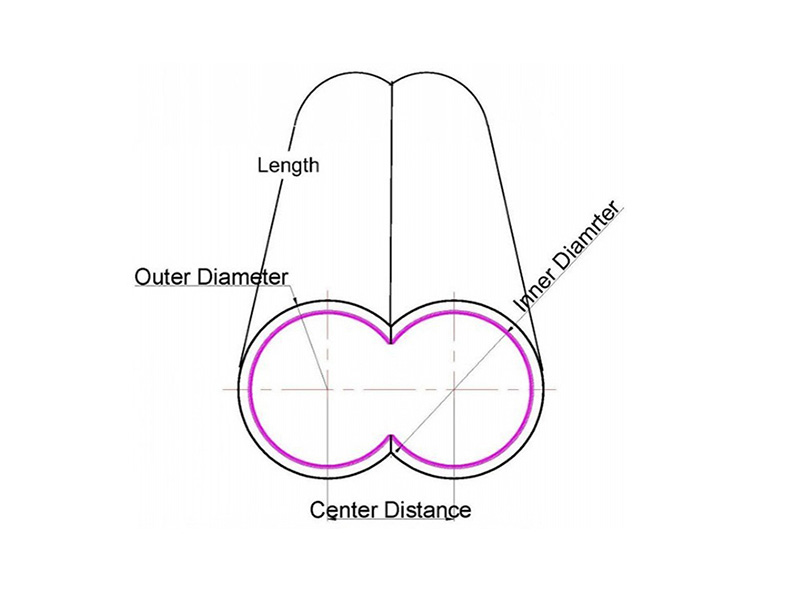
| Extruder Type | Single / Parallel Twin / Conical Twin |
| Screw Diameter & L/D | Defines the basic screw configuration |
| Output & Screw RPM | Helps evaluate production load and operating conditions |
| Current Service Life | Shows existing wear performance |
| Wear Photos / Measurements | Helps identify wear location and severity |
| Original Drawing or Dimensions | Supports replacement and customization |
Adding calcium carbonate to plastic is not “cheating” when it is part of a properly engineered formulation.
It is materials science.
The real question is not whether calcium carbonate should be added, but which type, particle size, particle-size distribution, surface treatment and loading level are appropriate for the polymer, product and production process.
When these variables are properly balanced, calcium carbonate can deliver genuine cost optimization while maintaining the required product performance.
When filler quality, dispersion or loading is poorly controlled, however, the savings can quickly disappear through brittle products, unstable processing, higher scrap rates and accelerated equipment wear.
The cheapest filler is not always the lowest-cost solution. The goal is true cost efficiency across material, production, quality and maintenance.
For high-filler extrusion, long-term economics depend on more than the price per kilogram of resin or CaCO3.
A successful system balances formulation + screw design + wear-resistant material + barrel construction + operating conditions.
That is how calcium carbonate becomes a genuine tool for cost reduction and performance optimization — rather than a hidden source of product problems and maintenance cost.
If your screw and barrel wear faster than expected, do not automatically replace them with exactly the same specification.
Send PIPLL your polymer type, CaCO3 percentage, filler grade or particle size if available, extruder model, screw dimensions, output, screw RPM, current service life and wear photos.
PIPLL can evaluate whether the issue is mainly related to wear resistance, screw design, barrel construction, operating conditions — or a combination of factors.


+86 15267878906

1306 W building , NB-IoT Industrial Park, No. 199 Changxing Road, Jiangbei, Ningbo.
 Languages
