 Languages
Injection Screw and Barrel: Why an Injection Screw Is Not an Extrusion Screw
-
-
Injection Screw and Barrel: Why an Injection Screw Is Not an Extrusion Screw
Injection moulding is cyclic and extrusion is continuous, and almost every dimensional difference between the two screws follows from that one fact — a shorter L/D, a deeper metering section, a check ring on the nose, and a barrel that is idle for part of every cycle. This guide gives the numbers for L/D, compression ratio, shot size and residence time, explains what a worn check ring looks like on a moulded part, and sets out the wear data behind the choice between nitriding, bimetallic and HVOF.
INJECTION SCREW BARREL · INJECTION MOLDING SCREW DESIGN · NON-RETURN VALVE AND CHECK RING · INJECTION SCREW WEAR AND REPLACEMENT
-
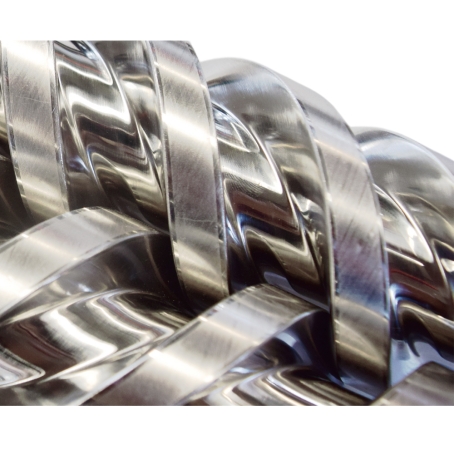
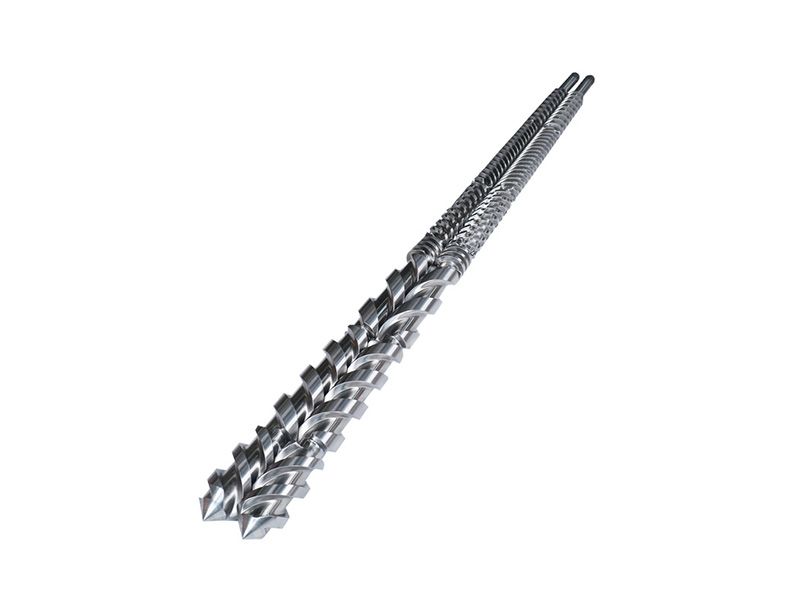
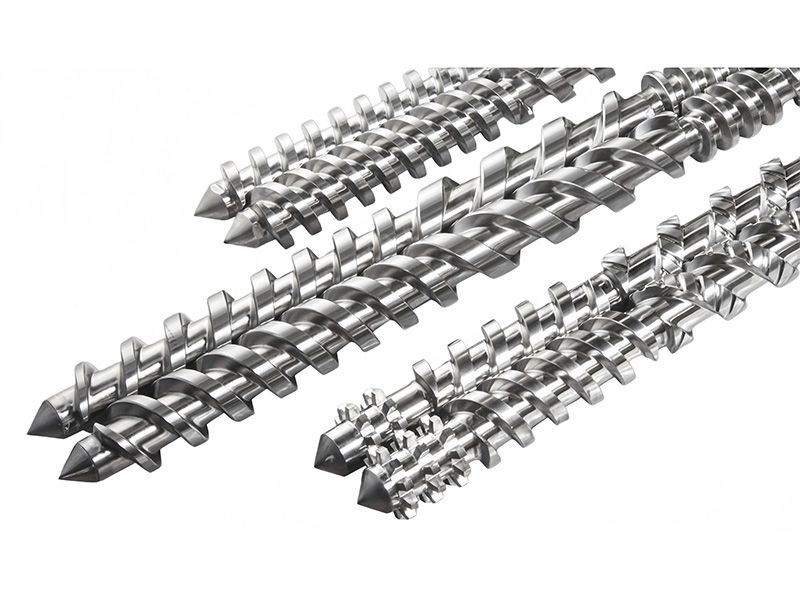
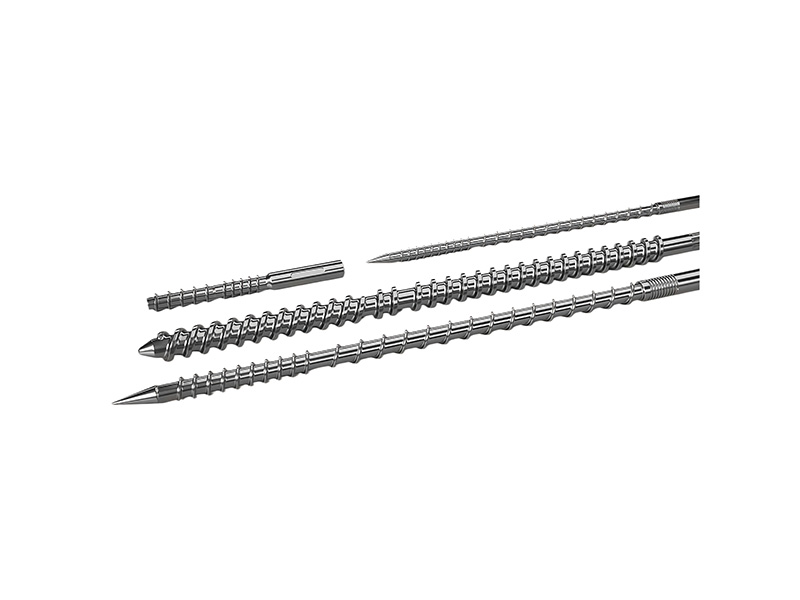
A hardfaced injection screw. The geometry is set by the plasticising duty; the surface is set by what the filler does to it.
-
1. The difference that explains everything
An extrusion screw turns continuously. Polymer enters at the hopper, leaves through the die, and every gram of it sees roughly the same shear history because the flow is steady. Residence time is simply barrel volume divided by throughput, and it is the same for every pellet. That is the process the single screw barrel range is built around, and it is why extrusion screws can afford an L/D of 30 and a shallow metering section. What that looks like on a real line is set out in the pipe and tube screw layout .
An injection screw does the same pumping job, but only during the plasticising stroke. Then it stops, acts as a piston, and drives the accumulated melt forward. The consequences run through the whole design:
- The melt has a history, not a residence time. Material at the front of the shot may have been sitting in the barrel for three or four cycles; material at the back for one. The spread can be a factor of four, so a long barrel is not a neutral choice — it widens the distribution at both ends.
- The screw carries axial load. Injection pressure of 80–180 MPa acts on the screw tip and is transmitted back through the flights, the root and the drive coupling. An extrusion screw carries almost none of this, which is why the root diameter, keyway and nose thread of an injection screw are sized as structural parts. The extrusion equivalent is the through-hardened screw shaft .
- Output is measured in grams per shot, not kilograms per hour. The metering section is sized for plasticising rate at an acceptable melt temperature, not for pressure build-up against a die. That is why custom screw design starts from the moulding machine, not from a bore diameter.
- The seal is a wear part. There is no die to hold pressure, so a spring-loaded check ring at the screw nose does the sealing. It is the single most common cause of shot-weight drift in service. Replacing it is routine screw and barrel maintenance .
-
Characteristic Extrusion screw Injection screw Duty Continuous pumping against a die Cyclic plasticise, retract, inject, hold Typical L/D 24–33 18–24 Metering flight depth 0.025–0.045 × D 0.05–0.08 × D Compression ratio 2.5–4.0 2.0–3.0 Feed section Often grooved for high output Usually smooth bore Screw nose Simple torpedo or none Check ring, tip, sometimes mixing head Axial load on screw Negligible 80–180 MPa at the tip Output metric kg/h g/shot and g/s recovery rate Dominant failure mode Flight wear, barrier damage Check ring leak, feed-zone wear -
KEY INSIGHT
An extrusion screw is a pump. An injection screw is a pump that is also a piston, and its piston ring is a consumable. If you treat the check ring as a lifetime component, you will spend the rest of the machine's life compensating for it with longer strokes and higher pressures — which is how a wear problem turns into a quality problem. -
2. L/D: why the injection screw is shorter
Injection screws run 18 to 24 diameters where extrusion screws run 24 to 33. The reason is residence time distribution rather than mixing quality. A longer screw gives better distributive mixing and steadier output, both of which matter for colour and masterbatch work — but it also lengthens the barrel, and in a cyclic process a longer barrel means more material sitting at temperature between shots. That trade-off is why high-speed extrusion screws are built short and deep rather than long and shallow.
Injection duty Typical L/D Comment General purpose, PE / PP / PS 18–20 Shortest practical screw; easy to keep melt temperature stable Engineering resins, PA / POM / PC 20–22 Enough length for a mixing section before the check ring Glass-fibre reinforced 20–22 Mixer after the compression zone; wear protection matters more than length Precision and optical parts 22–24 Better melt homogeneity; longer residence time has to be managed Thin-wall, high speed 20–23 High plasticising rate, deep metering, generous cooling Vented barrel 22–26 First stage, decompression zone, second stage Micro moulding 16–18 Barrel volume is the constraint, not mixing L/D on its own does not define a screw. Two 22:1 screws can behave completely differently if one puts 60 % of its length in the feed zone and the other 40 %. When you specify a replacement, give feed, compression and metering lengths as well as the ratio — the replacement guide sets out the full list, and the same discipline applies whether the screw feeds an extruder or a moulding machine. The eight-point twin-screw checklist shows how the same questions are framed on the twin-screw side.
-
3. Compression ratio and metering depth
Compression ratio is the feed flight depth divided by the metering flight depth, measured geometrically. It controls how much the polymer is compacted and how much work is done on it. In injection the ratio is lower than in extrusion because the screw does not have to generate die pressure, and because a deep metering section is what keeps shear heating under control during a long plasticising stroke. How the same depth decision is made on an extrusion line is covered in the PE extrusion screw guide .
Polymer Injection compression ratio Metering depth (× D) Note PE , PP 2.5–3.2 0.07–0.09 Deeper metering; watch for poor pressure transfer if too deep PS , ABS , SAN 2.0–2.5 0.06–0.08 Amorphous; low ratio avoids over-shearing PC 2.0–2.5 0.06–0.08 High viscosity; generous metering depth, long compression zone PA 6 / PA 66 2.0–2.8 0.06–0.08 Melt is fluid; a check ring in good condition is essential POM 2.0–2.5 0.06–0.07 Narrow processing window; no dead spots PET 2.0–2.5 0.06–0.08 Hydrolysis risk; drying dominates, not geometry Rigid PVC 1.8–2.5 0.06–0.08 Low ratio, streamlined flow path, no stagnation PMMA 2.2–2.8 0.06–0.08 Optical parts; homogeneity matters more than ratio GF30 / GF50 PA or PBT 2.0–2.4 0.07–0.09 Lower ratio, deeper metering, wear protection on flights The metering depth is the number most often copied wrongly. Injection metering sections are roughly twice as deep as extrusion ones, and there is a physical reason: the metering zone has to hold enough melt to fill the shot while the screw retracts, and it has to do so without generating the shear heat that a shallow channel would produce at the same screw speed. A screw built to an extrusion drawing and dropped into a moulding machine will plasticise hot and recover slowly, and no amount of barrel cooling will bring the melt temperature back. The reverse case, an extrusion screw dropped into a high-speed line, is analysed in the HDPE pipe screw guide .
-
4. The check ring: the part that decides shot repeatability
The check ring — sliding ring, non-return valve, back-flow stop, the name varies by region — is a ring that slides on the screw nose. During plasticising the melt pressure pushes it forward off its seat and polymer flows past it. During injection the pressure reverses, the ring seats, and the path closes. Everything about shot consistency depends on that seat closing cleanly, every cycle, for millions of cycles.
Type How it seals Best for Watch out for Sliding ring, 2-piece Ring face against a seat on the tip General purpose, most common design Seat wear produces a progressive shot-weight drift 3-piece / double ring Two sealing faces, better alignment High-speed, thin-wall, tight tolerance More sliding mass; needs a longer decompression Ball check Ball against a conical seat Small diameters, high screw speed Ball chatter at low speed; poor for high-viscosity melt Spring-loaded poppet Spring closes the valve before injection Low-viscosity resins, PA and PET Spring fatigue and polymer ingress into the spring cavity KEY INSIGHT
Cushion repeatability is the cheapest check-ring test there is, and it costs twenty cycles. If the cushion is unstable, stop looking at the mould and the drying system until the valve has been inspected. -
5. Shot size, residence time and the 20–80 rule
Shot weight should fall between 20 % and 80 % of the barrel's maximum shot capacity, with 40–70 % as the comfortable band. Both limits are residence-time limits in disguise.
- Below 20 % the melt sits in the barrel for many cycles. Thermal degradation, colour shift and acetaldehyde or monomer generation follow.
- Above 80 % there is not enough plasticising time between shots. The screw runs at its speed limit, melt temperature climbs, and the cushion becomes erratic.
Resin Practical residence-time ceiling Why PE, PP 10 min Thermally robust; the limit is usually colour, not degradation PS, ABS 8 min Yellowing and gradual molecular-weight loss PC 6 min Hydrolysis plus yellowing; drying quality dominates PMMA 6 min Depolymerisation to monomer above about 260 °C PA 6 / PA 66 5 min Oxidation and colour drift; moisture sensitive PET 5 min Hydrolysis; IV drop is irreversible POM 4 min Unzips to formaldehyde; also attacks the screw if overheated Rigid PVC 3 min Dehydrochlorination; the shortest window of any commodity resin -
6. Back pressure and screw speed
Back pressure is the resistance the screw works against while retracting. Typical settings run 5–15 MPa (50–150 bar); colour and masterbatch dispersion may need 20–30 MPa; shear-sensitive resins should stay at the bottom of the range.
Screw diameter Max rpm at 0.3 m/s Max rpm at 0.6 m/s Typical machine setting 25 mm 229 458 150–300 rpm 35 mm 164 327 120–250 rpm 45 mm 127 255 100–200 rpm 60 mm 95 191 70–150 rpm 75 mm 76 153 60–120 rpm -
7. Wear: what glass fibre does to a nitrided screw
Three mechanisms act at once: abrasion from hard particles, adhesion/galling when the melt film breaks down, and corrosion from HCl, bromides or acidic residues.
Surface Unfilled resin GF30 GF50 Nitrided 38CrMoAlA, 0.4–0.7 mm, 900–1,100 HV 4–8 years 6–18 months 3–9 months Bimetallic centrifugal cast, Ni-based + WC, 55–62 HRC 8–12 years 2–4 years 12–24 months HVOF tungsten carbide, 1,100–1,400 HV, 50–100 µm 8–12 years 2–4 years 12–24 months Through-hardened tool steel, 48–54 HRC 5–10 years 12–24 months 6–12 months PM HIP tool steel, 60–64 HRC 10+ years 3–5 years 18–30 months -
Contact us