 Languages
Inside the Twin Screw Barrel: How Recycled Plastic Is Re-Engineered
Inside the Twin Screw Barrel: How Recycled Plastic Is Re-Engineered
A practical guide to how post-consumer flake becomes specification-grade pellet — and why the screw-barrel assembly decides whether the line makes money.
POST-CONSUMER RECYCLING · CONICAL TWIN SCREW BARREL · WEAR PROTECTION · PELLET QUALITY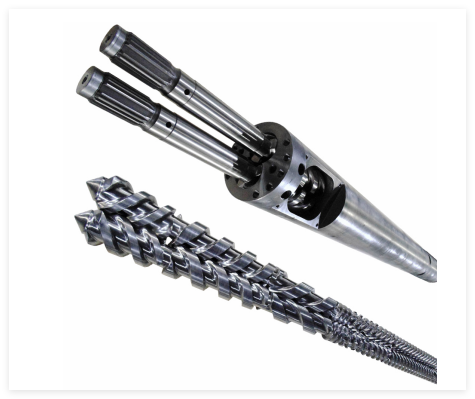
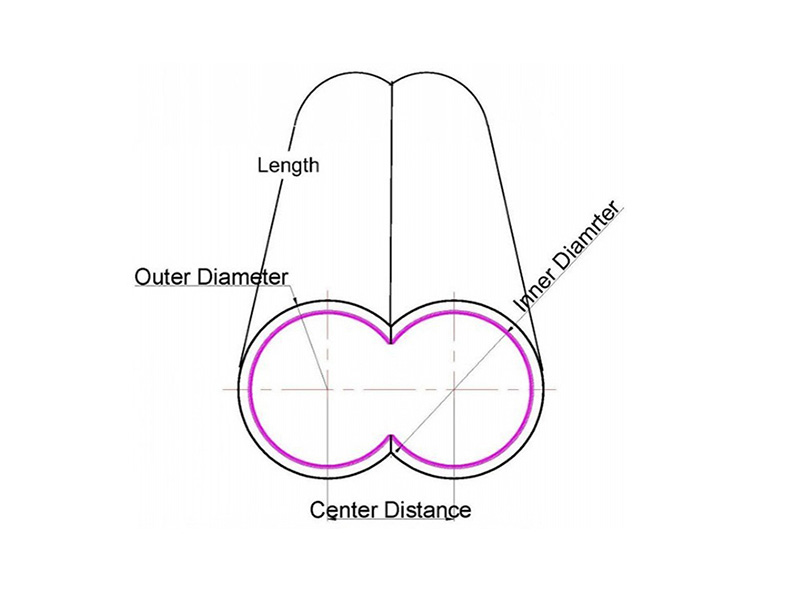
Parallel twin screw barrel
the alternative geometry, and the reason conical barrels dominate recycled dutyFrom bale to pellet: where the technical load sits
A post-consumer recycling line is a sequence of conditioning and conversion stages. Most of them prepare the material. Only one of them has to convert it.
- Sorting – material separated by polymer family.
- Washing – organic and inorganic residue removed.
- Shredding – flake of controlled, consistent size.
- Drying – moisture reduced to a specification suitable for melt processing.
- Extrusion – flake compacted, degassed, melted, homogenized and pressed through a die.
- Pelletizing – strand water-cooled and cut into pellet.
KEY INSIGHT — The extruder carries the highest technical load in the line. Compaction of low-bulk density feedstock, removal of volatiles, homogenization across a range of viscosities and die pressure build-up all happen inside the twin screw barrel .Any inefficiency in the screw-barrel assembly therefore shows up in the finished pellet, not somewhere else:
- Incomplete compaction → internal voids that reduce bulk density.
- Insufficient mixing → colour streaks and melt inhomogeneity.
- Residual volatiles → surface bubbles on the finished part.
The reverse also holds. A well-specified assembly absorbs a meaningful degree of upstream variability in the flake supply, so the investment pays back across the whole line rather than at the extruder alone.
Why conical geometry is the standard for recycled feedstock
Virgin pellet arrives at the feed throat as a uniform, high-bulk-density solid. Recycled flake does not. It is irregular in geometry, lower in bulk density and inconsistent in melt behaviour — so the screw has to actively grip the feedstock instead of simply transporting it.
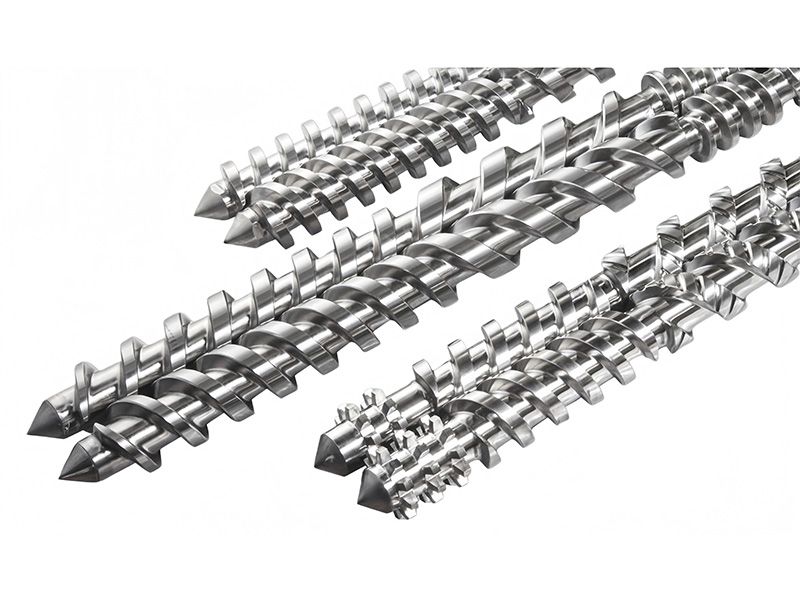
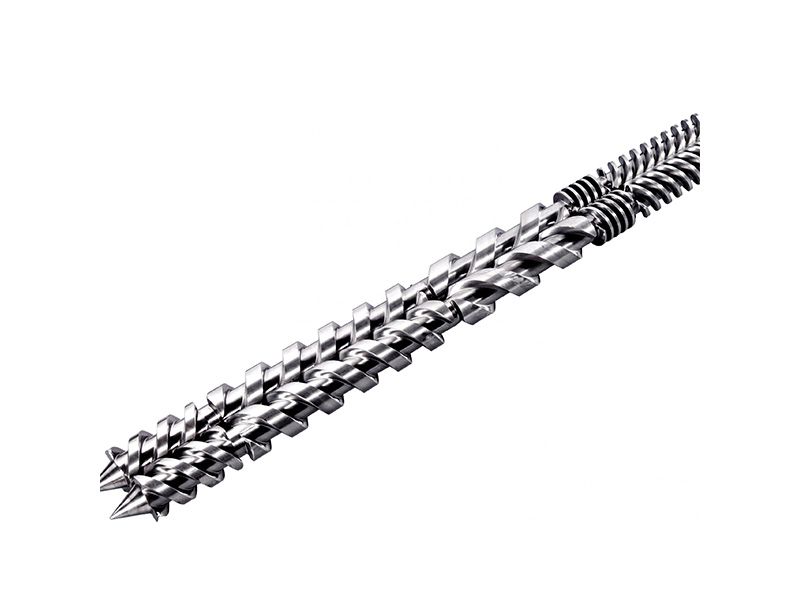
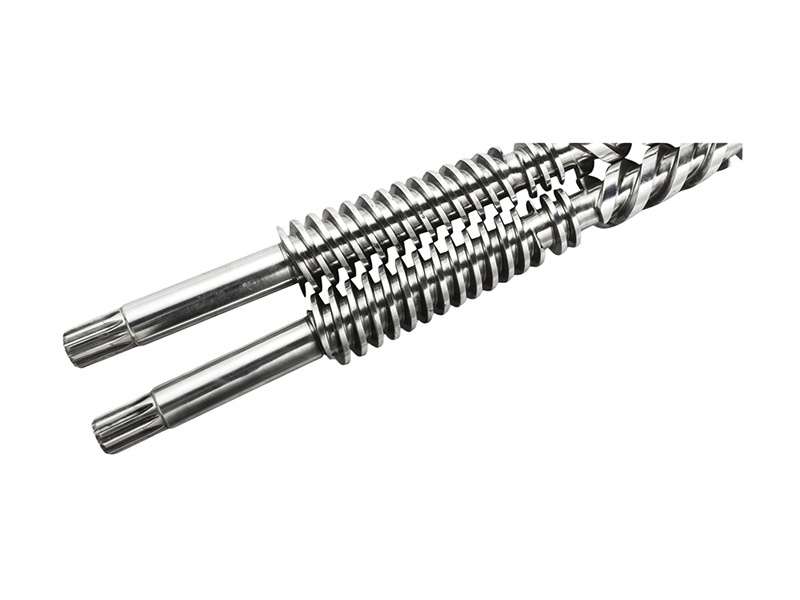
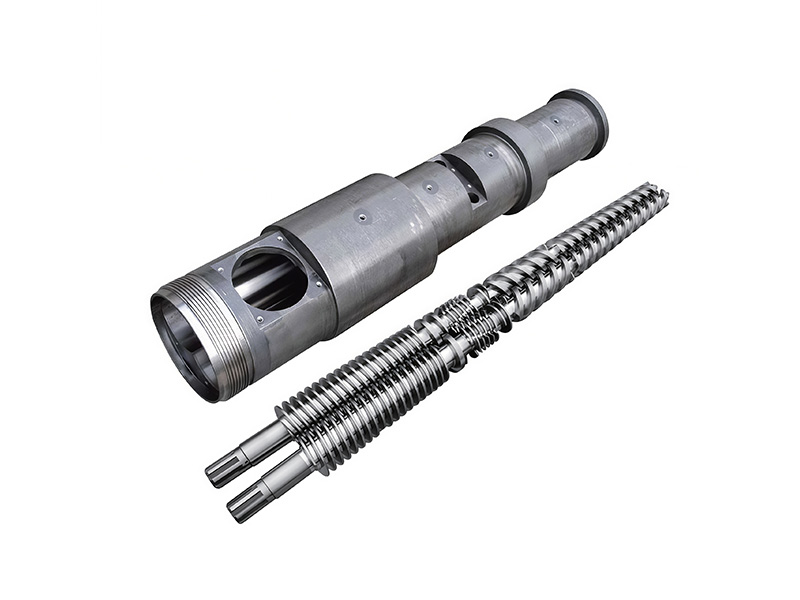
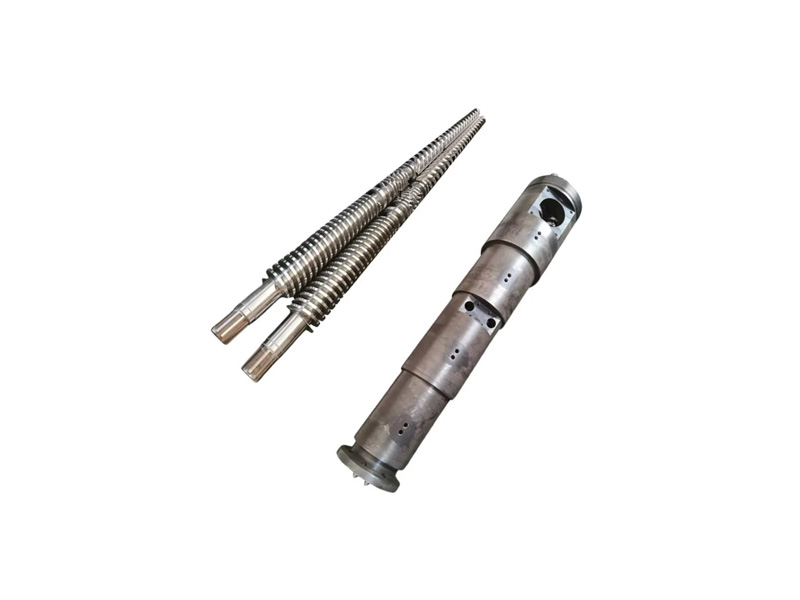
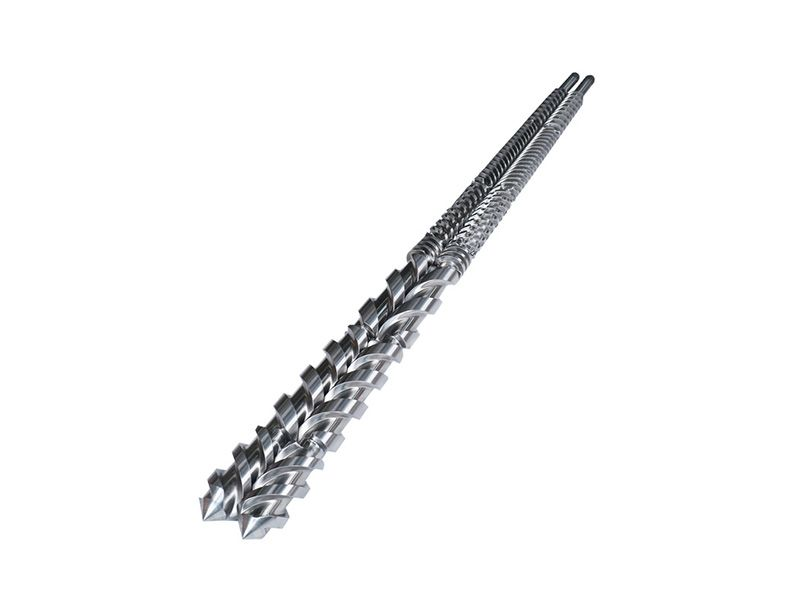
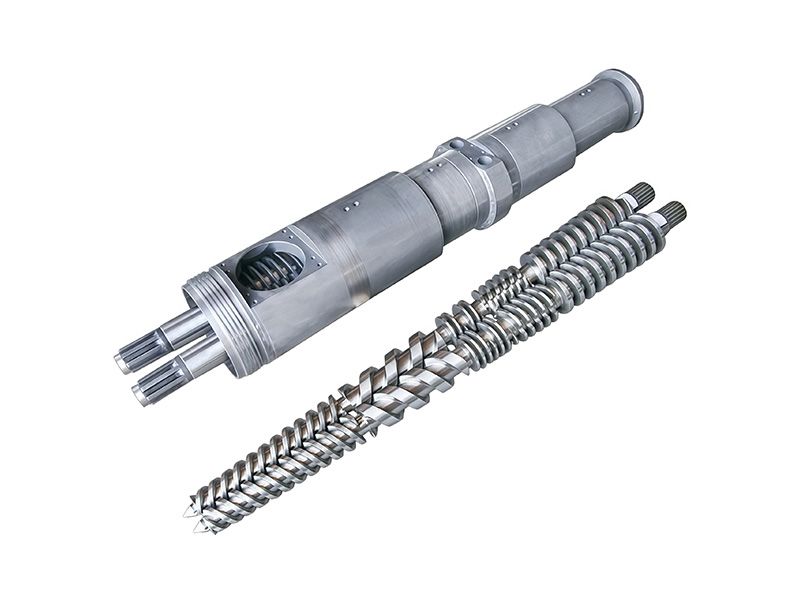
A conical twin screw barrel solves this geometrically. As the screws taper toward the die end, the volume between flights decreases progressively, so loose flake is compressed into a dense, void-free melt without the starve-feeding or surging a parallel geometry can produce.
- Feed intake. A parallel geometry begins to starve-feed once flake bulk density drops below roughly 0.4 kg/L. A properly specified conical geometry keeps feeding at 0.2 kg/L or lower.
- Die-end pressure. Applications needing high die-end pressure — dense pellet at high throughput — benefit from the natural pressure build of a conical geometry.
- Energy. The same pressure is generated with lower specific energy input, avoiding a heavier drive and a larger heating system.
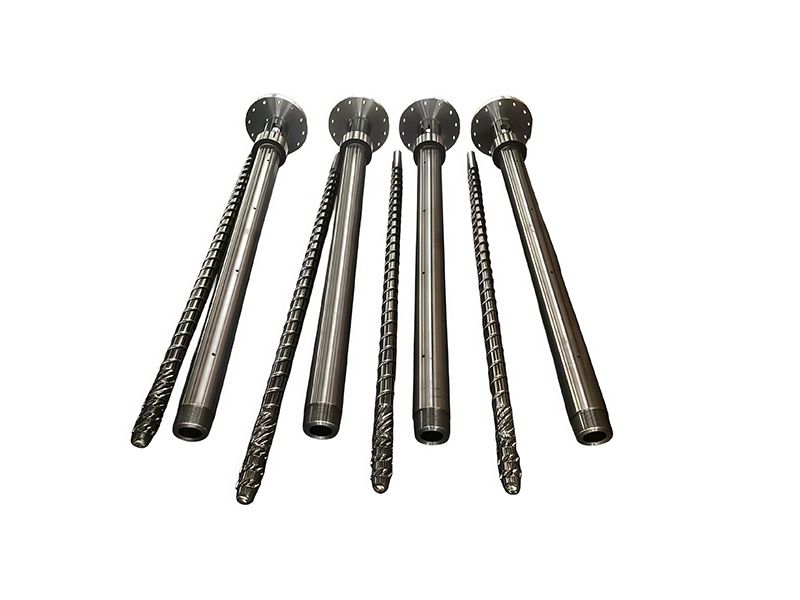
Geometry Feed intake on low-density flake Starve-feed threshold Die-end pressure build Typical recycled duty Conical twin Excellent ≈0.2 kg/L or lower Strong, natural Standard choice Parallel twin Limited ≈0.4 kg/L Needs more drive power Compounding, virgin and dry blends 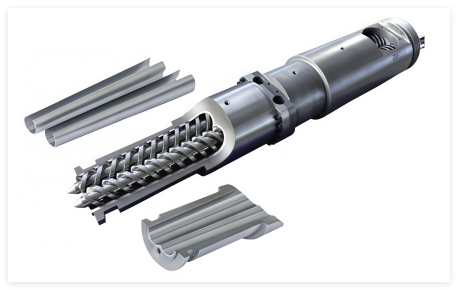 Conical twin screw barrel with replaceable wear-resistant liner (PIPLL production).
Pelletizing starts with melt quality
The strand leaving the die is water-cooled and cut by a rotary cutter. Cut quality and pellet shape depend on how uniform the melt is at the die. A homogeneous, void-free melt improves cut quality and reduces fines, which in turn raises bulk density and handling quality. The pelletizing conical twin screw barrel page documents the configuration PIPLL specifies for specification-grade recycled pellet.
Why recycled feedstock wears hardware faster
A screw barrel in a virgin-PVC compounding line typically reaches end of life in five to seven years. In a recycled-feedstock line of comparable throughput, that figure can halve or worse. Three mechanisms act together.
- Residual contamination. Even after washing, flake carries paper fibre, aluminium, glass fines and mineral dust. Once the polymer is molten these become hard abrasive inclusions, acting on the barrel bore like a continuous lapping compound.
- Melt inhomogeneity. Mixed grades with different viscosities and thermal histories produce uneven melt, loading the screw flights with fluctuating shear and pressure.
- Volatile and corrosive residue. Food oils, cleaning agents and beverage components generate acidic and oxidative by-products at processing temperature, attacking nitrided surfaces before mechanical abrasion is even considered.
KEY INSIGHT — Field data: bimetallic assemblies on clean PVC deliver seven to nine years. The same assemblies on post-consumer recycled feedstock commonly retire at three to five. Ignoring all three mechanisms at the specification stage typically produces a service-life shortfall of 40–60%.
Design modifications specific to recycled duty
A recycled-material conical twin screw barrel optimized for virgin PVC or PE is not the right tool for a recycled line. Four modifications matter.
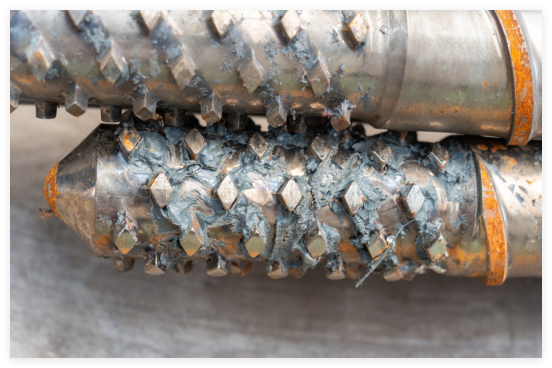 Flight-land wear on screws retired from recycled-feedstock service.
- Forged screw cores. Higher fatigue strength and impact resistance for the torque spikes irregular feed produces.
- Deeper feed flights. More volumetric intake in the feed section, so low-density flake is drawn into the channel rather than riding on the flight OD.
- Wear-resistant bore lining. The single most consequential modification — covered in the next section.
- Vacuum venting. Recycled feed retains more volatiles and entrained moisture, which must be removed at a defined point before the metering section. Vent location and vacuum-pump duty are specified with the barrel, not retrofitted.
PIPLL publishes the specification, resin families and throughput ranges for this configuration on the recycled-material conical twin screw barrel . The closely related high-filler case — heavy calcium loading, WPC and SPC — is documented on the high-filling polymer conical twin screw barrel .
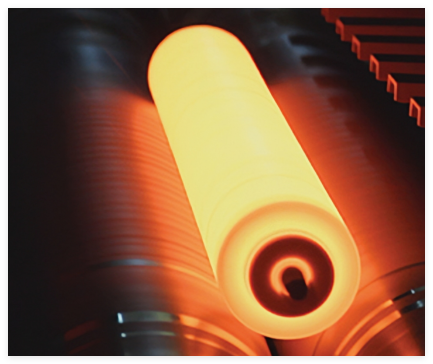 Centrifugal casting of the bimetallic liner — the wear protection is metallurgically fused to the steel shell, not coated onto it.
Bimetallic or nitrided: the wear-protection decision
Two liner technologies dominate the market, and their cost and service-life profiles differ sharply.
Criterion Nitrided Bimetallic Construction Thermo-chemical case hardening, sub-millimetre depth Ni-Fe-Cr-B or cobalt-rich alloy, 2–3 mm, fused to steel Surface hardness Typically 900–1000 HV, declining with depth Above 60 HRC through the full alloy depth Abrasion resistance Adequate for clean unfilled polymer Several times that of nitrided Initial cost 40–50% lower on an equivalent 65 mm conical assembly Higher Best duty Virgin PVC, virgin PE, clean unfilled polymer Glass-filled, mineral-filled, post-consumer recycled On virgin-PVC or virgin-PE duty, nitriding is the economic choice: lower initial cost and an acceptable cost per year of service. On glass-filled, mineral-filled or post-consumer recycled duty, the operating-cost differential favours bimetallic construction even at a higher outlay — the bimetallic assembly typically outlasts the nitrided one by a factor of two to three, which reverses the cost-per-year calculation decisively.
KEY INSIGHT — Bonding strength is the third selection criterion, and the one most often missing from cost-driven specifications. A liner that is poorly bonded to its substrate spalls under thermal cycling and accelerates wear instead of retarding it. Ask for layer thickness and an ultrasonic bonding-strength result.Engineering detail on both constructions is in the bimetallic or nitrided screw barrel article and the bimetallic screw barrel guide , which also covers alloy selection .
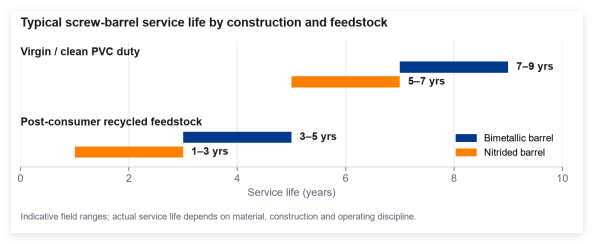 Figure 1. Typical service life by barrel construction and feedstock (indicative field ranges). Actual service life depends on material, construction and operating discipline.
The screw is half the system
Attention focuses on the barrel because of its size and cost, but the screw carries equal responsibility for the wear profile of the line.
- Flight lands. These are the cylindrical surfaces in direct contact with the barrel bore — the highest-wear regions on the screw.
- Surface technology. On recycled duty they need the same protection as the barrel. PIPLL supplies a standard bimetallic extrusion screw and, for a middle-cost option, a through-hardened screw that outperforms a standard nitrided build at lower cost than a full bimetallic.
- Mixing geometry. Recycled-duty screws use kneading elements or reverse-flight sections for distributive and dispersive mixing. The trade-off is real: aggressive mixing produces a more uniform melt but also local pressure peaks that stress the thrust bearing.
An experienced twin screw barrel manufacturer matches the mixing configuration to the viscosity profile of the actual feedstock rather than applying one geometry to every recipe.
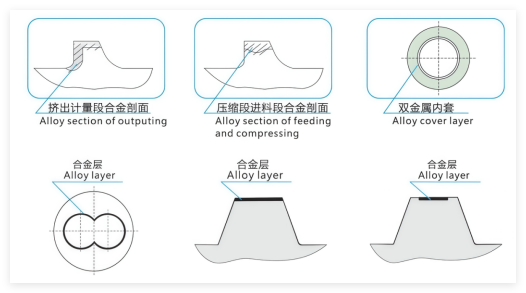 Where the wear-resistant alloy layer sits: screw flight sections, barrel bore and bimetallic liner sleeve.
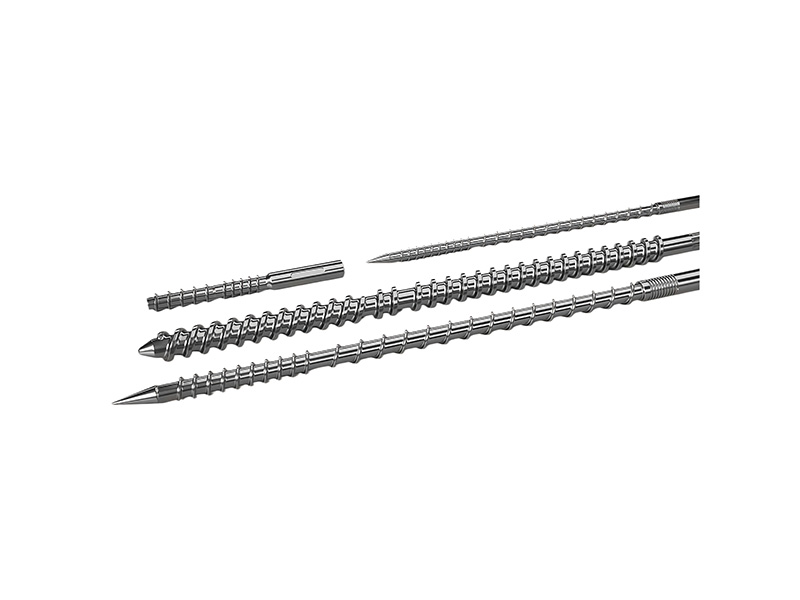
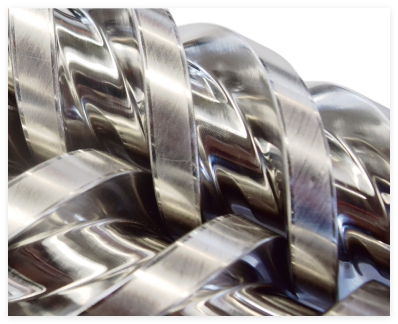 Bimetallic extrusion screw with hardwood flight lands for high-wear duty.
Three pellet defects with a mechanical cause
Most quality defects in recycled pellet originate in the screw-barrel assembly, not in the polymer.
Defect Mechanical cause Correct remedy Black specks Carbonized polymer in the dead corners of a worn mixing section, or in bore scratches Geometry correction or barrel re-surfacing — purging only masks it Colour and melt inhomogeneity The screw is conveying rather than mixing Mixing-element configuration matched to the viscosity range, not a change of resin source Low pellet bulk density Inadequate compaction upstream of the die; starved feed section or insufficient conical compression ratio Correct conical specification at the design stage A practical exercise: sample the current pellet output and score it against these three criteria. If any of them is off, the cause is almost always in the assembly and is correctable by redesign or wear-driven replacement. Additives and post-extrusion blending mask the symptom; only a change of processing geometry removes it.
Where the margin between recyclers actually comes from
The difference in operating margin between two recyclers of similar size, running similar feedstock, is rarely the price of incoming material. It comes down to two things:
- The design quality of the screw-barrel assembly.
- The discipline of the operating team in maintaining it.
A purpose-designed recycled-material conical twin screw barrel , operated inside its specification envelope and inspected on a planned schedule, outperforms an apparently identical line running a generic barrel on every metric that matters — pellet quality, throughput stability and unplanned downtime.
Three documents to demand from any supplier
- Material certificate for the supplied barrel.
- Bonding-strength test result for the bimetallic liner.
- Inspection report covering screw diameter at multiple points along the length.
A factory-direct manufacturer such as PIPLL supplies all three as standard with every shipment, alongside documented manufacturing process and capacity data. Recyclers who procure on price alone usually meet the cost differential in unplanned downtime instead of on the procurement line.
One upstream stage deserves separate attention. Drying has a disproportionate effect on extruder life: incomplete drying puts steam in the melt, voids in the pellet and localised corrosion on the bore. Delivering flake at the correct moisture specification extends screw-and-barrel life independently of the wear-protection technology chosen. The same principle governs the adjacent WPC and SPC segments, where high-filler processing is the dominant wear driver.
Frequently asked questions
Can a standard twin screw extruder process recycled material?Technically yes, but a standard compounding barrel is not optimized for the wear profile of recycled feedstock. The reduction in service life and the rise in unplanned downtime usually exceed the saving on a lower-cost purchase.
Is bimetallic construction mandatory for recycled PET?For post-consumer PET flake, yes. Paper fibre residue and aluminium contamination destroy a nitrided surface in a small fraction of the duty cycle of a bimetallic liner. See maximizing screw and barrel lifespan in PET flake and rigid regrind .
Is recycled PE less aggressive than recycled PET?Generally yes — PE is intrinsically softer and less abrasive, though contamination still matters. The PE extrusion page describes the typical line setup.
What inspection interval suits heavy recycled duty?Every six months. Use the check extruder screw wear without teardown procedure in a planned shutdown window.
How much throughput is lost switching from virgin to recycled feedstock?Typically 15–25%, depending on feedstock composition. Volumetric capacity is unchanged, but melting and homogenizing contaminated flake takes more energy and narrows the operating window. A purpose-built recycled-material barrel minimizes the penalty through better feed intake and melt homogeneity.
Does recycled feedstock change pellet colour?Yes. Post-consumer flake carries the colour signature of its original application, so standard recycled pellet is grey or off-white. Buyers needing colour-specific output either specify a higher-grade monomaterial stream or use the pellet where colour is not critical. It is a feedstock property, not a defect.
Are single-screw extruders ever used for recycled material?Rarely in serious commercial pelletizing, though single-screw recycling granulation equipment exists for lower-value applications. The twin screw advantage in compacting and homogenizing irregular feedstock is decisive.
The short version
- Recycled plastic becomes specification-grade resin only after the extruder, and the conical twin screw barrel carries the technical load.
- Recycled duty needs purpose-built geometry: deeper feed flights, forged cores, vacuum venting and a wear-resistant bore lining.
- Nitrided construction suits clean virgin polymer. Recycled feedstock is a bimetallic application.
- The screw needs the same wear protection as the barrel.
- Specify the material certificate, bonding-strength result and dimensional inspection report up front.
Need help specifying a recycled-duty barrel?
Send a flake sample and your line parameters to the engineering team. PIPLL reviews OEM drawings, worn-part measurements and operating conditions to recommend the metallurgy, flight geometry and barrel protection that fits the feedstock. A technical response is typically returned within one working day.
- Custom screw and barrel assemblies for recycling and extrusion lines
- Conical twin screw barrels for recycled feedstock, pelletizing and high-filler duty
- Bimetallic barrels and hard-faced screws for abrasive service
- Barrels with internal liner sleeves for replaceable wear protection
- Dimensional inspection and OEM-fit verification